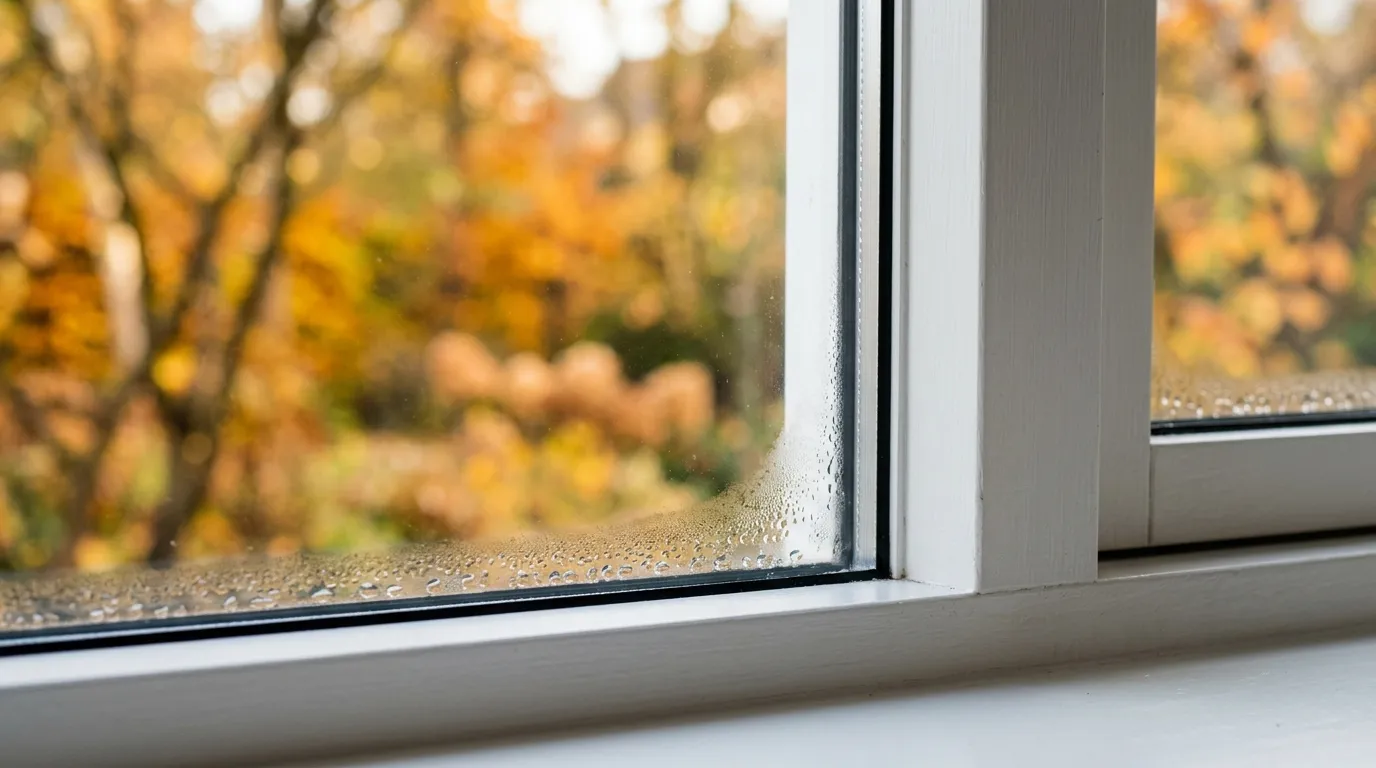
One morning in late September you pull back the curtain and the bottom of the glass is beaded with water. It was not there all summer, and nothing about the window changed overnight. What changed is the outdoor temperature, and it met a house still full of summer moisture. Here is why windows sweat on the first cold nights, when it is harmless, when it points to a real problem and what to do about it this week.
Why Condensation Shows Up on the First Cold Nights
A Quebec summer loads your house with water. Humid outdoor air comes in through open windows and doors for months, and the wood framing, drywall, furniture, carpets and especially the basement slowly absorb it. By September, the air inside a typical Montreal-area home often sits somewhere between 55 and 65% relative humidity, which feels perfectly comfortable while it is warm outside.
Then the first clear, calm night drops the outdoor temperature to 3 or 4°C. The house is closed up again, the heat may not even be running yet, and all that stored moisture is still in the air. The inner surface of the glass is now the coldest thing in the room, and when warm humid air touches it, the water comes out of the air exactly the way it does on a cold glass of lemonade in July.
This is why early-fall condensation often looks worse than mid-winter condensation in the same house. In January the furnace has been drying the air for months and indoor humidity is naturally lower. In September you have the highest indoor moisture of the year meeting the first real temperature drop, and the windows are where the two collide.
Dew Point: Why the Glass Edges Wet First
Every mass of air has a dew point, the surface temperature at which its water vapour starts to condense. At 21°C and 50% relative humidity the dew point is roughly 10°C. At 21°C and 60% it climbs to about 13°C. Any surface in the room colder than that number will collect water, and on a cold night the glass is the first surface to cross the line.
The glass is not the same temperature everywhere. The centre of a sealed unit is usually the warmest part of the window, while the outer few centimetres near the spacer, the strip that holds the panes apart, run colder because heat escapes more easily through the edge. Cold air sliding down the inside of the pane also pools at the bottom, which is why condensation almost always starts as a band along the lower edge and in the bottom corners.
That pattern is useful information. A thin line of fog along the bottom edge that clears by mid-morning tells you the humidity is a bit high for the weather. Water that covers the whole pane, drips onto the sill and never dries tells you the humidity is far too high, the glass is performing poorly, or both.
- Bottom edge and corners: coldest zone, first to fog.
- Behind closed blinds or heavy curtains: warm room air cannot reach the glass, so it runs colder.
- Deep window recesses: less air circulation around the glass.
- North-facing and wind-exposed windows: colder exterior surface, colder interior glass.
Which Windows Show Condensation More
Older double-glazed units with aluminum spacers are the most common culprits in Quebec homes built before the 2000s. Aluminum conducts heat very well, so the glass edge on those units can run several degrees colder than the centre, and the bottom band fogs at humidity levels a newer window would handle without a trace. Single glazing combined with a storm window, still found in older plexes, behaves the same way and often fogs on the inside of the storm panel as well.
Frame material plays a role too. Metal frames without a thermal break can collect frost on the frame itself, not just the glass. PVC and wood frames stay warmer on the room side, and modern hybrid frames are built to keep the interior surface close to room temperature. Windows with warm-edge spacers and triple glazing push the edge temperature up enough that the same humidity that soaks an old window may leave the new one completely dry.
Room location matters as much as the window. Bathrooms, kitchens, laundry rooms and bedrooms where people sleep with the door closed produce much more moisture than a living room. A perfectly good window in a small bedroom with two sleepers and no airflow can sweat every morning while an identical unit in the hallway stays clear. If you are weighing new units, our window collection shows the glazing and frame options that keep the glass edge warmest.
When Condensation Is Normal and When It Is a Warning Sign
Light condensation on the room side of the glass during the first cold nights is normal, especially in the morning and especially in bedrooms and bathrooms. If it clears within a few hours once the sun is up or the heat runs, and the sill stays dry, the window is simply telling you humidity is higher than the weather allows. Adjusting ventilation usually solves it within a week or two.
Condensation between the panes is a different story. Moisture inside a sealed unit means the edge seal has failed and humid air is getting into the space that should be dry and filled with argon or air. It cannot be wiped away, it will come and go with the weather, and over time it leaves a milky film on the inner glass. The fix is a new sealed unit or a new window, not a humidity adjustment.
Condensation on the outside of the glass on a cool, humid morning is actually a good sign. It means the exterior pane is staying cold because very little heat is leaking through the window from inside. It burns off as the sun hits it and never needs attention.
- Normal: fog on the bottom edge in the morning, gone by noon, dry sill.
- Ventilation problem: water covering most of the pane, running down onto the sill daily.
- Failed seal: fog or haze between the panes that you cannot reach with a cloth.
- Damage underway: black spots on the sill, peeling paint, soft wood or swollen drywall below the window.
- Good sign: dew on the exterior glass on cool mornings.
Humidity Targets as the Outdoor Temperature Drops
The right indoor humidity is not a fixed number. The colder it gets outside, the colder your glass gets, and the lower indoor humidity must be to stay under the dew point. A cheap digital hygrometer from a hardware store, placed in the main living area away from the kitchen and bathroom, will tell you where you stand in a few minutes.
In early fall the goal is simply to bring the house down from summer levels, around 55 to 65%, to the mid-40s. As real cold arrives, keep lowering the target in step with the outdoor temperature. The guidelines below are widely used in Canada and assume reasonably good double or triple glazing.
If you already have a humidifier on the furnace, leave it off until the outdoor temperature is consistently below freezing, and set it according to this table rather than to a comfort number. Many homes that fight window condensation all winter simply have a humidifier set too high. Lowering the setting a few points is often all it takes to keep the glass clear.
- Outdoors above 10°C: up to about 50% indoors.
- Outdoors 0 to 10°C: about 40 to 45%.
- Outdoors 0 to −10°C: about 35 to 40%.
- Outdoors −10 to −20°C: about 30 to 35%.
- Outdoors −20 to −30°C: about 25 to 30%.
- Outdoors below −30°C: 20 to 25%.
Quick Fixes You Can Make This Week
Most early-fall condensation disappears once the house dries out, and you can speed that up considerably. The idea is to remove moisture at the source, keep air moving across the glass and give the house a few weeks to release what it absorbed over the summer. Most houses need two to four weeks of steady ventilation to release that stored moisture.
Start with the exhaust fans. A bathroom fan should run during every shower and for at least 20 minutes afterwards, and the range hood should be on whenever something is boiling. If you have a heat recovery ventilator or energy recovery ventilator, check that it is running and that its filters and core were cleaned this year. A basement dehumidifier set to about 45 to 50% can pull a surprising amount of water out of the whole house in September.
Then help the glass stay warm. Open blinds a few centimetres at night so room air can reach the window, keep furniture and heavy drapes away from the heating registers or baseboards under the windows, and turn the heat on for a few hours on the first cold mornings. Wipe the water off the sill whenever it appears so it does not soak into the wood or drywall.
- Run bathroom fans 20 minutes after every shower.
- Use the range hood when cooking, especially pasta and soups.
- Dry laundry in the dryer, vented outside, not on racks indoors.
- Move large groups of houseplants away from the windows.
- Store firewood outside, not in the basement.
- Run a basement dehumidifier until the heating season settles in.
- Leave blinds slightly open overnight in bedrooms.
When New Windows Are the Real Solution
If you have followed the humidity targets for a few weeks and some windows still stream with water every cold morning, the glass itself is probably the weak point. Old aluminum-spacer units, windows with failed seals and frames that let cold air leak around the sash all create cold interior surfaces that no amount of ventilation will fully fix. In those cases, the window is the source of the problem rather than the humidity.
Modern units with warm-edge spacers, argon or krypton fill and triple glazing keep the interior pane much closer to room temperature, which raises the humidity level the window can tolerate before fogging. That lets you keep the house comfortable in January without watching water run down the glass. Replacing only the sealed unit is also possible when the frame and sash are still sound.
Every house is different, so the exact cost depends on your project, the number of openings and the options you choose. The simplest way to know is to request a free estimate: a Unisson advisor will look at the windows that sweat, check for failed seals and tell you whether a glass replacement or a full window makes more sense. The visit comes with no obligation and is a good opportunity to ask every question about condensation in your home.
Frequently Asked Questions
Is condensation on the inside of my windows in September normal?
Yes, light condensation on the bottom edge of the glass is common during the first cold nights because the house is still holding summer moisture. If it clears within a few hours and the sill stays dry, lowering indoor humidity will usually solve it.
What causes fog between the panes of glass?
Fog between the panes means the edge seal of the sealed unit has failed and moist air has entered the space between the glass. It cannot be fixed with ventilation. The sealed unit or the window needs to be replaced.
What indoor humidity should I aim for in fall?
Aim to bring the house from summer levels down to about 40 to 45% while outdoor temperatures stay above freezing, then keep lowering it as it gets colder, to about 30 to 35% at −10 to −20°C.
Why does only one room get condensation?
Bedrooms, bathrooms and kitchens produce more moisture, and closed doors keep that moisture concentrated. A window in a small bedroom with the door closed overnight can sweat while identical windows elsewhere stay dry.
Does condensation on the outside of the window mean something is wrong?
No. Dew on the exterior glass on a cool morning means very little heat is escaping through the window, so the outer pane stays cold. It disappears once the sun reaches it.
How much does it cost to replace windows that keep sweating?
The exact figure depends on your project, the size and number of windows and whether the frame can be kept. Request a free estimate and a Unisson advisor will give you a precise quote.