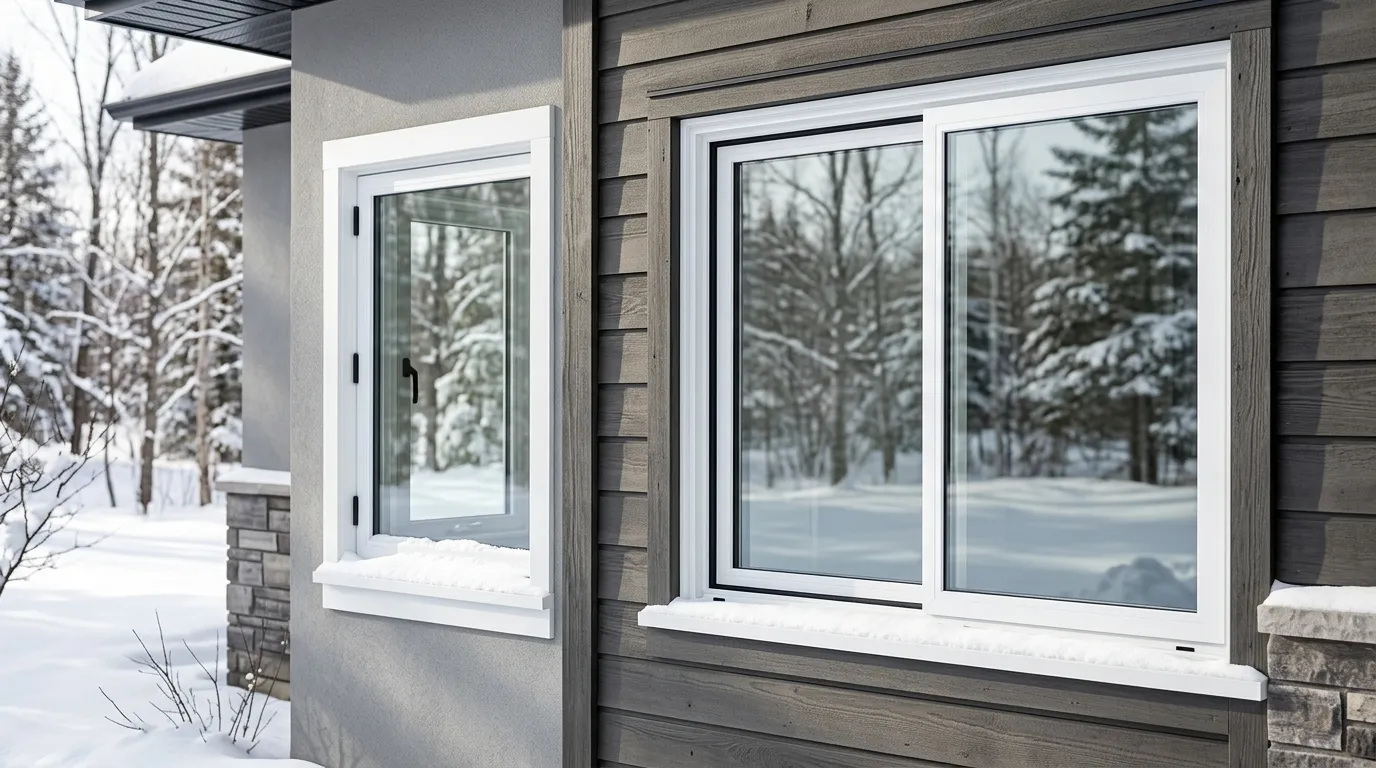
Two windows can have the same glass, the same frame material and the same energy rating on the label, yet one lets a thin stream of January air into the room and the other does not. The difference is usually not the glass but the way the sash closes. Here is how compression-seal windows and sliding-seal windows behave in a Quebec winter, why sliders still make sense in some rooms, and how to choose the right type for each wall of your house.
Two Ways a Window Can Seal
Every operable window has a gap between the moving sash and the fixed frame, and something has to close that gap. There are two basic approaches. In a compression-seal window, the sash swings shut and presses squarely against gaskets all around its perimeter, like a refrigerator door closing on its rubber seal. Casement and awning windows work this way.
In a sliding-seal window, the sash moves parallel to the frame, so the seal has to let it glide past. Horizontal sliders and single- or double-hung windows use brush-type pile or flexible fins that stay in light contact with the sash while it moves. Those seals are designed to allow movement first and block air second.
Both approaches can make a good window, and quality varies widely within each category. But the physics are different, and in a climate where the outdoor air is at −25°C and pushed by a northwest wind, the difference becomes something you can feel with the back of your hand. That difference is what the rest of this guide is about.
Why Compression Seals Are Tighter in Winter
A compression gasket is squeezed flat when the window locks. There is no gap for air to find, only a continuous band of rubber or foam pressed between two surfaces. On a quality casement, a multipoint lock pulls the sash in at several places along its height, so the pressure is even from top to bottom rather than concentrated at one handle.
Wind actually helps a casement. Because the sash opens outward, wind pressure on the exterior face pushes the sash harder against its gaskets. On a slider, the same wind pushes the sash sideways against pile weatherstripping that was designed to leave a little clearance, and air can be driven through the brush fibres and along the meeting rail where the two sashes overlap.
In laboratory air-leakage tests, casements and awnings typically post the lowest leakage figures of any operable window, often close to a fixed picture window. Well-built sliders and hung windows can meet the requirements for Quebec, but they rarely match a compression seal once the wind picks up. The practical result is less draft, less cold air washing down the glass and fewer cold spots around the sash.
- Casement: hinged on the side, cranks outward, compression gaskets, multipoint lock.
- Awning: hinged at the top, opens outward from the bottom, compression gaskets.
- Horizontal slider: one or two sashes glide sideways, pile or fin seals.
- Single- or double-hung: sashes slide vertically, pile seals and a meeting rail.
- Fixed: does not open, sealed permanently, the tightest of all.
What Casements and Awnings Do Well
Beyond airtightness, casements open fully, which means the whole sash area becomes ventilation in summer. The outward-swinging sash also acts like a scoop, catching breezes that run along the wall and directing them into the room. For bedrooms, a casement is usually the easiest way to meet egress requirements with a reasonably sized window.
Awning windows are the quiet workhorses of Quebec homes. Because they are hinged at the top, they can stay open during a light rain without letting water in, which makes them ideal in bathrooms, above kitchen counters and in basements. Paired below a large fixed pane, they give ventilation without breaking up the view.
Both types lock with a positive action that you can feel, which also makes them hard to force from outside. If you want the tightest operable option for your most exposed walls, our casement windows are built with multipoint locking and continuous compression gaskets for exactly that reason. An awning version of the same system works well wherever a side-swinging sash would be awkward.
Why Sliders Still Suit Some Rooms
A slightly less airtight window is not automatically the wrong choice. Sliders have no crank, no hinge arms and no sash swinging into the yard, which matters in several real situations. A window facing a deck, walkway, balcony or narrow side yard can be a hazard if the sash projects outward at head height, and a slider avoids that entirely.
Sliders are also simple to operate for children and older adults, have few moving parts that can wear out and are easy to fit with a screen on the inside. In basement openings set in window wells, a slider often gives a larger clear opening in a low, wide format than a casement could. Many homeowners also simply prefer the look of a horizontal slider in a wide, short opening.
Orientation softens the airtightness gap. A slider on a sheltered east wall, under a deep porch roof or facing a courtyard sees far less wind pressure than one on an exposed northwest corner. Used in the right places, a good-quality slider performs perfectly well through a Quebec winter.
Freeze-Ups: Frozen Tracks and Iced Operators
Each window type has its own winter failure mode. On sliders and hung windows, the trouble is the track. Melting snow, rain and condensation collect in the bottom channel, and if the weep holes that drain it are blocked by dust, insects or debris, the water sits there and freezes. The sash then locks solid to the track, and forcing it can tear the weatherstripping or crack the frame.
On casements and awnings, the weak points are the operator and the gasket. Condensation running down the glass can freeze around the crank mechanism or glue the sash to its seal. Forcing the crank on a frozen sash is the most common way homeowners strip the gears of an operator in January. The fix is patience: let the room warm up, or use a hair dryer on a low setting a safe distance from the glass, then open gently.
A few minutes of preparation in the fall prevents most freeze-ups. Keeping indoor humidity under control also matters, because much of the ice on operators starts as interior condensation. The checklist below takes less than an hour for a typical house.
- Vacuum slider and hung-window tracks and clear the weep holes with a pipe cleaner.
- Apply a silicone spray to tracks and gaskets; avoid oil or grease, which attract dirt.
- Lubricate casement operators and check that the crank turns smoothly before the cold.
- Close and lock every window fully so gaskets and pile are properly engaged.
- Never force a frozen sash or crank; warm it gradually first.
Choosing the Right Type for Each Room and Wall
In most of southern Quebec, the coldest winter winds come from the west and northwest. Those are the walls where compression-seal windows pay off most, especially in living spaces and bedrooms where you sit or sleep close to the glass. South-facing walls are sunnier and usually less windy, and east walls are often the most sheltered of all.
Think of the house room by room rather than choosing one style for everything. A mix is normal and often looks better, as long as the frame colour and sightlines match. The guide below reflects what we recommend most often in Quebec homes.
- Northwest and west bedrooms and living rooms: casements, or fixed panes with casement or awning vents.
- Kitchen over the sink: awning or casement, easy to reach with a crank across the counter.
- Bathrooms: awning, placed high for privacy and open in light rain.
- Basement in a window well: slider or hopper, depending on the clear opening needed.
- Next to a deck, walkway or balcony: slider, so no sash projects outward.
- Sheltered east walls and covered porches: slider or hung window if you prefer the look.
- Large views: fixed picture window, the tightest option, with operable units at the sides.
Planning Your Window Mix
Airtightness is only one part of a window's winter performance. Glass package, spacer, frame material and, above all, installation quality all matter, and a perfectly sealed casement installed in a poorly insulated opening will still feel cold. The type you choose should fit the room, the wind exposure and how you use each window.
The cost of each option depends on your project, the sizes and the mix of styles, so there is no single number that applies to every house. The easiest way to plan is to request a free estimate. A Unisson advisor will walk through each room with you, note which walls take the wind and recommend where casements, awnings, sliders or fixed units make the most sense.
Frequently Asked Questions
Which window type is the most airtight?
Fixed windows are the tightest because they never open. Among operable windows, casements and awnings are usually the most airtight because their sashes close against compression gaskets that wind pressure pushes even tighter.
Are sliding windows bad for Quebec winters?
No. A good-quality slider performs well, especially on sheltered walls. It is typically a little less airtight than a casement under strong wind, so it is best used where its advantages matter, such as next to decks or in basements.
Why does my sliding window freeze shut?
Water collects in the bottom track and freezes, usually because the weep holes are blocked. Clean the track and weep holes in the fall and apply silicone spray to prevent it.
How do I open a casement window that is frozen?
Do not force the crank, which can strip the operator gears. Let the room warm up or use a hair dryer on low at a safe distance, then open gently once the ice releases.
Can I mix casements and sliders on the same house?
Yes, and it is very common. Matching frame colour and sightlines keeps the exterior consistent while each room gets the window type that suits it.
How much do casement windows cost compared to sliders?
The exact figure depends on your project, sizes and options. Request a free estimate and a Unisson advisor will price the mix that suits your home.