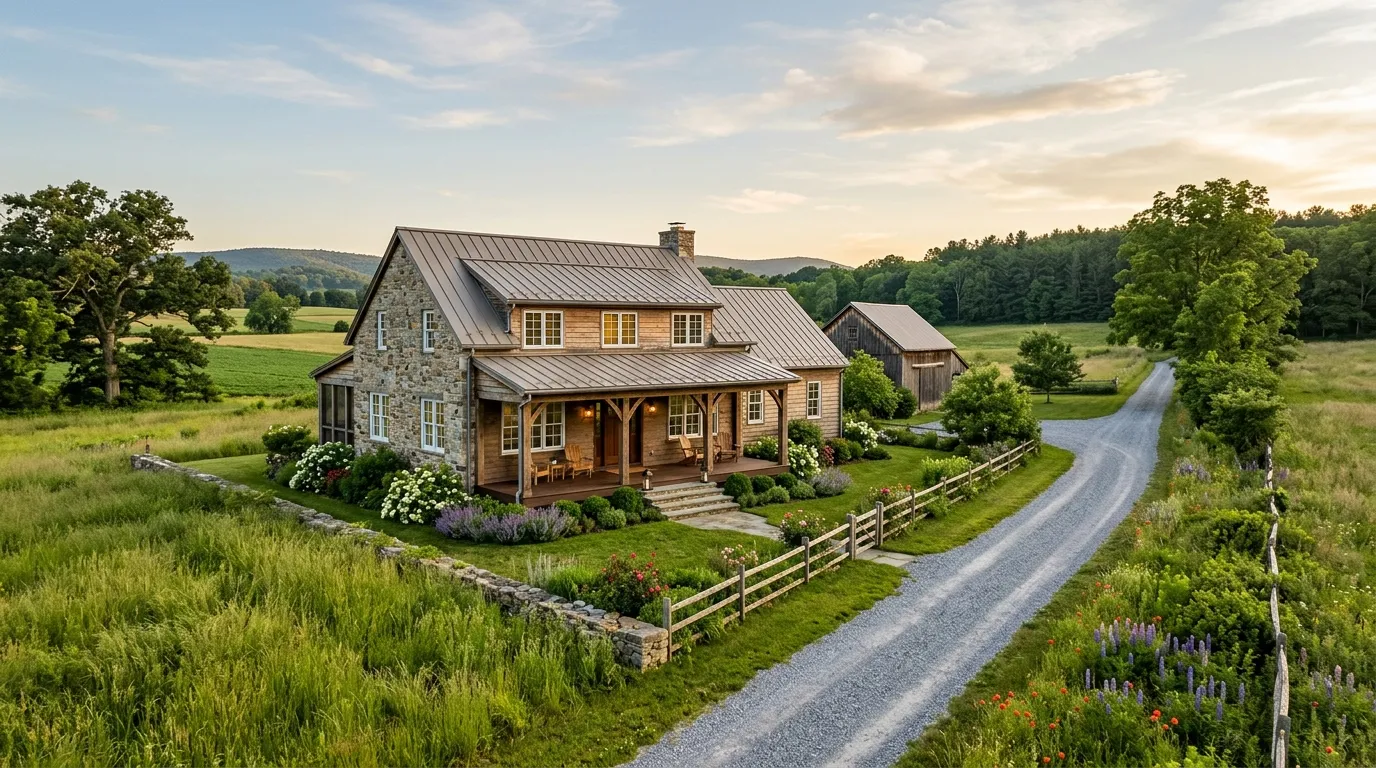
Curran is the kind of place where a house is expected to last a century and the wind gets a full field's worth of run-up before it reaches your windows. Unisson Groupe now serves this corner of Alfred and Plantagenet township directly from our factory in Saint-Laurent — measurement, manufacturing, delivery and installation by our own bilingual crews. Here is what that means for a farmhouse or bungalow on the concession roads south of Plantagenet.
Why Unisson now serves Curran
Curran sits a few kilometres south of Plantagenet on County Road 2, in the farm country of Alfred and Plantagenet township, roughly a quarter of an hour from Alfred. It is a hamlet of a few hundred people with a parish church, Saint-Luc, whose records reach back to the 1830s, and a working landscape of dairy barns, cash-crop fields and long gravel driveways. For years, homeowners here had two choices for windows and doors: a big-box store in Rockland or Hawkesbury, or a dealer reselling somebody else's product. Unisson Groupe is now a third option — a manufacturer with its own factory, delivering and installing along the Ottawa River corridor from Hawkesbury to eastern Ottawa.
Factory-direct means exactly what it sounds like. The person who measures your openings works for the company that builds the windows, and the crew that installs them works for that same company. There is no distributor margin layered onto the price, no finger-pointing between a seller and a manufacturer if something needs adjusting, and no waiting for a third party to relay a question about your sill height. From our plant in Saint-Laurent, Curran is roughly an hour and a half by Highway 40, the 417 and County Road 17 — close enough that a measurement visit and an installation are routine trips, not special expeditions.
Our crews are bilingual as a matter of course, which matters in a hamlet where French is the everyday language for most families. Whether the conversation at the kitchen table happens in French and the paperwork in English, or the other way around, you can deal with us in whichever language you prefer from the first phone call to the final walkthrough.
- One company, start to finish: measurement, manufacturing, delivery and installation
- RBQ licence 5670-0248 and ENERGY STAR certified windows and doors
- Bilingual service in French or English, your choice, at every step
Homes in Curran: farmhouses, bungalows and open-field wind
The housing stock around Curran is a mix anyone from rural Prescott-Russell will recognize. Along the concession roads you find one-and-a-half and two-storey farmhouses from the late 1800s and early 1900s — some in brick, many clad in siding over the original wood — with tall, narrow window openings and a porch that has been rebuilt at least once. In and near the hamlet itself there are brick-veneer and vinyl-sided bungalows from the 1960s through the 1980s, and along the county roads a scattering of newer homes on large lots.
What fails is fairly predictable. In the older farmhouses, the original wood double-hung sashes have been painted shut, the frames are often out of square after a century of settling on a stone foundation, and cold pours through the gap between sash and jamb. In the bungalows, the aluminum sliders and early double-pane units of the 1970s and 1980s have lost their seals: fog between the panes in the morning, frost on the interior track in January, and condensation pooling on the sill. Entry doors from the same era are usually hollow steel with a weatherstrip that no longer touches the slab.
The climate does the rest. Curran regularly sees −25 to −30 °C on clear January nights, and there is very little between the fields and your west wall to slow the wind. Spring brings the freeze-thaw cycle that works water into any crack in the caulking, and the South Nation River valley to the north adds humidity that shows up as condensation on poorly insulated glass. Add the dust of a working farm in summer and you have conditions that reward a well-sealed, easy-to-clean window.
Products that fit Curran homes
For most homes here, our UPVC windows are the practical choice: multi-chamber frames that do not conduct cold, fusion-welded corners, and a finish that shrugs off barn dust with a garden hose. Where you want a dark exterior colour that will not fade on a south-facing wall, our hybrid windows pair a UPVC interior with an aluminum-clad exterior. Both are built at our Saint-Laurent plant to the exact dimensions of your openings, which matters in a farmhouse where no two windows are quite the same size.
We recommend triple glazing for any exposed elevation in Curran. The gain over double glazing is most obvious on the windward side of a house with fields around it: less radiant cold near the glass, less interior condensation on humid days, and a real difference in a room heated with oil or propane. All of our standard units meet the ENERGY STAR requirement that has applied across Canada as a single national specification since 2020 — a U-factor of 1.22 W/m²·K or lower, or an Energy Rating of 34 or higher — and many of our triple-glazed configurations exceed it comfortably.
Style-wise, casement and awning windows suit the tall openings of an older farmhouse and seal tighter against wind than sliders. If you want to keep the look of divided panes, we can add grilles between the glass or simulated divided lites on the exterior in a colonial or prairie pattern. For doors, an insulated steel or fibreglass entry door with a multi-point lock handles the mudroom traffic of a farm, and a sliding or garden patio door gives the kitchen a proper view over the fields. See the full range on our windows page.
- UPVC casement and awning windows for tall farmhouse openings
- Hybrid windows for dark exterior colours on sun-exposed walls
- Triple glazing, Low-E and argon for windward elevations
- Steel or fibreglass entry doors with multi-point locks; sliding and garden patio doors
Ontario rules: building code, rebates and permits
Ontario homes fall under the Ontario Building Code rather than Quebec's, and there are a few practical differences worth knowing. For a straight replacement — a new window in the same rough opening, without changing its size or structure — a building permit is generally not required in Ontario, though you should confirm with the Alfred and Plantagenet building department, since interpretations and fees vary from one township to the next. If you want to enlarge an opening, add a new one, or change a bedroom window in a way that affects egress, a permit is normally needed, and we will tell you in advance if your project falls into that category.
Rebates in Ontario change frequently, so treat this as a starting point rather than a promise. At the time of writing, the province's main residential program is the Home Renovation Savings Program, delivered by Enbridge Gas and Save on Energy with support from the Ontario government. It has offered a fixed amount per ENERGY STAR certified window or door opening, but only as part of a package that includes a home energy assessment and at least two categories of upgrade — windows alone have typically not qualified. Rural homes heated with oil, propane or electricity have been eligible, but confirm the current rules and deadlines directly with the program before you count on the money.
Several federal programs that homeowners remember from a few years ago — the Canada Greener Homes Grant among them — have closed to new applicants, so be wary of any sales pitch built around them. Our estimators keep track of what is actually open and will tell you honestly whether your project is likely to qualify.
How it works from Montréal: measurement to installation
The process starts with a free in-home estimate. One of our technicians drives out to Curran, measures every opening, checks the condition of the sills and framing, and goes over styles, colours and glazing with you. You receive a written quote listing each window and door by size and configuration, with no obligation. Because we build in our own factory, the quote reflects the real cost of manufacturing and installing, not a dealer's markup on a catalogue price.
Once you approve the quote, your windows and doors go into production at our Saint-Laurent plant. Typical lead time is four to six weeks in peak season; it is often shorter in winter, which is a perfectly good time to install, since our crews work one opening at a time and the house is never left open to the cold. On installation day, our own crew — not a subcontractor — arrives from Montréal with the units, removes the old windows, prepares and flashes the openings, sets, shims and seals the new ones, and finishes inside and out. A typical farmhouse or bungalow with ten to fifteen openings takes one to two days.
Every project comes with a manufacturer's warranty on the windows and doors and our own warranty on the installation, both in writing on your contract. Financing is available through our partner Financeit, with terms from 12 to 240 months and weekly, bi-weekly or monthly payments, so a whole-house replacement can be spread out rather than paid in one lump. Afterwards, a single phone call handles any service question — you deal with us, not with a chain of intermediaries.
- Step 1: free in-home measurement and written quote
- Step 2: manufacturing at our Saint-Laurent factory, typically 4–6 weeks in peak season
- Step 3: delivery and installation by our own crews, usually 1–2 days
- Step 4: written warranties, financing from 12 to 240 months, one contact for service
Frequently Asked Questions
Do you really come out to Curran for a single window?
Yes. We plan measurement visits and installations along the Hawkesbury–Ottawa corridor, so a single window or door in Curran is grouped with other appointments in Prescott-Russell. There is no minimum order and no charge for the estimate.
Can you replace windows in a farmhouse that is out of square?
That is one of the main reasons to buy from a manufacturer. Because each unit is built to measure, we size it to the actual opening, and our installers shim and square the frame in place. Where a sill or jamb has rotted, we tell you before ordering and include the repair in the quote.
Do I need a permit from Alfred and Plantagenet township?
For a like-for-like replacement in the same opening, usually not, but we recommend a quick call to the township building department to confirm. If you are enlarging an opening or changing a bedroom window, a permit is generally required and we will flag it during the estimate.
Is the service available in French?
Yes. Our estimators, office staff and installation crews are bilingual, and every document — quote, contract, warranty — can be in French or English as you prefer.
How far in advance should I book for a fall installation?
Allow four to six weeks of production plus scheduling, so an estimate in late summer generally means installation before the first hard frost. Winter installations are also possible and often come with shorter lead times.