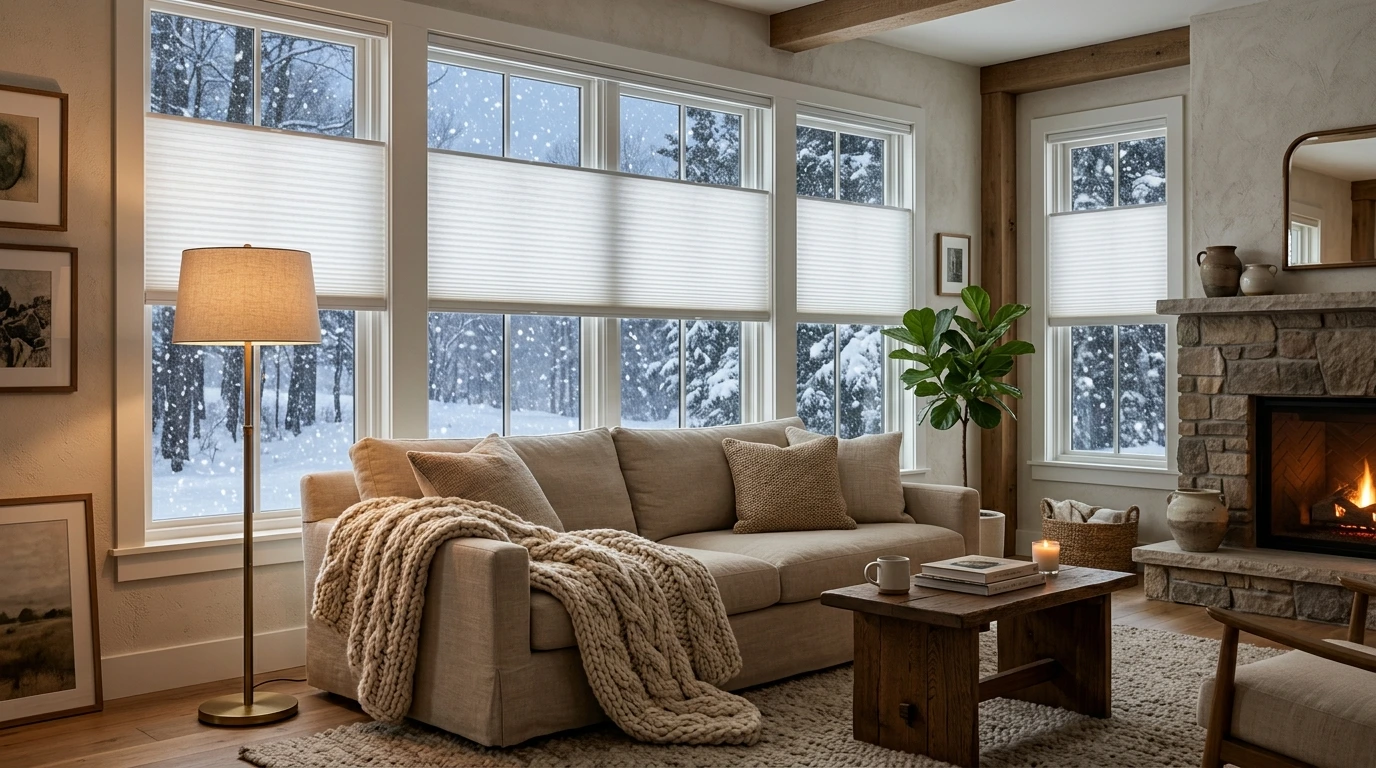
Window coverings are usually chosen for style, privacy and light, but in a Quebec winter they also play a role in comfort. Used well, window coverings add winter insulation at night, reduce the chill you feel near large windows and slow the cold draft that slides down the glass. Used badly, they can trap moisture against the pane and hide a bigger problem. This guide compares curtains, cellular shades and blinds and explains how to get real benefit from them without side effects.
How a Window Makes a Room Feel Cold
In winter, a window takes heat from a room in three ways. Your body and the furniture radiate heat toward the cold glass, which is why you feel chilly sitting near a window even when the thermostat says the room is warm. Air touching the glass cools, becomes heavier and slides down to the floor, creating a steady cold current. And any air leak around the sash or the frame lets outside air in directly.
A window covering works mainly on the first two. It places a layer of fabric and trapped air between the room and the glass, so you radiate heat toward a warmer surface and the cold air from the glass is partly contained behind it. It does very little for air leaks, which have to be solved at the window itself.
Window Coverings and Winter Insulation: How the Options Compare
Not all coverings insulate equally. The ones that work best share two features: they trap a layer of still air, and they fit closely to the window opening so that air cannot circulate freely around their edges. A beautiful covering that leaves wide gaps on the sides and top may look warm but does much less at night than it seems.
Cellular shades, also called honeycomb shades, are usually the most effective of the common options because their cells trap air in pockets across the whole surface. Lined thermal curtains come next, especially when they are long and close to the wall. Roller shades and Roman shades help moderately, and slatted blinds offer the least insulation because air moves freely between the slats.
- Cellular shades: air pockets across the whole shade; double-cell models and side tracks add more.
- Thermal curtains: lined, heavy fabric; most effective when floor length and close to the wall.
- Roman and roller shades: moderate help, better when mounted tightly inside the frame.
- Slatted blinds: good for light control, little insulation since air moves between slats.
- Layering: a shade inside the frame plus a curtain on top combines the strengths of both.
Getting the Fit Right
How a covering is installed matters as much as what it is made of. Inside-mount shades that fill the window recess with only small gaps at the edges keep more air still than shades hanging loosely in front of the frame. Side channels or tracks, available on some cellular shades, close those edge gaps even further.
For curtains, the goal is to stop the loop of cold air that runs down the glass, under the curtain and across the floor. Curtains that reach the floor or the windowsill, that return to the wall at each side and that sit under a valance or a cornice at the top are usually more effective than short panels on a rod well away from the wall, in most rooms.
Large openings deserve special thought. A wide picture window or a patio sliding door loses a lot of heat at night, but it also needs to stay easy to use. Vertical cellular shades, panel tracks or full-width curtains on an extended rod keep the opening practical while covering the whole glass surface.
A Simple Daily Routine for Winter
Window coverings work best when you use them with the sun. On clear winter days, open them fully on south, east and west windows to let solar heat and daylight into the room. That free warmth matters in a Quebec winter, and there is no reason to block it.
Close them at dusk, when the glass starts to cool quickly, and keep them closed through the night. On north-facing windows that get little direct sun, you can leave insulating shades partly lowered during the day in very cold weather, as long as you keep an eye on moisture.
- Open coverings on sunny facades in the morning to let the sun in.
- Close everything at dusk, before the room starts to cool.
- Keep north-facing shades partly lowered on the coldest days.
- Open them again in the morning to let the glass and frame dry.
Watch for Condensation and Keep Heaters Clear
There is a trade-off that many people do not expect. Once a covering is closed, the glass behind it gets colder because it no longer receives heat from the room. If indoor air is humid, water condenses on that colder glass, and in deep cold it can turn into frost on the pane and the frame. Left for weeks, that moisture can damage sills and encourage mould.
To avoid it, keep indoor humidity moderate and lower it during cold snaps, run bathroom and kitchen fans, and open coverings every morning so the glass can dry. If you see water pooling on the sill despite those habits, it may be a sign that the window itself is too cold.
Safety matters too. Many Quebec homes have electric baseboard heaters under the windows. Curtains must never cover or touch a heater, both for fire safety and because the heat would be trapped behind the fabric instead of warming the room. Follow the clearances in your heater's instructions, and choose cordless coverings in homes with young children.
When Coverings Are Not Enough
Coverings improve comfort, but they cannot make a failing window perform like a good one. If you feel drafts even with the shade closed, see fog between the panes, notice frost forming on the inside of the frame every night, or find that curtains move on windy days, the problem is the window, not the decor.
Modern glass packages reduce the cold-glass effect at its source. A Low-E coating keeps the inner pane warmer, which can mean less radiant chill, less downdraft and less condensation, whether the coverings are open or closed. To see how glass, frame and installation work together, read our page on understanding energy efficiency.
Get Advice on Cold Windows With a Free Estimate
If your window coverings are doing the work your windows should be doing, it may be time to have them looked at. Start with the simple fixes: new weatherstripping and fresh caulking can be enough on windows that are otherwise sound. When drafts, frost on the frame or fog between the panes persist, an assessment of the glass, the seals and the installation helps you see whether a repair or new windows make more sense.
Unisson Groupe manufactures and installs windows and doors in Saint-Laurent, Montreal, and serves the Greater Montreal area. You can request a free in-home estimate to go over the rooms that feel cold and talk through the options for each window.
Frequently Asked Questions
What type of window covering insulates best in winter?
Cellular or honeycomb shades are usually the most insulating common option, especially double-cell models with side tracks. Lined thermal curtains that reach the floor and return to the wall come close. Combining a shade inside the frame with a curtain on top usually gives the most benefit.
Do thermal curtains really make a difference?
Yes, mostly at night and near large windows, because they reduce the cold you feel from the glass and slow the cold air sliding down to the floor. Their effect depends a lot on fit: long curtains close to the wall with a valance on top usually work better than short, loose panels.
Why do my windows get more condensation when the curtains are closed?
A closed covering keeps room heat away from the glass, so the pane gets colder and humid air condenses on it more easily. Keep indoor humidity moderate, use ventilation fans and open the coverings in the morning so the glass can dry.
Can curtains hang over a baseboard heater?
They should not. Curtains covering or touching a baseboard heater are a fire risk and trap the heat behind the fabric. Respect the clearances in your heater's instructions, or use shades mounted inside the window frame instead.
Are window coverings a substitute for new windows?
They improve comfort, but they do not fix air leaks, failed seals or cold frames. If you still feel drafts or see frost and fog with the coverings closed, the windows themselves likely need attention.