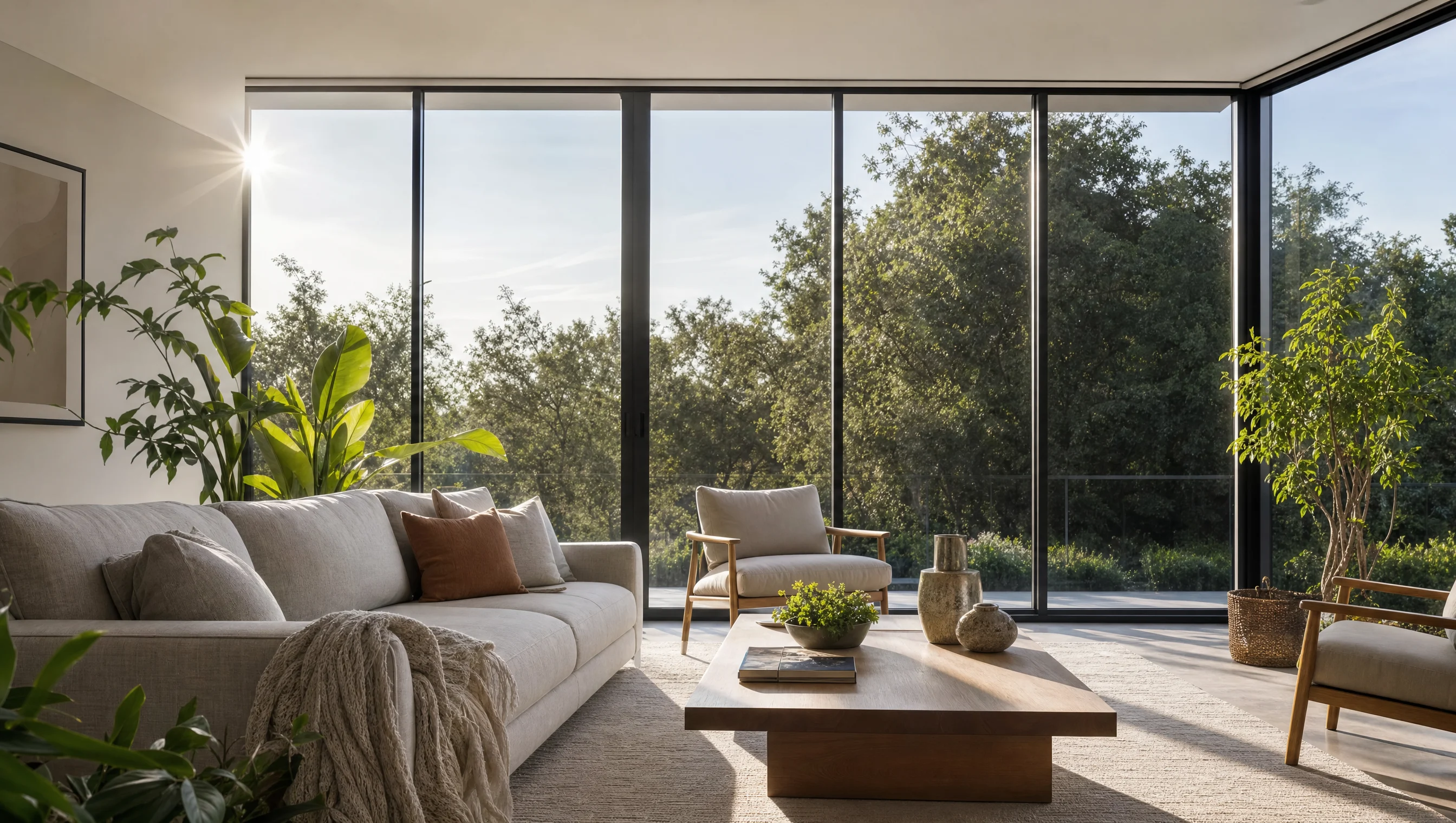
Quebec summers are no longer mild. Montreal now routinely climbs past 30°C, and a stretch of humid days in July can push poorly shaded interiors above 32°C even with the blinds drawn. The good news: modern glazing can reject most of that solar heat before it ever crosses the threshold — quietly, permanently, and without dimming your rooms.
Why Heat Gain Matters in Quebec Homes
For decades, Quebec homeowners have judged windows almost entirely on winter performance — and for good reason, with January nights around −10°C and the occasional −25°C cold snap. But the climate has shifted. Montreal recorded multiple days above 35°C during the 2025 heat dome, and Environment Canada now issues several heat warnings per summer for the Greater Montreal area. South- and west-facing rooms in Plateau triplexes, Saint-Laurent bungalows, and West Island two-storeys are bearing the brunt of it.
Glass is the weak point. In a home with older clear double-pane units, windows can account for up to 70% of the summer cooling load — far more than walls or the roof. A single 1.2 m × 1.5 m west-facing window with clear glass can admit the equivalent of a 1,000-watt space heater running through the hottest hours of the afternoon. Multiply that across a living room wall of glass and the air conditioner never catches up.
Reducing that load at the glass is almost always cheaper than fighting it with mechanical cooling. Upsizing a central air conditioner or adding mini-splits costs thousands and raises your Hydro-Québec bill every summer for the life of the equipment. High-performance glazing solves the problem once, runs at zero operating cost, and pays you back every July and August thereafter.
Understanding the Solar Heat Gain Coefficient
The single most important spec for summer comfort is the Solar Heat Gain Coefficient, or SHGC. It is a number between 0 and 1 that tells you what fraction of the sun’s energy striking the glass passes through as heat. A SHGC of 0.25 admits 25% of available solar heat; a SHGC of 0.60 — typical of plain double glazing — lets through 60%. Cutting that number in half can roughly halve the heat entering through a given window.
For Quebec, the right target depends on orientation. On the brutal west and south-west exposures that catch the late-afternoon sun, aim for a low SHGC of 0.25–0.30. On east, north, and most south windows where a little passive winter gain is welcome, 0.30–0.40 is a sensible balance. The goal is not the lowest possible number everywhere — it is matching the glass to how each window actually behaves through the year.
SHGC and the U-factor (which governs winter heat loss) are separate, independently tunable properties. A well-specified window can hold a low U-factor of about 0.18 for winter while also holding a low SHGC for summer. Many quotes list only the U-factor; if SHGC is missing, the installer chose it for you, and they very likely defaulted to a single number across your whole home.
Low-E Coatings That Stop Heat
The technology doing the heavy lifting is the solar-control Low-E coating — a microscopically thin, transparent layer of silver and metal oxides deposited on the glass surface. It works like a one-way mirror for infrared: it reflects the sun’s radiant heat back outside while allowing visible daylight to pass through almost untouched. Your rooms stay bright; the heat stays out.
The 2026 generation of triple-silver Low-E is remarkably good at this trade-off. The best coatings now block roughly 78% of infrared energy while still transmitting around 65% of visible light, so a room can feel noticeably cooler without looking dim or tinted. This is a genuine leap over the single-silver coatings of a decade ago, which forced a harsher choice between light and heat rejection.
Position matters as much as the coating itself. In a sealed insulated glass unit (IGU), the Low-E layer sits on a specific internal surface — for cooling-priority climates it belongs on surface 2, the inner face of the outermost pane, so it intercepts heat before it enters the cavity. A reputable manufacturer engineers this for you; it is one more reason factory glass beats anything applied after the fact.
- Choose a “solar-control” or “summer-priority” Low-E coating for west- and south-west-facing windows
- Combine the coating with an argon or krypton gas fill to lower the U-factor at the same time
- Pair solar-control Low-E with triple-pane construction for the lowest combined SHGC and U-factor
- On windows where winter sun is welcome, ask for a balanced Low-E that still allows some passive solar gain
Window Tinting vs Coated Glass
When summer heat becomes unbearable, many homeowners reach for aftermarket tint film as a quick fix. It does reduce heat, but the drawbacks are significant. Applying film to a sealed double- or triple-pane unit traps additional heat between the panes, which raises stress on the perimeter seal and can lead to premature seal failure — fogging, condensation between the glass, and a cloudy haze that cannot be cleaned.
More to the point, most window manufacturers explicitly void their glass warranty the moment a film is applied. You trade a 20-year sealed-unit warranty for a film that typically carries a 5- to 10-year guarantee and a noticeable shift in the visible colour of the glass — often a grey or bronze cast that changes how your home looks from the street.
Factory-applied Low-E avoids every one of these problems. The coating lives inside the sealed cavity where nothing can scratch or peel it, it is colour-neutral so your view stays true, and it is covered by the same long-term warranty as the rest of the window. For a home you plan to keep, coated glass is the durable answer; film is a stopgap.
Exterior Shading and Overhangs
Glass does the most work, but the cheapest BTU of cooling is the one you block before it reaches the window at all. Exterior shading — an overhang, an awning, a pergola, or even a well-placed deciduous tree — intercepts sunlight outside the building envelope, which is far more effective than interior blinds that stop heat only after it has already entered the room.
South-facing windows respond especially well to a fixed horizontal overhang. Because the summer sun rides high in the Quebec sky — over 65° above the horizon at midday in late June — a modest overhang of 45–60 cm can shade the glass through the hottest months while still letting the low winter sun stream in to warm the room. It is a one-time, no-maintenance feature that works automatically with the seasons.
West windows are the hardest case, because the late-day sun arrives almost horizontally and slips under any overhang. Here, retractable exterior awnings, vertical solar screens, or a strategically planted tree do the most good — ideally combined with a low-SHGC Low-E unit as the second line of defence.
- Add a 45–60 cm overhang above south-facing windows to block high summer sun while admitting low winter sun
- Use retractable awnings or vertical solar screens on hard-to-shade west exposures
- Plant deciduous trees on the south-west side — full shade in summer, bare branches that admit light in winter
- Choose light-coloured exterior frames and shading, which absorb and re-radiate less heat than dark surfaces
Strategic Ventilation Choices
Even the best glass benefits from a smart ventilation plan, because Quebec summers cool off meaningfully after sunset. A home that can flush warm daytime air and pull in the night breeze runs its air conditioner far less. The window style you choose determines how well this works: a casement or awning unit cranks open to nearly its full area, while a horizontal slider opens only about 50% and a single-hung even less.
Casement windows act like a scoop, their hinged sash catching and directing breezes into the room, which makes them the best choice for natural cooling. Awning windows open from the bottom and can stay open during a light summer rain, ideal high on a wall or over a kitchen sink. Planning operable units on opposite sides of the house sets up cross-ventilation that pulls fresh air through the whole floor.
Pairing this with simple habits multiplies the effect: open up in the cool evening and overnight, then close windows and draw shades before the morning sun gains strength. Done consistently, night ventilation plus solar-control glass can keep a Quebec home comfortable on many summer days without the air conditioner running at all.
Rebates and the Real Cost of Upgrading
High-performance windows are an investment, but two programs soften the cost meaningfully for Quebec homeowners. Rénoclimat, the provincial program, pays up to roughly $150 per rough opening when you replace old windows with ENERGY STAR-certified units, following a pre- and post-work energy evaluation. The federal Canada Greener Homes initiative has offered grants of up to $5,000 toward eligible energy retrofits, with windows among the qualifying measures — always confirm current program status before you budget.
To qualify for these incentives, your windows must be ENERGY STAR certified for Climate Zone D, the rating band that covers the Montreal region. That certification already requires a strong balance of low U-factor and well-controlled SHGC, so chasing the rebate naturally steers you toward glass that performs well in both seasons. Make sure your installer holds a valid RBQ licence, as proper documentation is needed for the program paperwork.
On lifetime cost, the math favours quality glazing. A full window upgrade for a typical Montreal home runs in the range of $12,000–$25,000 depending on size and count, but the combination of lower summer cooling bills, reduced winter heating, and the available rebates shortens the real payback considerably — all while making the house quieter and more comfortable every single day.
Get a Free Heat-Gain Assessment
Every home is different, and the right answer for your west-facing living room is rarely the right answer for your north-facing bedroom. Our team visits your home, measures the sun exposure of each opening, and recommends the optimal Low-E coating, SHGC target, and operable style room by room — so you pay only for the performance each window actually needs.
We will also walk you through the Rénoclimat and Greener Homes paperwork and provide the documentation those programs require. Request a free assessment and find out exactly how much cooler — and quieter — your home could be this summer.
Frequently Asked Questions
What SHGC should I target for west-facing windows?
Target 0.25–0.30 for west exposures. These windows receive the strongest, most direct afternoon heat during Quebec summers, and a low SHGC is the single most effective way to keep those rooms comfortable.
Does solar-control glass hurt me in winter?
Not meaningfully. Modern Low-E coatings are tuned to block summer infrared while still admitting daylight and some passive solar gain, and the same coating that controls summer heat usually lowers the U-factor that governs winter heat loss. A reputable installer balances both for each orientation.
Can I add solar control to existing windows?
Aftermarket films work but trap heat between the panes, often void the manufacturer warranty, and reduce the sealed unit’s lifespan. If the perimeter seals are still intact, replacing just the insulated glass unit (IGU) with a factory Low-E version is a cleaner, longer-lasting fix.
How much can the right windows cut my cooling bill?
In a home with older clear glass, upgrading to solar-control Low-E can cut window-related heat gain by 50–70%. Because windows often drive the majority of the summer cooling load, that translates into noticeably lower Hydro-Québec bills and an air conditioner that cycles far less.
Do I need triple-pane for summer comfort?
Not strictly — a quality double-pane unit with solar-control Low-E and argon fill handles most summer heat well. Triple-pane adds the lowest combined SHGC and U-factor, plus better sound and winter performance, which is why many Quebec buyers choose it for the largest or most exposed openings.
Are window upgrades eligible for Quebec rebates?
Yes. Rénoclimat pays up to roughly $150 per rough opening for ENERGY STAR Zone D windows, and federal programs such as Canada Greener Homes have offered grants up to $5,000 for eligible retrofits. Use an RBQ-licensed installer and confirm current program rules before budgeting.