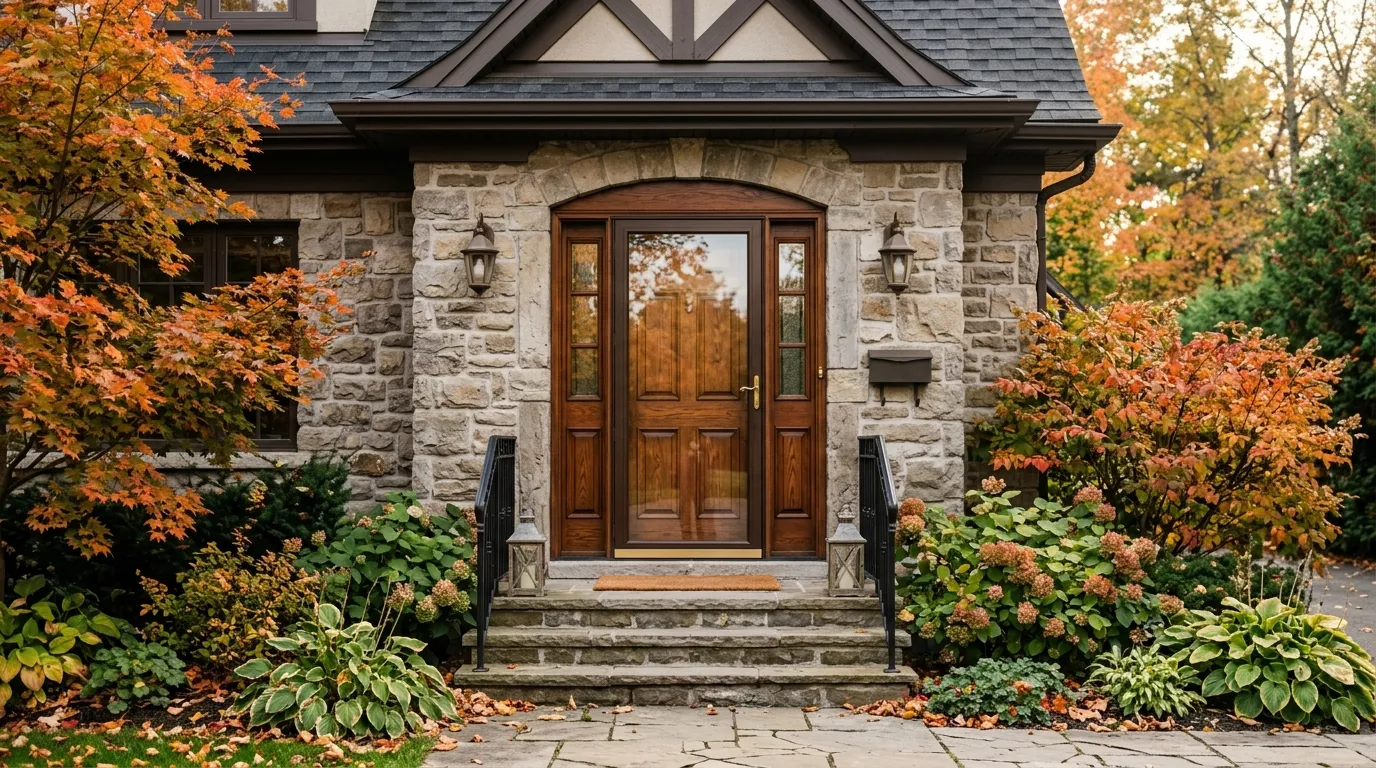
For decades, a storm door was as much a part of a Quebec entrance as the mailbox. Yet most new homes in Laval, Longueuil and the West Island are built without one, and many homeowners who replace their entry door are told to leave it off. Here is what a storm door actually does, when a modern insulated door makes it redundant, when it still earns its place, and the one situation where it can damage your new door.
What a Storm Door Actually Does
A storm door is a second, lighter door mounted on the exterior side of the entry frame, usually aluminum with interchangeable glass and screen panels. Its original job was simple: create a still-air pocket between the outside and the main door so that wind, driven rain and blowing snow never touch the primary door directly. In the era of solid wood entry doors with single-pane lites and no weatherstripping, that pocket cut drafts noticeably and kept the wood from soaking, warping and rotting.
The thermal benefit was real but modest. A storm door with its glass panel in place adds roughly the insulating value of a single pane of glass plus a dead-air layer — on the order of R-1 to R-2. Against a 1970s wood door at R-2, that was a meaningful improvement. Against a modern insulated steel or fiberglass slab, the same addition is a rounding error.
The storm door also protects the main door's finish from UV, hail and wind-driven debris, and in summer it swaps to a screen so the entry can be left open for cross-ventilation without letting in mosquitoes. Those secondary functions, not the insulation, are why many Quebec homeowners still want one.
How Modern Entry Doors Changed the Math
A current-generation insulated exterior door is a polyurethane foam core wrapped in a steel or fiberglass skin, typically rated between R-5 and R-7 for the slab itself. It ships with a compression weatherstrip on all three sides, an adjustable sill, a multi-point or deadbolt lock that pulls the slab tight against the seal, and a thermally broken frame. In a properly installed unit the air leakage is so low that the still-air pocket a storm door creates no longer buys you anything you can measure on a Hydro-Québec bill.
Glass lites in modern doors are also sealed insulating units — double or triple glazed, argon filled, with a low-E coating — so the classic weak point of an old door is gone. Add a composite or fiberglass skin that does not absorb water and cannot rot, and the second historical justification for a storm door, protecting the wood, disappears as well.
This is why most door manufacturers, Unisson included, consider a storm door optional at best on a new insulated entry. On a sheltered entrance with a porch roof or recessed vestibule, it adds cost, a second set of hinges and a closer to maintain, and one more thing to swing out of the way when you are carrying groceries at -25 °C.
When a Storm Door Still Earns Its Place
If your entry door is older than about 2005, wood or hollow steel, and you are not planning to replace it in the next few years, a storm door remains the cheapest way to reduce drafts and protect it. Installed, it costs a fraction of a new entry system and buys time. It will not make an R-2 door perform like an R-6 one, but it will stop wind from driving through a tired weatherstrip.
Exposure matters more than age. An entry facing north or west on an open lot in Saint-Eustache, Repentigny or on the South Shore, with no porch roof and nothing to break the wind, takes a beating from horizontal snow and freezing rain. There, a storm door keeps ice from forming on the main door's weatherstrip and lock, protects the finish, and keeps the threshold clear enough to open on a February morning. A sheltered entrance under a deep porch simply does not face the same conditions.
Ventilation is the third case. A full-view storm door with a screen panel lets a family open the front door on a July evening and pull air through the house without inviting mosquitoes and blackflies — something no entry door can do on its own. If your home has no screened windows near the entry and you rely on cross-breeze rather than air conditioning, the screen function alone may justify it.
Finally, there is the pet and toddler factor: a storm door lets you see who is at the door and hold it open for a delivery without the main door swinging into the house. These are lifestyle reasons, not energy reasons, and they are entirely legitimate.
- Older entry door (wood or uninsulated steel) not slated for replacement soon.
- Exposed entrance with no porch roof, facing prevailing wind or driven snow.
- Screen ventilation wanted at the entry in summer.
- Finish protection for a painted or stained wood door you want to preserve.
- Convenience: seeing visitors, letting in light while keeping pets in.
The Heat-Trap Risk on Dark Doors With Full Glass
Here is the situation where a storm door does active harm. Put a full-view glass storm door in front of a dark-coloured entry door — black, charcoal, deep burgundy, dark green — on a south or west exposure, and the gap between the two doors becomes a solar oven. Surface temperatures on the main door can exceed 70 °C on a sunny July afternoon. That is hot enough to soften vinyl trim, bubble paint, delaminate a fiberglass skin from its foam core and warp a steel slab enough that the weatherstrip never seals properly again.
Most entry door manufacturers exclude this damage from their warranty explicitly. The wording usually reads that a storm door installed over a dark door or a door with decorative glass voids the finish and warp coverage unless the storm door is vented or the exposure is shaded. Read your warranty before you add a storm door, especially if you paid for a dark factory finish.
If you want both a dark door and a storm door, there are workarounds. Choose a storm door with a ventilating design — a retractable screen that stays partly open, or a model with built-in vents at top and bottom — so hot air escapes. Keep the glass panel out from May to September. Or accept a lighter colour on the main door. On a north-facing or well-shaded entry the risk is low, but a south-facing black door behind full glass is asking for a claim that will not be paid.
Storm Door Styles and What They Cost
Full-view doors have one large glass panel with a matching screen you swap seasonally, or a retractable screen that rolls down from the top. They show off the entry door behind them and let in the most light, but they are the ones most exposed to the heat-trap problem. An aluminum full-view with a retractable screen is priced above a basic model; the exact figure depends on size and hardware.
Ventilating doors split the glass into two panels, one of which slides to expose a screen. They let you get air without changing panels, and because part of the glass can always be open, they naturally relieve the heat build-up on dark doors. Prices sit in the same range as full-view models. Mid-view and high-view doors have a solid kick panel at the bottom — useful with dogs and in households that tend to kick the door open with a foot — and cost somewhat less.
Whatever the style, look at the hinge side, the closer and the frame. A heavy-duty aluminum frame with a full-length piano hinge or three steel hinges will survive Quebec's wind loads; a thin-gauge frame with two small hinges will rack out of square in a few seasons. A dual-closer system, one at top and one at bottom, keeps the door from slamming in a gust. Ask that the storm door frame be sealed to the brickmould with a compatible exterior sealant, and that it be sized to leave enough clearance for the entry door's handle set.
- Full-view: one large glass panel, seasonal or retractable screen; most light, most heat risk.
- Ventilating: two glass panels, one slides to reveal screen; best compromise.
- Mid-view / high-view: solid lower panel; durable with pets and kids.
- Security storm door: steel with laminated glass and a deadbolt; heavier and the most expensive type.
Storm Door or New Entry Door: Where to Put the Money
If the goal is comfort and lower heating costs, the honest answer is that a storm door on an old door is a patch, and a new insulated entry system is the repair. A worn entry door leaks air through the sill, the hinge side, the lock side and around the glass. A storm door slows that air down but does not stop it, and it does nothing about the conducted heat loss through a thin slab. A new door addresses all of those at once, and unlike a storm door it also improves security, sound insulation and curb appeal.
Budget is the deciding factor for most families. A storm door is an easy decision when the entry door has a few good years left. A full entry replacement, priced according to size, sidelights and glass, is a bigger commitment — but it is the one that changes how the front of the house feels in January. If you are already replacing windows, bundling the door into the same project usually saves on installation and coordinates the exterior finishes.
One combination almost never makes sense: buying a premium insulated entry door and then adding a storm door on top for energy reasons. You are paying for two seals where one is already doing the job, and if the new door is dark, you may be voiding its warranty in the process. Add a storm door to a new entry only for the screen, the pet, or the exposed-entrance reasons above — and choose a vented style.
A Quick Decision Guide
Start with the door you have. If it is a modern insulated steel or fiberglass door installed in the last fifteen years, sealed and latching properly, skip the storm door unless you want a screen or the entrance is badly exposed. If it is older, wood or hollow, and replacement is more than two or three years away, a storm door is a sensible interim investment.
Then look at the exposure and colour. North-facing or shaded entries can take any storm door. South and west entries with a dark main door need a ventilating model or no storm door at all. Check the entry door's warranty wording before buying — it takes five minutes and can save a rejected claim.
Finally, weigh the daily use. If you carry children, groceries or a stroller through that door every day, a second door with a closer is a genuine nuisance in winter, and a quality entry door with a good seal will serve you better on its own. If you love an open front door on summer evenings, the screen will earn its keep. Our team can look at your entrance during a free measurement visit and tell you plainly which case you are in.
Frequently Asked Questions
Does a storm door save energy in Quebec?
On an old, uninsulated or leaky entry door, yes, modestly — it blocks wind and adds a still-air layer worth roughly R-1 to R-2. On a modern insulated steel or fiberglass door with good weatherstripping, the measurable savings are close to zero.
Can a storm door damage my new entry door?
It can if the main door is dark-coloured, faces south or west, and the storm door has full glass. Heat builds up between the two doors and can warp the slab, bubble the finish or delaminate a fiberglass skin, and most manufacturers exclude this from warranty. Use a ventilating storm door or leave it off.
Do new homes in Quebec still get storm doors?
Rarely. Builders install insulated entry doors that do not need the extra protection, and buyers generally prefer the cleaner look. Storm doors are now mostly added afterward for screen ventilation, pets, or on very exposed entrances.
How much does a storm door cost installed?
The installed price of an aluminum storm door in the Montreal area depends on style, screen type and hardware; steel security storm doors with laminated glass sit at the top of the range. The exact figure depends on your opening and options — request a free estimate.
Can I add a storm door to any entry door?
Usually, as long as the brickmould is deep enough and the entry door's handle set leaves clearance for the storm door to close. Doors with a protruding decorative handle or a very shallow exterior frame may need a spacer or a different handle.
What is the best storm door for a Quebec winter?
A heavy-gauge aluminum frame with a full-length hinge, dual closers and a glass panel that seals against the frame. A ventilating style is the safest choice, as it works with any main door colour and still gives you a screen in summer.