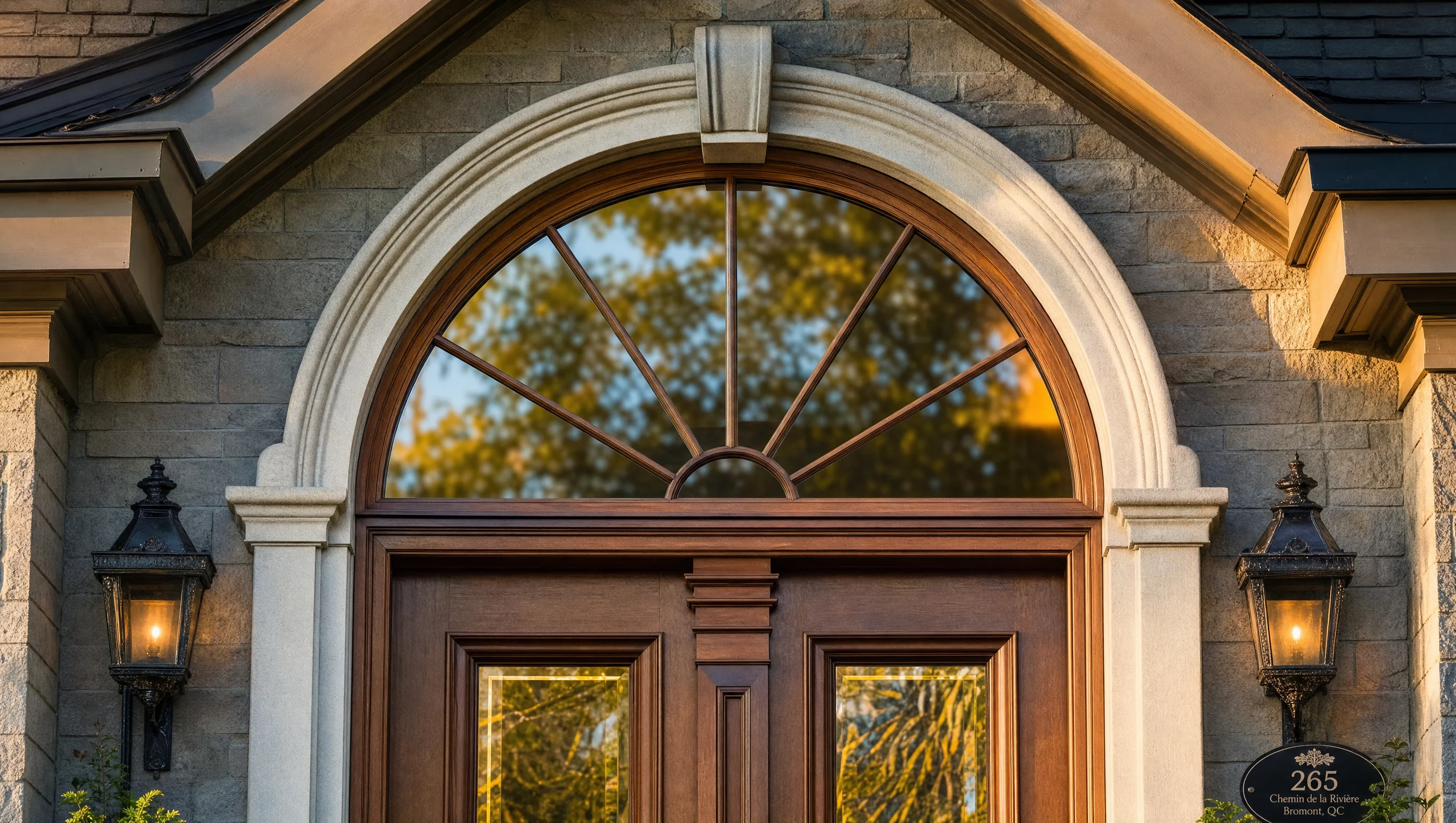
Specialty shapes — half-circles, triangles, octagons, and trapezoids — add architectural punch where standard rectangles simply cannot. They draw the eye to a gable peak, crown an entryway, or pour daylight into a stairwell that a square window would leave dim. In a province where so many homes share the same rectangular casements, a single well-placed shaped window is often the detail that makes a facade memorable.
Why Quebec Homeowners Reach for Specialty Shapes
Walk through Outremont, the Plateau, or an established corner of the West Island and you will notice that the most charming facades rarely stop at the rectangle. A Palladian arch above a front door, a triangle tucked into a Victorian gable, a porthole punctuating a modern infill — these are the touches that signal a home was designed rather than simply built. Specialty shapes let you echo the architecture you already have instead of fighting it.
There is a practical case too. Many Quebec homes have geometry that a rectangle cannot serve: cathedral ceilings in a great room, dormers carved into a sloped roof, a two-storey foyer that goes dark by 3 p.m. in December. A trapezoid that follows a roofline or a half-circle that caps a tall opening captures daylight a boxy window would miss, which matters when our shortest days deliver barely eight hours of sun.
Because Unisson manufactures locally in Saint-Laurent, custom geometry is not the exotic special order it once was. We can match the exact radius of an existing arch, fabricate a triangle to the precise pitch of your gable, and colour-match the frame to your other windows so the new shape reads as intentional, not added on.
Common Specialty Shapes in Quebec
Most shaped windows fall into a handful of recognizable families. Knowing the vocabulary helps you talk to a designer and price a project accurately, since each shape carries a different fabrication and glazing cost.
- Half-circle (eyebrow): the classic crown over front doors and Palladian compositions — pairs naturally with a rectangular picture window beneath
- Full circle (porthole): popular in modern and coastal-style homes, and a striking accent in stairwells or above kitchen sinks
- Triangle: fits the gable peaks of Victorian, farmhouse, and country homes, following the exact roof pitch
- Octagon: a small, decorative accent window ideal for stairwells, powder rooms, and dormers
- Trapezoid & rake: custom angles that track sloped ceilings, cathedral great rooms, and shed dormers
- Quarter-round and elliptical transoms: elegant toppers that sit above doors and large fixed units
Performance and the Quebec Climate
Specialty shapes are typically fixed (non-operating), which is actually an advantage in our climate: with no moving sash and no operating hardware, they form one of the tightest seals of any window type. That tight seal translates directly into lower air leakage and better comfort on a −25°C night.
The shape does not exempt a window from real thermal performance. Insist on the same specifications you would demand of a rectangle: a double or triple-pane sealed unit, Low-E coatings, and an argon-filled cavity. Spec'd correctly, a shaped fixed window can hit a U-factor at or below 1.40 W/m²·K and qualify as ENERGY STAR certified for Zone D — the Canadian climate zone covering Greater Montreal, Laval, and the South Shore.
One detail worth raising with your installer is glazing safety. The Quebec building code requires tempered or laminated safety glass in many large or low-mounted openings, and curved or angled glass behaves differently under load than a flat rectangle. A reputable manufacturer engineers this into the quote rather than leaving it as a surprise.
- Fixed shapes mean fewer seals to fail over a 30-year lifespan
- Specify Low-E + argon to reach ENERGY STAR Zone D and Rénoclimat eligibility
- Pair a fixed shape with an operable rectangle below for ventilation
- Confirm tempered or laminated glass where the code requires it
What Specialty Shapes Cost in 2026
Expect to pay a premium over an equivalent area of rectangular glass — typically 30 to 80% more. That premium is not markup for its own sake; it pays for custom tooling, hand-finishing of curved or mitred frames, and the specialized cutting and tempering of non-rectangular glass. The more unusual the radius or angle, the higher the surcharge.
As a rough 2026 benchmark in the Montreal area, a 90 cm half-circle starts around $1,200 installed, a small octagon accent runs roughly $700 to $1,100, and a large triangular gable window can land between $1,500 and $3,000 depending on size and glazing. A full Palladian assembly — arch plus flanking sidelites and a picture window — is a multi-unit project priced accordingly.
There is good news on rebates. A shaped window still counts as a rough opening under Rénoclimat, which pays up to $150 per opening when you replace an old window with an ENERGY STAR Zone D model. Stack that with the federal Canada Greener Homes Initiative (up to $5,000 across your project) and the premium shrinks meaningfully.
Design Tips That Keep a Facade Balanced
The cardinal rule: specialty shapes work best as accents, not as the dominant window in a wall. One confident shape anchors a composition; three competing shapes on the same facade read as busy. Choose the focal point — usually the entry or the highest gable — and let it lead.
Repeat the geometry of your home rather than introducing a foreign one. A half-round eyebrow over a large picture window mirrors the arches you may already have over a porch or in masonry detailing. A triangle window should match the exact pitch of the roof above it, or the eye will catch the mismatch immediately.
Think about interior light, not just the street view. A porthole on a north wall delivers soft, even light all day; a west-facing triangle floods a room with warm late-afternoon sun but may need Low-E with a lower solar heat gain coefficient to avoid summer overheating. Walk each room at the time of day you use it most before you commit to a placement.
Finally, plan the trim and grilles early. Internal grille bars, a contrasting frame colour, or a stained-glass insert can turn a simple half-circle into a signature feature — but these choices affect lead time and cost, so raise them at the design stage rather than after the order is placed.
Next Steps for Your Project
Specialty shapes reward careful measurement and an experienced manufacturer. Because each unit is built to your opening, there is little room for after-the-fact correction — the radius, the angle, and the glass safety rating all have to be right the first time.
Start with an on-site assessment so we can measure your openings, confirm code requirements, and show you finish and grille options in person. To explore what is possible for your home, request a free estimation or browse the full specialty shapes collection. We design and build every unit locally in Saint-Laurent and back the installation with a long-term warranty.
Frequently Asked Questions
Are specialty shape windows ENERGY STAR certified?
Yes. With the right glazing — Low-E coatings and an argon-filled double or triple-pane unit — shaped windows meet ENERGY STAR Zone D requirements and qualify for Rénoclimat. Always confirm the U-factor on the spec sheet before ordering.
Can specialty shapes be made operable?
Sometimes. Smaller triangles and trapezoids can be built awning-style, and some manufacturers offer venting half-rounds. Most specialty shapes are fixed, however, so plan to pair them with an operable rectangle below if a room needs ventilation.
What is the lead time for a custom shape?
Typically 6 to 10 weeks, longer than a standard rectangle because of the custom tooling and specialized glass cutting. Unusual radii, stained-glass inserts, or special colours can extend that, so order early if you are working to a renovation deadline.
How much more do shaped windows cost than rectangles?
Plan on 30 to 80% more than the same area in rectangular glass. As a 2026 benchmark, a 90 cm half-circle starts near $1,200 installed and a large triangular gable window can reach $3,000 depending on size and glazing.
Do I need safety glass in a specialty shape window?
Often, yes. The Quebec building code requires tempered or laminated safety glass in many large or low-mounted openings, and curved glass has its own structural considerations. A qualified manufacturer engineers this into the quote so you are not caught off guard.
Can you match the shape of an existing window?
Yes. Because we manufacture locally in Saint-Laurent, we can replicate an existing radius or angle and colour-match the frame so a replacement reads as original to the home rather than a visible patch.