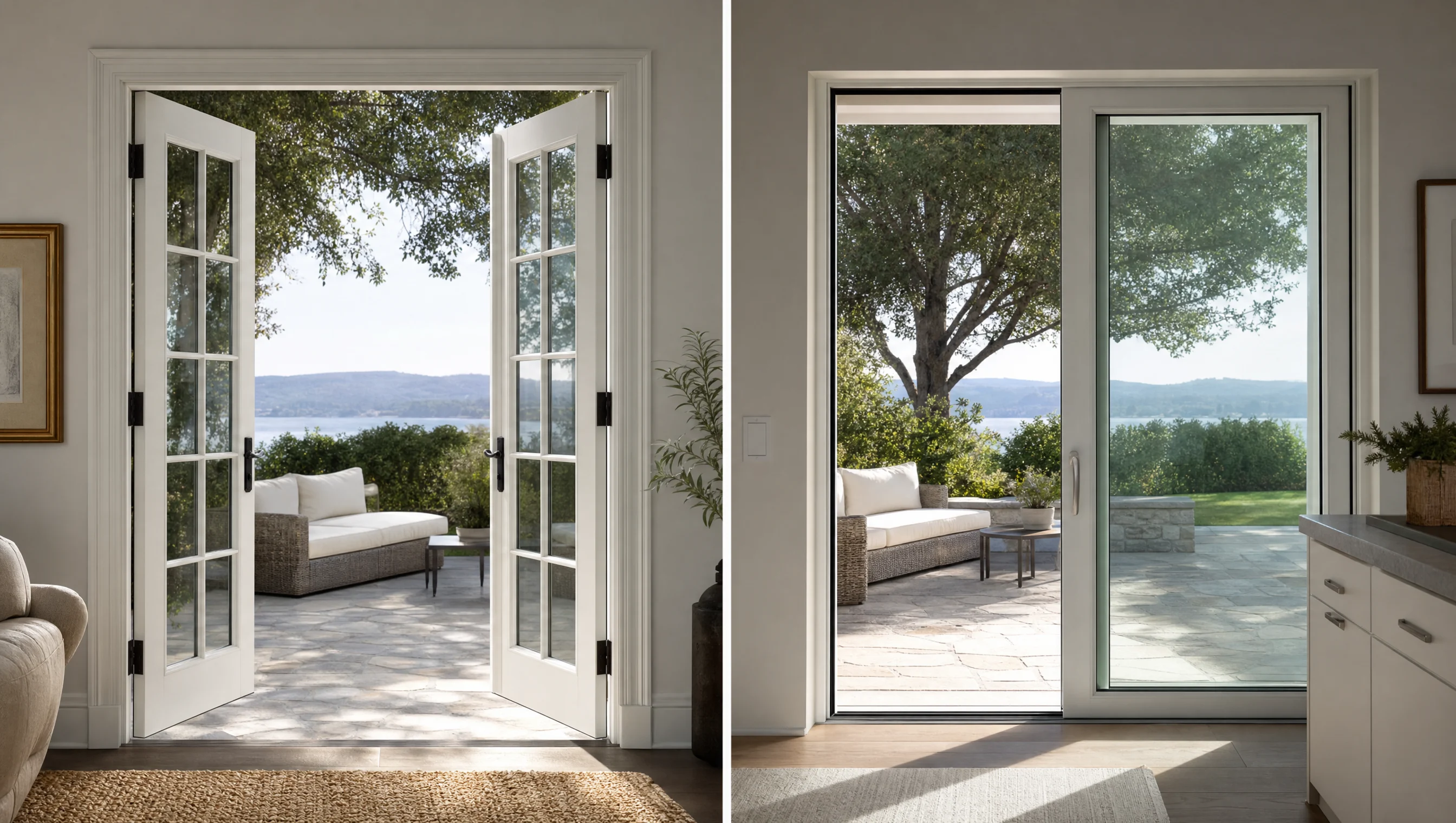
Both styles open onto the same backyard, yet they behave like completely different products once a Quebec winter arrives. A sliding door glides on a track and never steals an inch of floor space, while a French door swings open on hinges for a wide, dramatic threshold. Choosing well means matching the door to your room layout, your ventilation habits, and the −25°C nights that test every seal.
The Two Styles at a Glance
A sliding patio door — sometimes called a patio slider — has one fixed panel and one panel that rolls horizontally along a bottom track. The most common configuration in Quebec homes is a two-panel unit roughly 60 to 72 inches wide, though three-panel and pocket variations exist for wider openings. Because nothing swings into the room, sliders are the default choice for kitchens, dining nooks, and condo balconies where every square foot counts.
A French patio door is a hinged door, usually sold as a pair of leaves that meet in the centre, though single-leaf versions are common for narrower openings. One leaf is typically active and the other is held shut by flush bolts at the head and sill. When both leaves open you get a clear, unobstructed passage that a slider can never match — ideal for moving furniture, hosting, or framing a garden view.
Neither style is universally « better ». The right answer depends on how much swing clearance you have, how you ventilate in summer, how the door reads from the street, and how hard you want it to fight the cold. The sections below break down each factor with Quebec specifics so you can decide with confidence.
- Sliding: space-saving, easy one-hand operation, lower price, smaller maximum opening.
- French (hinged): full-width opening, classic look, premium feel, needs swing clearance.
- Both: available in fibreglass, vinyl, and clad-wood with double or triple glazing for our climate.
Footprint — Floor Space Required
This is the single biggest practical difference. A sliding door operates entirely within the plane of the wall: the moving panel passes in front of the fixed one and consumes zero floor space inside or outside the home. That makes it the obvious pick when a dining table, kitchen island, or sofa sits close to the opening — a frequent reality in Montreal duplexes and Saint-Laurent bungalows where rooms are compact.
A French door, by contrast, needs a swing arc. An inward-swinging pair of 30-inch leaves sweeps roughly 30 inches of floor on each side, so you need close to 60 inches of clear space inside to open both fully. Outward-swinging French doors free up interior space but can interfere with a railing, deck furniture, or snow accumulation in winter — an important consideration when a Quebec storm drops 20 to 30 cm overnight.
Before you fall in love with the look of French doors, sketch the room. Mark where the leaves land and confirm nothing — a chair, a heat register, a floor lamp — lives in that arc. If the math is tight, a slider almost always solves it, and a three-panel slider can deliver a wide opening without any swing at all.
- Slider: 0 floor space used — safe near tables and traffic paths.
- French inward: plan ~60 in of clear interior swing for a double unit.
- French outward: protects interior space but watch for snow and deck obstructions.
Ventilation Differences
Quebec summers are short but genuinely hot — Montreal regularly sees several days above 30°C with high humidity — so cross-ventilation matters. A French door can fling both leaves wide open, turning the whole opening into a doorway to the breeze. For households that air out the home aggressively on cool evenings or want maximum airflow onto a patio, that full opening is a real advantage.
A sliding door, however, can only ever open to half its width because one panel is fixed. A 72-inch slider gives you a 36-inch opening at most. That is plenty for foot traffic and a steady breeze, but it will never match the throw-it-all-open feeling of a French pair. The trade-off is that a partially open slider is easy to leave cracked for ventilation without swinging a leaf into the room.
There is also an insect-screen angle. Sliders accept a simple sliding screen that lives permanently on the track and never gets in the way. French doors require a hinged or retractable screen system that costs more, can sag over time, and is fussier to operate. If you keep windows and doors open all summer with kids and pets passing through, the slider screen is the lower-maintenance choice.
- French: 100% of the opening can be cleared for maximum airflow.
- Slider: maximum ~50% opening, but effortless to leave partly open.
- Screens: sliders use a simple track screen; French doors need pricier hinged or retractable screens.
Energy and Sealing
In our climate the seal is everything. A hinged French door compresses its weatherstripping against the frame when latched, much like a quality exterior entry door. Done right with a multi-point lock that pulls the leaf tight at three or more points, a French door can deliver an excellent airtight seal and a very low air-leakage rate — which is exactly what you want when the thermometer reads −30°C in January.
A sliding door seals differently. The moving panel relies on brush or fin weatherstripping that wipes along the frame as it rolls, plus an interlock where the two panels meet. Modern sliders from quality manufacturers seal very well, but an older or budget slider is more prone to drafts and to the bottom track icing up. Look for a thermally broken sill, a robust interlock, and warm-edge spacers in the glass.
Whichever style you choose, the glazing package drives the energy number. For Quebec you want at least double glazing with a low-emissivity coating and argon fill; triple glazing is worth considering for north-facing walls and noise-prone streets. Verify the unit carries an ENERGY STAR certification for Climate Zone D, which covers most of southern Quebec and is the qualifying threshold for several rebate programs. You can read more about coatings on our low-emissivity glass page.
- French doors: compression seal + multi-point lock = excellent airtightness.
- Sliders: brush/fin seals; choose a thermally broken sill and quality interlock.
- Glazing: double or triple, low-E, argon, warm-edge spacers, ENERGY STAR Zone D.
Security and Durability
Security is closer than most people assume. Both styles can be specified with multi-point locking hardware that engages the frame at the top, middle, and bottom, which dramatically increases resistance to forced entry compared with a single deadbolt. On a French door, the inactive leaf is held by flush bolts that seat into the head and sill, making it effectively a fixed point once locked — a slight security edge.
Sliders have one classic vulnerability: a panel that can be lifted off its track or pried at the meeting rail. Reputable units counter this with anti-lift blocks, a robust hook-style multi-point lock, and an auxiliary foot bolt or a simple bar in the track. Specify these and a slider is plenty secure for a family home.
On durability, sliders have fewer moving parts exposed to weather and no hinges to sag, so they tend to need little adjustment over a 20-year life if the rollers are good quality. French doors carry the weight of each leaf on hinges, so over time a heavy leaf can drop slightly and need a hinge adjustment — routine but worth knowing. Fibreglass and clad-wood frames hold up best against Quebec's freeze-thaw cycles, which can exceed 30 transitions across a single shoulder season.
- Both: spec multi-point locks for serious security.
- Slider extras: anti-lift blocks and a track bar close the classic gap.
- French extras: flush-bolted inactive leaf adds a fixed, hard-to-force point.
Cost and Value in Quebec
Budget usually nudges buyers toward sliders. For a comparable quality and glazing package, a French patio door typically runs 15 to 25% more than a slider, driven by the extra hardware, the second leaf, hinges, and the more complex screen. As a rough 2026 guide in the Montreal area, an installed quality slider often lands in the $2,500 to $4,500 CAD range, while an installed French patio door of similar calibre tends to sit in the $3,500 to $6,500 CAD range — wider for premium clad-wood or oversized units.
Installation cost and complexity also differ. Replacing a slider with a slider in the same rough opening is straightforward. Converting a slider opening to French doors — or vice versa — can require reframing the opening, adjusting the header, and sometimes flooring repair where the swing changes, all of which add labour. Always confirm the contractor holds a valid RBQ licence and itemizes the opening work separately.
Both styles can qualify for energy rebates when they meet the efficiency thresholds. Through Rénoclimat, eligible door and window upgrades can earn grants tied to each rough opening, and the federal Canada Greener Homes stream has historically offered up to $5,000 for a package of qualifying improvements. Pairing the right glazing with these programs can recover a meaningful slice of the price difference — a French door's premium shrinks when a rebate offsets it.
- Slider installed (2026, MTL): roughly $2,500–$4,500 CAD.
- French door installed: roughly $3,500–$6,500 CAD, 15–25% premium.
- Rebates: Rénoclimat per rough opening + up to $5,000 via Canada Greener Homes for qualifying packages.
How to Choose for Your Room
Start with the floor plan, not the photo. If furniture or a traffic path sits within about five feet of the opening, a slider is almost always the practical winner — this covers most kitchens, condos, and tight dining rooms across Montreal and Laval. If you have a generous, open room and the opening faces a feature garden or deck you want to show off, French doors reward you with a wider, more architectural threshold.
Think about how you actually live. Households that throw the home open on summer evenings and prize maximum airflow lean French; households that want effortless one-hand operation, a permanent screen, and zero swing lean slider. Resale and curb appeal can also tip the scale: French doors read as a premium feature on heritage and upscale homes, while sliders suit clean, contemporary elevations.
When you are ready to compare real specs, look at the actual energy ratings, the locking hardware, the sill design, and the screen system side by side — not just the picture. Our team can walk a sample of each through your room and model the rebate math for your exact openings.
- Pick a slider for tight rooms, easy ventilation, lower cost, low maintenance.
- Pick French doors for wide openings, full airflow, premium look and resale appeal.
- Either way: confirm Zone D rating, multi-point lock, and rebate eligibility before signing.
Browse Options
Compare specs on our patio doors and patio sliding doors pages, and explore garden doors if you want a hinged look in a single leaf.
Curious how the project pencils out? Review how financing windows and doors works in Quebec, then book a free estimate to price your exact opening.
Frequently Asked Questions
Which costs more, sliding or French patio doors?
French doors typically cost 15–25% more than a comparable slider because of the extra leaf, hinges, hardware, and screen. In the 2026 Montreal market an installed slider often runs $2,500–$4,500 CAD versus $3,500–$6,500 CAD for a French door of similar quality.
Which is more secure?
Both can use multi-point locks that engage the frame at several points. A French door with flush bolts on the inactive leaf is slightly more secure, while a slider closes its classic gap with anti-lift blocks and a track bar.
Can I convert a slider into French doors?
Often yes, but the rough opening and header must suit the new configuration. Reframing, sill changes, and sometimes flooring repair add cost, so have an RBQ-licensed contractor confirm the opening before you commit.
Which style is better for ventilation?
French doors win on raw airflow because both leaves open the full width, while a slider opens to about half its width. A slider, however, is easier to leave partly cracked and uses a simpler permanent screen.
Do both styles qualify for rebates in Quebec?
Yes, when they meet ENERGY STAR Zone D efficiency thresholds they can qualify for Rénoclimat grants tied to each rough opening and the federal Canada Greener Homes program. Verify the certification on the exact model before assuming eligibility.
Which holds up better over 20 years in our climate?
Sliders have fewer weather-exposed moving parts and no hinges to sag, so they often need less adjustment over time. French door leaves ride on hinges that may need occasional tuning, but fibreglass or clad-wood frames on either style resist freeze-thaw best.