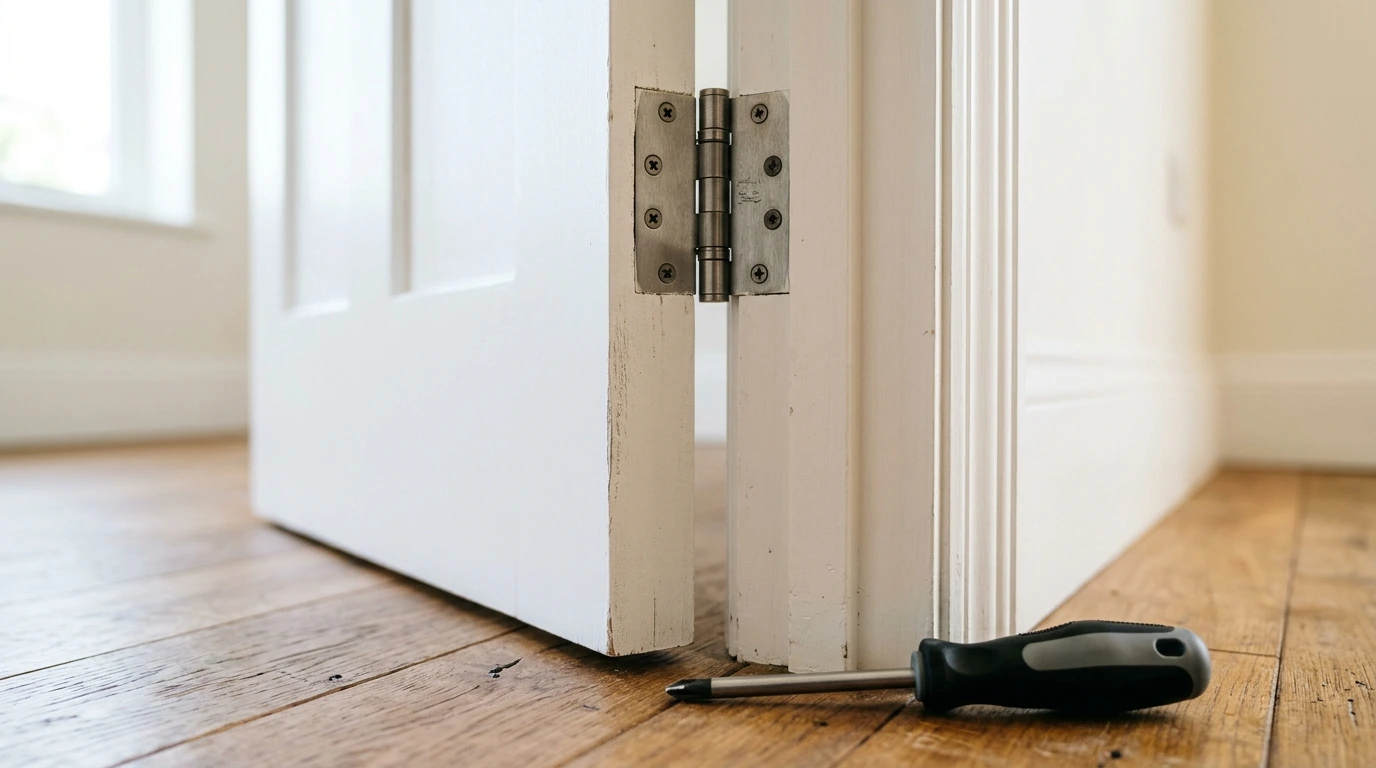
A sagging door is one of those small problems that slowly gets worse: first it rubs at the top corner, then the latch stops catching, then a draft appears along the edge. The good news is that a sagging door fix is often simple once you know the cause. This guide explains why doors drop or stick on their hinges in Quebec homes, how to diagnose the problem and which repairs you can do yourself before calling in a professional.
Signs Your Door Is Sagging or Out of Adjustment
A door that hangs correctly has an even gap all around it, roughly the thickness of a coin, between the slab and the frame. When the door starts to sag, that gap closes on one side and opens on the other. The classic pattern is a door that drops on the latch side: it rubs at the top corner farthest from the hinges, while a wider gap appears near the top hinge.
Most homeowners notice the symptoms long before they notice the sag itself. The door has to be pushed or lifted to close, the deadbolt needs a little jiggle to slide into the strike, or the weatherstripping is worn in one spot. On an exterior door, you may see daylight at a corner or feel cold air along one edge in winter.
- Rubbing or scuff marks: worn paint at the top latch-side corner of the door or the frame.
- Uneven gaps: wide at the top near the hinges, tight at the top on the latch side.
- Latch or deadbolt trouble: you must lift, push or pull the door for the bolt to engage.
- Drafts and light: daylight or cold air at one corner of an exterior door.
- A door that moves on its own: it drifts open or closed when you let go.
What Causes a Door to Sag or Rub
The most frequent culprit is the top hinge. It carries most of the weight of the door, and its screws often bite only into the thin jamb rather than into the framing behind it. Over years of opening and closing, those screws loosen or strip their holes, and the door slowly pivots downward on the latch side.
Weight makes it worse. Solid doors, doors with large glass inserts and exterior doors with heavy hardware put more strain on the hinges than a hollow interior door. Worn hinge pins add play, and children swinging on the handle or heavy bags hung on the door speed up the wear.
In Quebec, the seasons play a role as well. Wood doors and frames absorb humidity in summer and swell, then shrink in the dry heated air of winter, so a door that rubs in July may close perfectly in January. Freeze-thaw cycles and settling can also shift the frame itself, especially in older homes, and a frame that is no longer square makes any door look like it is sagging.
How to Diagnose the Problem Before You Adjust
Before grabbing a screwdriver, take a few minutes to find out exactly where the door binds. Close it slowly and watch where it touches first. Look for shiny or scuffed spots on the edge of the door and on the frame, then slide a sheet of paper around the perimeter: where it drags or catches, the gap is too tight.
Next, open the door halfway and gently lift the handle side. If the door moves up and you see the top hinge shift or hear it click, the hinge or its screws are loose. If nothing moves but the door still rubs, the issue may be the frame, the strike plate or swelling of the slab itself.
Finally, check the frame for square with a tape measure. Measure the two diagonals of the opening from corner to corner; if they differ noticeably, the frame has racked. A level held against the hinge-side jamb also tells you whether it is still plumb. These checks show whether you are facing a simple hinge adjustment or a bigger problem.
Sagging Door Fix: Step-by-Step Repairs
Most sagging doors can be corrected with a few simple tools and a little patience. Work from the simplest fix to the most involved, and test the door after each step.
When the screws in the top hinge are stripped, a common approach is to replace one jamb-side screw with a longer screw that reaches the wall framing behind the jamb. Drawing that hinge tight into the framing pulls the top of the door back toward the hinge side and lifts the latch corner. Be careful not to overtighten, which can bow the jamb; on an exterior door, first check that there is solid shimming behind the jamb at that spot. Match the screw finish to the hinge for a clean look.
- Tighten every hinge screw: start with the top hinge, on both the door side and the jamb side.
- Repair stripped holes: fill them with wood glue and wooden matches or a small dowel, let it dry, then drive the screw back in.
- Shim the bottom hinge: a thin cardboard shim behind the jamb-side leaf of the bottom hinge pushes the bottom of the door toward the latch side, which tilts the top latch corner back up.
- Adjust the strike plate: if the door hangs correctly but will not latch, file or shift the strike slightly.
- Plane only as a last resort: trim a swollen wood door only once the hinges are tight, and seal the bare edge afterward.
Adjusting Exterior, Patio and Garden Doors
Modern pre-hung exterior doors in steel or fibreglass swell less than wood, but they are heavier and rely on precise alignment to compress their weatherstripping. Some have adjustable hinges that allow small corrections with a hex key. If yours do, read the manufacturer's instructions before making changes, since a small turn goes a long way. Steel and fibreglass slabs should not be planed: if one rubs, look at the hinges, the alignment or the frame instead.
Patio sliding doors do not hang on hinges, but they can sag in their own way. The rolling panel sits on adjustable rollers at the bottom, and when those rollers wear or drop, the panel drags on the track, leaves a gap at the top and stops locking properly. Cleaning the track and adjusting the roller screws at the base of the panel often restores a smooth glide. The panel is heavy glass, so if it has to be lifted out of the track, get a second person or leave the job to a professional.
Hinged garden doors combine both challenges: a wide, heavy glazed panel on hinges and a long weatherstrip that must seal evenly. Because the glass adds weight, the top hinge is under constant stress. Checking the hinge screws every fall is a simple habit that helps these doors keep sealing evenly through the winter.
When the Hinges Aren't the Real Problem
Sometimes no amount of hinge work will make a door close properly. A frame racked by settling, a warped slab or a jamb softened by rot at the bottom will keep pushing the door out of alignment. Water damage is especially common on exterior doors, where snow and meltwater sit against the threshold all winter.
Look closely at the bottom of the jambs and at the sill. Soft wood, peeling paint, dark stains or a threshold that flexes underfoot point to water infiltration. A door whose glass insert is foggy or whose skin is dented and separating may also be near the end of its useful life, even if the hinges are fine.
In those cases, repairing the frame or replacing the complete door unit usually makes more sense than adjusting it again and again. A new pre-hung door is installed with its own frame, squared and shimmed in the opening, with the aim of even gaps and a continuous seal from day one. You can browse the styles on our doors page.
- Rot in the jamb or sill: the hinge screws have nothing solid to bite into.
- Warped slab: the door touches the stop at the top or bottom but not in the middle.
- Frame out of square: the diagonals differ noticeably and adjustments do not hold.
- Adjustments needed every season: a sign of movement in the wall or a failing frame.
Getting Your Door Assessed: Free Estimate
A sagging door is rarely urgent, but it is worth dealing with before winter. A door that does not close squarely lets cold air in, wears out its weatherstripping and puts extra strain on the lock. Small adjustments in the fall can help you avoid a frozen latch or a draft in January.
If you have tightened the hinges and the door still rubs, or you suspect rot or a frame problem, a professional assessment will tell you whether repair or replacement makes more sense. Unisson Groupe manufactures and installs windows and doors and serves homeowners across Greater Montreal from Saint-Laurent. Request a free in-home estimate to go over the door, the frame and the possible options together.
Frequently Asked Questions
Why does my door rub at the top corner?
A door that rubs at the top corner on the latch side is usually sagging because the top hinge has loosened. Tightening the top hinge screws, or replacing one with a longer screw that reaches the framing, often pulls the door back into place.
Why does my door stick in summer but not in winter?
Wood doors and frames absorb humidity in summer and swell, then shrink in the dry heated air of winter. If the door only sticks in humid weather, wait for a dry spell before planing, and seal any bare wood so it absorbs less moisture.
How do I fix stripped hinge screw holes?
Fill the hole with wood glue and a few wooden matches or a small dowel, let it dry and trim it flush. Then drive the screw back in.
Can I fix a sagging door myself?
Many sagging doors can be fixed with a screwdriver, some wood glue and a few shims. If the frame is out of square, the jamb is rotten or the problem returns after every adjustment, it is better to have the door assessed by a professional.
When should a sagging door be replaced?
Replacement is worth considering when the frame or sill is rotten, the slab is warped, the glass insert is foggy or adjustments no longer hold. A new pre-hung door comes with its own frame and is installed square in the opening.