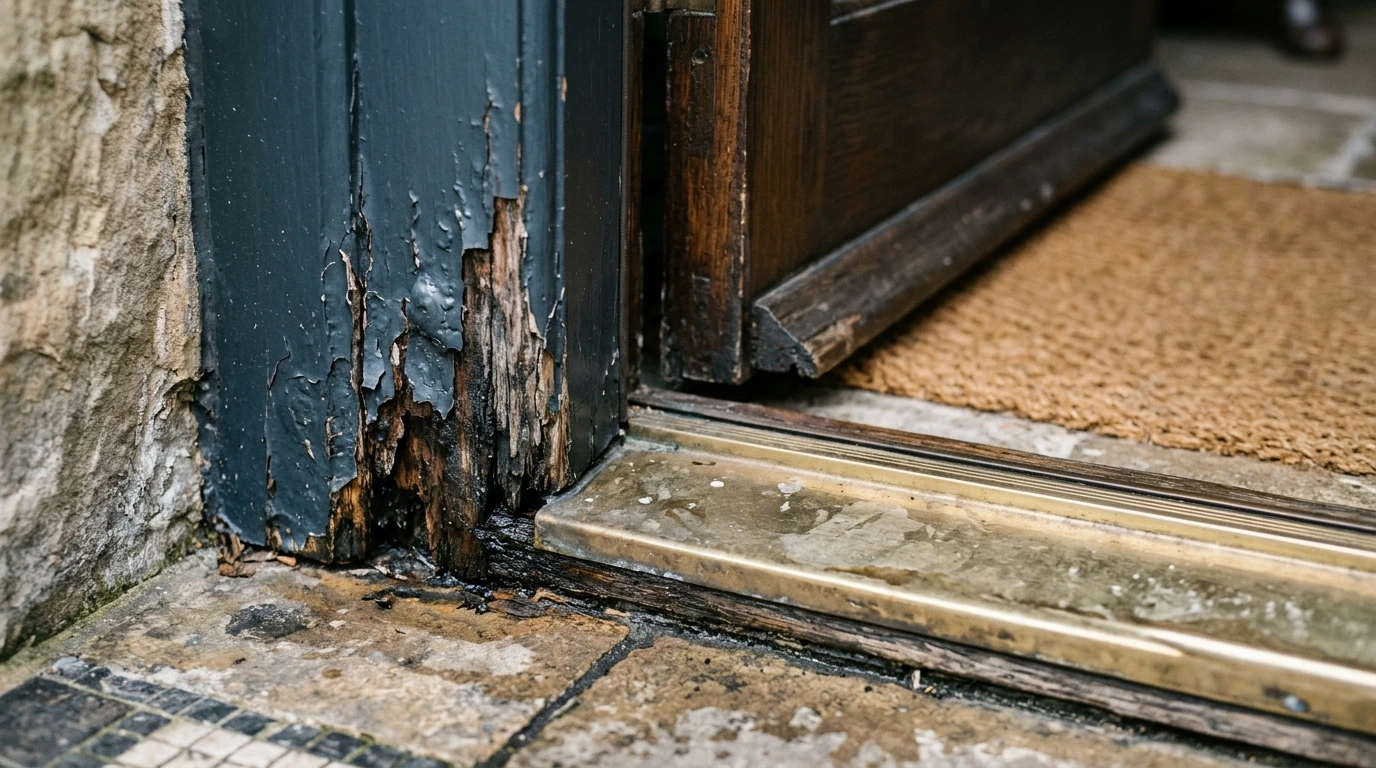
A rotten door frame rarely appears overnight. It starts as a bit of peeling paint at the bottom of a jamb, a sill that feels spongy underfoot or a door that suddenly drags, and it grows quietly every time snow melts against the threshold. In Quebec, where entry and patio doors sit in slush for months, rot at the base of the frame is one of the most common door problems. Here is how to recognize it, understand what causes it and decide whether to repair or replace.
The Parts of a Door Frame That Rot First
A door frame is more than the visible trim. It is made of two side jambs, a head jamb across the top, a sill or threshold at the bottom, and the exterior brick mould or casing that covers the joint with the wall. On older homes, most of these parts are solid wood, sometimes only protected by paint.
Rot almost always starts low. The bottom few inches of the side jambs and the ends of the sill are where water collects, where snow piles up and where the end grain of the wood is exposed. End grain absorbs water much like a bundle of straws, so once paint or caulking fails at that spot, moisture travels up into the jamb from below.
The brick mould and the exterior casing are the next weak point, especially at the corners where two pieces meet. A small open joint lets rain run behind the trim, where it stays out of sight and keeps the wood damp for weeks.
Signs of a Rotten Door Frame
The first clues are usually cosmetic: paint that blisters or peels near the floor, dark stains on the jamb or a line of mildew along the sill. Do not dismiss them as simple wear. Paint fails on rotten wood because the wood underneath is staying wet.
Function changes next. As the base of a jamb softens, the hinges and the strike plate can shift slightly, and the door starts to rub, sag or need a push to latch. You may feel a new draft at the bottom corner or see daylight where there was none before. Inside, look for stained or lifting flooring near the threshold and swollen baseboards on either side of the door.
- Soft or spongy wood when you press it with a thumb or a screwdriver
- Peeling or blistering paint at the bottom of the jambs or along the sill
- Dark staining, mildew or a musty smell near the threshold
- A door that suddenly sticks, sags or will not latch easily
- Gaps between the brick mould and the wall, or cracked caulking at the corners
- Water stains or soft spots on the floor just inside the door
What Causes Door Frame Rot in Quebec Homes
Wood rots when it stays wet long enough for fungi to grow. In a Quebec climate, the usual sources are snow that sits against the door all winter, meltwater that runs toward the threshold, and spring and fall rain driven against an unprotected entrance. Each freeze and thaw opens small cracks in paint and caulking, letting in a little more water each time.
Installation details matter as much as the weather. Doors set without a sill pan or proper flashing underneath can allow water to reach the subfloor. A missing drip cap above the head jamb lets rain run straight into the top of the frame. A deck or a landing that slopes toward the house sends water to the door instead of away from it.
Inside, condensation can also play a role. A poorly insulated door with worn weatherstripping gets very cold, and warm, humid indoor air can condense and even freeze on the inside of the frame, then soak in during milder days.
How to Check How Far the Rot Goes
Before deciding anything, find the edges of the damage. Probe the wood with an awl or a small screwdriver, starting at the bottom and working up. Healthy wood resists and the tip barely enters; rotten wood gives way, feels fibrous or crumbles. Mark the point where the wood becomes firm again on each jamb.
Then check the sill and the threshold, the corners of the brick mould and, if you can see it, the subfloor below the door. Press on the floor just inside the threshold. A soft or bouncy feel suggests that water has reached the structure, which changes the scope of the job considerably.
Finally, look at the door slab itself. Steel doors can rust from the bottom edge, and older wood doors can delaminate or swell. If the slab is damaged or very old, it often makes more sense to deal with the whole unit at once.
Repairing a Rotten Door Frame: When It Works
Small, localized damage can often be repaired. If the rot is limited to a few inches at the bottom of one jamb and the wood above is sound, the damaged section can be cut out and replaced with a new piece of wood or a rot-resistant composite, joined carefully and sealed. Shallow soft spots can be treated with a wood consolidant and filled with an exterior epoxy filler, then primed and painted.
A repair only lasts if you also fix the cause. If water keeps reaching the same spot because of a missing drip cap, a sloped landing or a failed sill, the new wood will eventually suffer the same fate. Seal all end grain, use exterior-grade products and keep a small gap between the bottom of the trim and the landing so it does not sit in water.
- Good candidates: rot limited to the lower end of one jamb or a short piece of brick mould.
- Poor candidates: soft sill, rot on both jambs, damaged subfloor or a door that no longer closes square.
- Essential step: correct the source of water before or during the repair.
When to Replace the Whole Door and Frame
Replacement becomes the better choice when the rot affects several parts of the frame, when the sill is soft, when the subfloor is damaged, or when the door is drafty, worn and hard to adjust. Patching an old frame around an old door keeps the original weaknesses in place, including a threshold that may never have been designed to shed water properly.
A full replacement lets the installer remove the old unit, inspect and repair the rough opening, install a sill pan and flashing, and set a new pre-hung door that is level, square and sealed. Many current exterior doors are available with frames that use composite or PVC components at the bottom, which absorb far less water than wood; ask what the lower jambs and sill of each model are made of.
The same logic applies to rear entrances. If the frame around a patio door or a garden door is rotting at the sill, the problem is usually tied to how water drains across the threshold, so a new unit with a well-designed sill, installed with a sill pan, can address the rot and the drainage at the same time. You can see finished door projects in our gallery.
Preventing Future Rot and Getting a Free Estimate
Whatever you decide, a few habits protect the frame. Clear snow away from the door after each storm, keep caulking joints intact around the brick mould, make sure gutters above the entrance work and that any landing slopes away from the house. Repaint bare wood before winter, paying special attention to end grain at the bottom of the jambs, and check the corners of the trim each fall.
A small soft spot at the bottom of one jamb is often a manageable do-it-yourself repair. It is time to call a professional when the sill or the floor inside feels soft, when both jambs are affected, or when the door no longer closes square, because the rough opening may need work too.
Unisson Groupe manufactures and installs windows and doors and is based in Saint-Laurent, Montreal. If you are unsure whether your frame can be saved, you can request a free in-home estimate and have the frame, sill and door looked at together, so you can weigh a repair against a replacement with the full picture in front of you.
Frequently Asked Questions
Can a rotten door frame be repaired without replacing the door?
Yes, when the rot is limited to a small area, such as the bottom few inches of one jamb or a piece of exterior trim. The damaged wood is cut out and replaced or treated with consolidant and epoxy filler. If the sill, both jambs or the subfloor are affected, replacing the whole unit is usually more sensible.
Why is only the bottom of my door frame rotting?
The bottom of the jambs is where snow, meltwater and rain collect, and where the end grain of the wood is exposed. Once paint or caulking cracks there, water wicks up into the jamb. A missing sill pan or a landing sloping toward the house makes it worse.
How do I know if water has damaged the subfloor?
Press on the floor just inside the threshold and look for stains, lifting flooring or a soft, bouncy feel. Musty odours near the door are another sign. If you suspect subfloor damage, have it inspected when the door is removed so the opening can be repaired properly.
Is a rotten door frame a problem for energy efficiency?
It can be. As rot softens and distorts the frame, the door may no longer press evenly on its weatherstripping. That can create drafts and cold spots, often at a bottom corner, and let more moisture into the wall.
How much does it cost to replace a rotten door frame?
It depends on the extent of the damage, the type of door and whether the opening or subfloor needs repairs. The only reliable answer is a quote based on your actual door. You can request a free in-home estimate to get one.