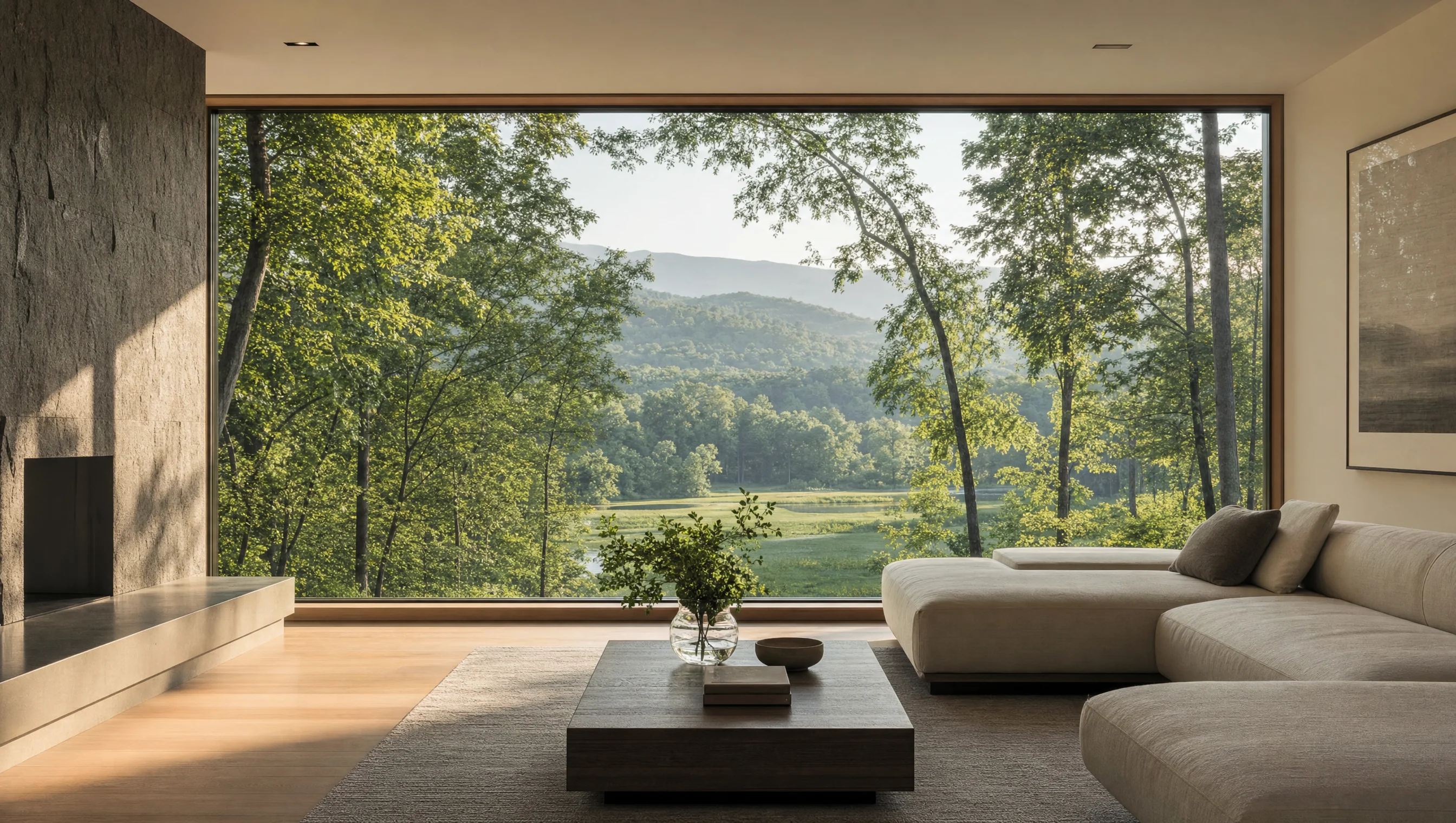
A single well-placed picture window can change how an entire room feels — turning a blank wall into a living frame for your backyard maples, the river, or the city skyline. Here is how to specify, size, glaze, and locate fixed windows that flood your home with daylight without turning it into a greenhouse.
What Makes Picture Windows Different
Picture windows are fixed, non-operating units engineered to do one thing supremely well: deliver an unobstructed view and the maximum possible daylight. Because they have no hinges, locks, or operating hardware, almost the entire opening becomes glass, and the sightline is uninterrupted by the chunky sash a casement or slider needs to function.
That lack of moving parts brings a real performance bonus. With nothing to open, a picture window has no weatherstripping gaps to fail over time, so it offers the tightest air seal of any window type — an advantage that matters in a Quebec winter when a −20°C wind is searching for any leak. Fixed units also tend to post a marginally lower U-factor than comparable operable windows, because there is no movable sash to conduct heat.
The trade-off is obvious and intentional: a picture window does not open, so it provides no ventilation. That is why these units are almost always specified as part of a composition rather than alone — the fixed pane handles the view and the light, while operable windows nearby handle the fresh air. Understanding that pairing is the key to using them well.
Where Picture Windows Work Best
Picture windows earn their place wherever the view or the daylight is the star and ventilation can be handled elsewhere. In Quebec homes, certain locations come up again and again because they pair a compelling outlook with a wall that can carry a large expanse of glass. The goal is to frame something worth looking at — a treed backyard in N.D.G., a water view in the West Island, a downtown skyline from a Plateau condo.
Use the list below as a starting point, then walk each room at different times of day to confirm how the light and view actually behave before you commit to glass size and placement.
- Living and dining rooms that face a strong view — the classic home for a large picture window
- Stairwells and double-height entrances, where a tall fixed unit floods two storeys with light
- Above kitchen sinks, paired with awning windows so you keep the view and still get venting
- Bedrooms facing a private, treed backyard where privacy is not a concern
- Master ensuite bathrooms, using obscure or frosted privacy glass to keep light while blocking sightlines
Glazing Big Glass for the Quebec Climate
A large pane of glass is a large opening in your thermal envelope, so the glazing spec matters even more on a picture window than on a small one. For Quebec, a triple-pane build with two Low-E coatings and an argon or krypton fill is the sensible default on any sizable fixed unit — it holds a low U-factor near 0.18 to fight winter heat loss while keeping the SHGC controlled so a south- or west-facing wall of glass does not overheat the room in July.
SHGC deserves special attention here precisely because the glass area is so large. A picture window on a west-facing living room can become a solar oven without a low SHGC of 0.25–0.30, while a north-facing unit can run a higher SHGC to welcome free winter warmth. The same orientation logic that applies to ordinary windows applies with extra force when the glass is this big.
Comfort near the glass is the other reason to spend on glazing. With a single or double-pane unit, the cold interior surface of a large window radiates a chill that makes the nearby seating area unpleasant in winter and drives condensation. A warm-edge spacer and triple glazing keep the inner pane warmer, so a sofa placed right against a picture window stays comfortable even on the coldest nights.
- Specify triple-pane with two Low-E coatings for any large fixed unit in Quebec
- Tune SHGC by orientation — low (0.25–0.30) on west, higher on north
- Insist on a warm-edge spacer to keep the inner glass warm and prevent condensation
- Choose ENERGY STAR Zone D certified glass to stay rebate-eligible
Sizing Limits and Building Code in Quebec
There are real limits on how big a single fixed pane can go. Most residential picture windows top out around 1.2 m × 1.8 m before structural, weight, and shipping constraints come into play — a unit that size in triple glazing already weighs enough to require two or three installers to set safely. Beyond those dimensions you move into specialty territory with engineering and handling implications.
Quebec’s building code adds safety requirements that shape large and low windows. Glass that sits close to the floor, next to a door, or in any location where a person could fall against it must be tempered or laminated safety glass — tempered shatters into harmless pebbles, while laminated holds together on a tear-resistant interlayer and adds useful sound and security benefits. Your installer should flag which openings trigger these rules.
Very large or very tall picture windows may also need a wind-load review, because a big rigid pane catches a lot of force in a gust. This is routine engineering, not a red flag, but it is one more reason to work with an established, RBQ-licensed installer who handles the calculations and the permit paperwork rather than improvising on site.
Pairing With Operable Units
Because a fixed pane provides no airflow, the smart move is to design the picture window into a multi-unit composition that restores ventilation without breaking the view. The most common and most satisfying Quebec layout is a large central picture window flanked by two casement windows, which crank fully open to scoop in a breeze while the fixed centre keeps the sightline clean.
A second classic pairing places a picture window above the kitchen sink with an awning window below or beside it. The awning hinges at the top and opens outward, so it can stay open during a light summer rain and vent cooking heat and humidity — a real benefit in a Quebec kitchen where winter condensation is a constant battle.
When you compose these groupings, keep the operable units on opposite or adjacent walls where possible to set up cross-ventilation, and match the frame profiles and colours so the assembly reads as one deliberate feature rather than a row of mismatched windows. A good designer treats the whole wall as a single composition.
Cleaning, Maintenance, and Longevity
A picture window’s biggest practical drawback is that it does not open, which means you cannot clean the exterior from inside the house the way you can tilt a hung window in. Plan cleaning access before installation: a ground-floor unit may be reachable with a pole and squeegee, but a tall stairwell or second-storey picture window may require a ladder, scaffold, or a professional cleaner once or twice a year. Build that into your decision.
On the upside, maintenance is otherwise minimal precisely because there is no hardware to wear out. There are no cranks to lubricate, no balances to replace, and no operable seals to compress and fail. A quality fixed unit is one of the lowest-maintenance windows you can buy, and a fibreglass or quality PVC frame will hold its shape and finish through decades of Quebec freeze-thaw cycles.
Do keep an eye on the perimeter caulking and the sealed-unit edge over the years. The single most important longevity factor for a large pane is the integrity of the insulated glass seal; a warm-edge spacer and a manufacturer warranty of 20 years or more on the sealed unit are signs you are buying glass built to last in our climate.
Design Your Picture Window Composition
Choosing a picture window is really about composing a wall: the right glass size, the right SHGC for that exposure, the right operable partners for ventilation, and a clean plan for cleaning access. Our team helps you balance all of it, with engineering and RBQ-licensed installation for the large and tall units that need it.
We will model the view, the daylight, and the summer heat for your specific exposure and bring you a design that frames what matters. Request a free design consultation and see what a picture window could do for your favourite room.
Frequently Asked Questions
Are picture windows more energy efficient?
Yes. With no operating hardware there are no weatherstripping gaps to fail, so picture windows offer the tightest air seal of any type, and the fixed sash usually posts a slightly lower U-factor than a comparable operable unit. In triple-pane form they are among the most thermally efficient windows you can install in Quebec.
Can I make a picture window taller than 1.8 m?
Yes, but it moves into specialty territory: taller units typically require tempered or laminated safety glass and a structural or wind-load review, and they get heavy enough to need a multi-person install. Floor-to-ceiling picture windows are popular in new builds, where the framing can be engineered for them from the start.
Do picture windows need cleaning access?
Yes — because they do not open, you cannot clean the exterior from inside, so plan access before installation. A ground-floor unit may need only a pole and squeegee, while a tall stairwell or upper-storey window may require a ladder, scaffold, or an annual professional cleaning.
Will a big picture window make the room cold in winter?
Not if it is glazed properly for Quebec. A triple-pane unit with two Low-E coatings, argon fill, and a warm-edge spacer keeps the interior glass surface warm, so seating placed right against the window stays comfortable and condensation is minimized even on a −20°C night.
What safety glass does Quebec code require for large windows?
Glass near the floor, beside a door, or in any location where someone could fall against it must be tempered or laminated safety glass. Tempered breaks into harmless pebbles, while laminated holds together and adds sound and security benefits; your installer should identify which openings trigger the requirement.
How do I get ventilation if the picture window does not open?
Design it as a composition. The standard Quebec solution is a central picture window flanked by casement or awning units that open fully, giving you the unbroken view and the daylight from the fixed pane plus real cross-ventilation from the operable ones beside it.