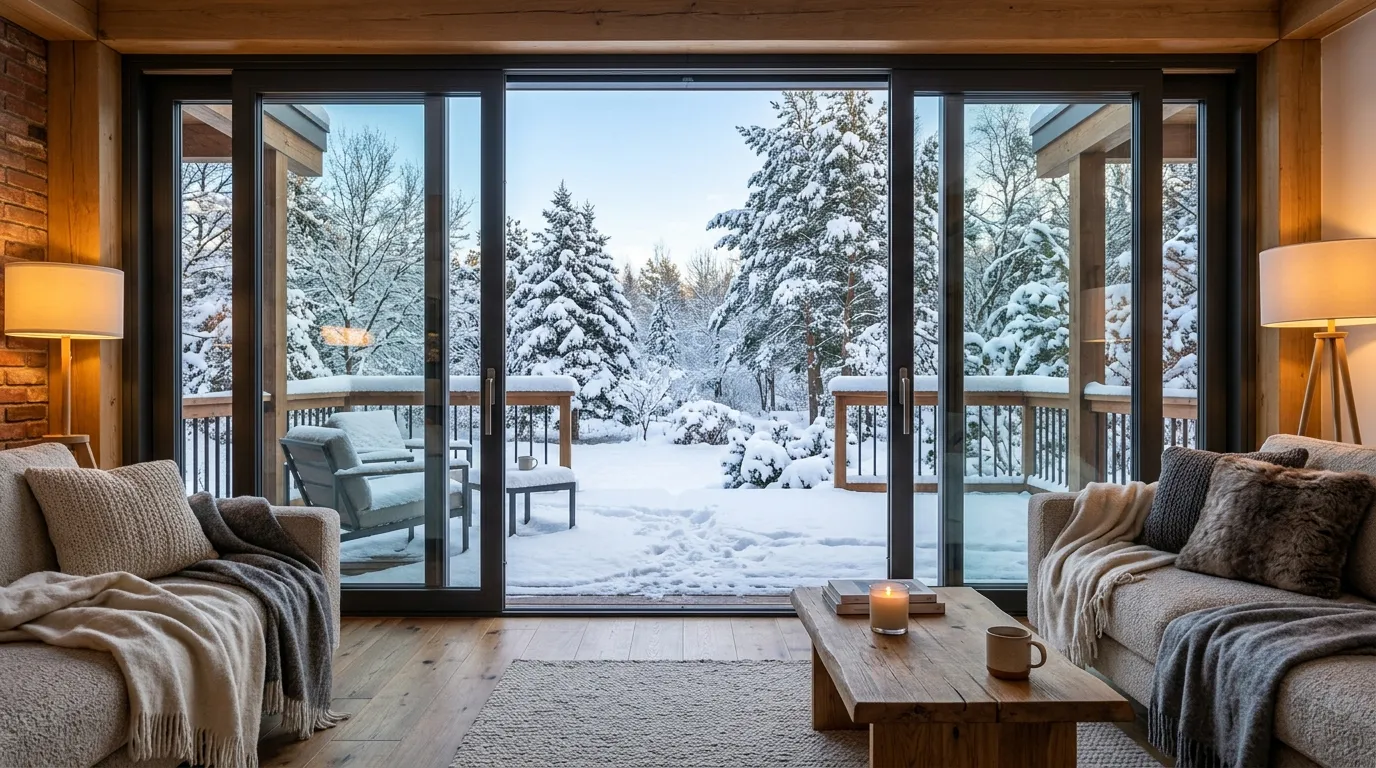
When the temperature drops below -20 °C, the patio door is usually the first opening in the house to complain. The track fills with ice, the latch refuses to turn, a thin draft finds its way through the middle of the door and a line of water or frost appears along the bottom of the glass. Most of these problems have simple causes and simple fixes, and a few are honest signs that the door has reached the end of its life.
Why patio doors struggle more than windows in a Quebec winter
A patio door is essentially the largest operable window in the house, and it sits at floor level, where cold air pools and snow piles up. It is opened dozens of times a week, often by kids and pets, so its seals and hardware wear faster than those of any window. It also has more linear metres of seal than almost any other opening, and each metre is a place where air can leak or moisture can freeze.
Sliding doors add a particular challenge: the moving panel must glide, so its seals are brush-type pile or pads that rely on precise alignment. When the house settles a few millimetres or the panel drops on worn rollers, that alignment is lost and cold air follows. Hinged patio doors (garden doors) seal differently, with compression gaskets on all four sides, but their threshold and latch are just as exposed to snow and ice.
Understanding which part of the door is doing what makes troubleshooting much easier. The frame, the sill and track, the panels, the interlock where two panels meet, the seals and the locking hardware each fail in their own recognizable way, and each has its own fix.
Ice in the track and a frozen latch
Ice in the bottom track almost always starts as water: snow melting off boots, rain driven against the glass, or condensation running down the inside of the panel. If the track's weep holes are blocked by grit, leaves or old sealant, that water has nowhere to go and freezes overnight. The first fix is simple: vacuum the track in the fall, then check that each weep slot on the exterior face of the sill is open using a thin plastic tool, never a metal pick that could scratch the finish.
When the door is already frozen shut, resist the temptation to force it or pour hot water in the track. Hot water refreezes deeper in the sill within minutes, and forcing the handle can bend the latch or crack the keeper. A hair dryer on low, held a few centimetres from the track and the lock edge, frees most doors in a few minutes; then wipe the track dry and move the door slightly to break the bond.
A latch that turns stiffly only in cold weather usually needs a dry silicone or graphite lubricant, not an oil that thickens and attracts dirt. If the latch no longer lines up with the keeper at all in January but works fine in July, the panel or frame is shifting with frost or the rollers are worn, and that is an adjustment rather than a lubrication problem.
- Vacuum the track and clear the weep holes before the first freeze
- Keep a path shovelled against the exterior sill so snowmelt does not sit against the door
- Use a dry silicone spray on the latch and track, never a thick grease
- Thaw gently with a hair dryer on low, then dry the track completely
Drafts at the interlock and along the edges
On a sliding patio door, the interlock is the vertical meeting point where the moving panel hooks into the fixed panel. It is the single most common source of drafts, because it depends on both panels being perfectly plumb and at the right height. If you feel cold air on the back of your hand in the middle of the door, look closely at that joint: are the pile seals flattened, is daylight visible, does the gap change from top to bottom?
Many interlock drafts come from a panel that has dropped on its rollers. Most sliding doors have adjusting screws at the bottom of the moving panel, behind small caps, that raise or lower each roller. Raising the panel a quarter-turn at a time until it meets the interlock evenly often cures the draft completely, and it makes the door glide more easily at the same time.
Along the vertical edges and the top of a sliding door, worn pile seals can usually be replaced, provided you find the right profile. On hinged patio doors, drafts at the edges generally mean the door slab needs a hinge adjustment or the compression gasket has lost its memory. The paper test is simple: close the door on a sheet of paper at several points, and if the paper slides out without resistance, the seal is not doing its job at that spot.
Condensation and frost along the bottom of the glass
A band of condensation or frost along the bottom of a patio door is one of the most common winter complaints. The bottom of the glass is the coldest part of the unit, because the chilled air falling down the pane collects there and the spacer that separates the panes conducts a little heat out at the edge. When indoor humidity is high, that cold edge is the first place where the water vapour in the room reaches its dew point.
Before blaming the door, look at the house. Indoor relative humidity around 30 to 35% is a reasonable target when it is -20 °C outside; showers, cooking, drying laundry indoors and a humidifier set too high can easily push it well above that. Heavy drapes or a floor-length blind closed tightly over the door trap cold air against the glass and make condensation much worse, so leaving a gap at the bottom for warm air to circulate often helps.
Where the door itself is at fault, the signs are different. Condensation or fogging between the panes means the sealed unit has failed and the glass must be replaced, while frost on the frame or on the metal parts of the sill points to a door without an adequate thermal break. A modern high-performance door with a warm-edge spacer and a well-insulated frame keeps the inside glass surface noticeably warmer at the bottom edge, which is exactly where the problem shows up.
Snow against the sill and a leaking threshold
Snow drifting against a patio door is not only a nuisance. As it melts in the afternoon sun and refreezes at night, it can push water past the sill and into the subfloor. Keeping a shovelled strip in front of the door and clearing the deck right up to the sill is the simplest protection, and on a balcony where snow builds up above sill height, a small canopy or open deck boards in front of the door give meltwater somewhere to go.
Watch for signs that water is already getting past the threshold: swollen or stained flooring near the door, loose tiles, a musty smell or dark marks at the bottom corners of the interior trim. These point to a sill that is not sloped correctly, a failed seal under the door, or a door installed without a proper sill pan beneath it. None of these is solved with a new bead of sealant on the outside; they call for a closer look at the installation itself.
Adjustment or end of life: how to tell the difference
Most winter patio door issues are adjustments: a dropped panel, clogged weep holes, a dry latch, flattened pile seals or a hinge that needs a turn. If the door moves easily once adjusted, the glass is clear and the frame is sound, a little maintenance can give it many more years. The question is not the age of the door alone, but whether its parts can still be brought back into alignment and sealed.
Some signs, however, point to a door that has reached the end of its useful life. Fogging between the panes, a frame that is cracked, warped or rotted, rollers that can no longer be found for an older model, or an aluminum frame with no thermal break that frosts over from the inside every cold night are all problems that adjustments will not solve. The same applies to a door that has been adjusted to the limit and still shows daylight at the interlock.
- Usually an adjustment: panel dragging or hard to slide, draft at the interlock, stiff latch, clogged weep holes, a single worn seal
- Often a repair: broken rollers on a current model, a damaged handle or lock, one sealed glass unit that has fogged
- Usually end of life: warped or rotted frame, fogging in several panels, water damage under the sill, frost on the frame from the inside, no parts available
Choosing a patio door built for Quebec winters
If replacement makes sense, a few features make the biggest difference in cold weather. Look for a low U-factor for the whole door, not just the centre of the glass, along with a warm-edge spacer, an insulated or thermally broken frame and multiple lines of weather seals. ENERGY STAR certification for the colder climate zones is a good baseline for most of Quebec.
Hardware and sill design matter as much as glass. A sill with a proper slope and generous drainage, tandem stainless steel rollers on sliding models and a multipoint lock that pulls the panel tight against its seals will all perform better at -25 °C than basic hardware. For hinged doors, an adjustable threshold and compression gaskets on all four sides help keep the seal tight as the house moves through the seasons.
Unisson builds its patio doors in Saint-Laurent for exactly this climate, in sliding and hinged configurations, and installs them with our own crews over a properly sealed and drained sill. The exact figure for your project depends on the size, glass and configuration you choose; the best way to know is to request a free estimate and let us look at the opening in person.
Frequently Asked Questions
Is it safe to use salt or de-icer on a frozen patio door track?
No. Salt and most chemical de-icers can corrode metal parts, damage rollers and leave residue that attracts more water. Use a hair dryer on low to thaw the track, then dry it completely and keep the track and weep holes clean.
Why does my sliding door only stick in winter?
Cold weather slightly changes the dimensions of the frame and the house, and ice or grit in the track adds friction. If the door is also hard to move in summer, the rollers are probably worn or the panel has dropped and needs an adjustment.
Is condensation at the bottom of my patio door normal?
A little on very cold mornings can be normal, especially with high indoor humidity. Heavy, persistent condensation or frost, or any fogging between the panes, points to a humidity issue in the home or a door whose glass or frame is no longer performing.
Can a patio door be installed in winter?
Yes. Unisson installs year-round. The crew removes the old door, then installs and seals the new one the same day, so the opening is never left exposed overnight.
Sliding or hinged: which is better in cold weather?
Both can perform very well when properly built. Hinged doors generally seal more tightly with compression gaskets, while sliding doors save floor space and are easier to use in tight areas. The right choice depends on your room layout, your deck and how you use the door.
How much does a new patio door cost?
The exact figure depends on your project: size, configuration, glass package, colour and the condition of the opening. Request a free estimate and we will give you a precise quote for your door.