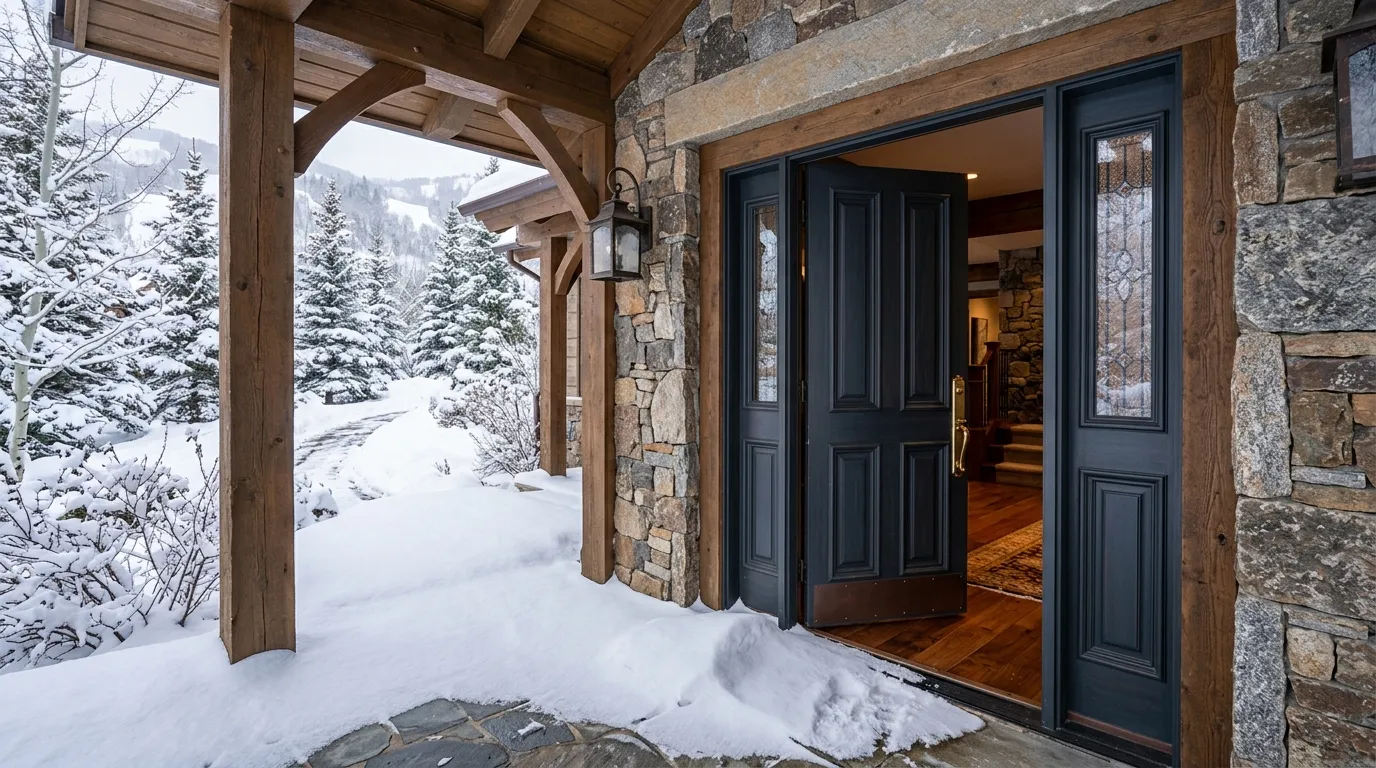
Ask ten door installers in the Montreal area which way an entry door should swing and nine will say inward without pausing. Ask the same question in Florida and you get the opposite answer. Both are right for their climate, and the reasons are worth understanding before you order a door, because swing direction affects how the door seals against wind, how it behaves after a 30-centimetre snowfall, how it is secured, and what happens at the threshold every time the temperature crosses zero.
Why Quebec Homes Default to Inswing
The case for inswing in a snow climate is simple physics. An inward-opening door can always be opened, no matter what has piled up outside it. After a February storm that leaves 30 cm on the step and a drift twice that against the door, you open it, step out and shovel. An outswing door in the same situation is blocked until someone clears the snow from the outside, or until you exit through the garage and walk around.
Ice is the subtler problem. Freeze-thaw cycles — Montreal averages more than 60 days a year that cross 0 °C — leave a layer of ice on the step exactly where an outswing door needs to sweep. A door that opens over ice either will not open at all or grinds its sweep against it and tears the weatherstrip. Inswing doors sweep over the interior floor, which is dry and warm.
There is also a hundred years of habit. Storm doors and screen doors open outward, so the primary door has to open inward for the two to coexist. Most Quebec homes built before 2000 have a storm door, and most homeowners keep them. An outswing entry door cannot take a conventional storm door at all, which alone settles the question for many buyers.
What an Outswing Door Does Better
Outswing doors exist because they solve real problems. The biggest is wind. When a winter gust hits an inswing door, it pushes the door away from its weatherstrip and toward the interior; the latch and hinges hold it, but the seal compression relaxes, and cold air comes through at the corners. The same gust on an outswing door presses the slab into its stops and tightens the seal. On an exposed northwest wall, or in open areas like the South Shore, Lanaudière farmland or the Gaspé coast, that difference is measurable in comfort.
The second is space. An inswing door claims a 90-degree quarter circle of your entrance hall, roughly a square metre for a 36-inch door, that has to stay clear of boots, benches and coat hooks. In a compact Montreal duplex or a Plateau entry with a straight staircase right inside the door, that square metre may not exist. Outswing gives it back.
The third is resistance to forced entry. The classic kick-in attack works because an inswing door is being pushed in the direction it wants to go, and the strike plate is the only thing resisting. An outswing door has to be pulled, and the whole jamb stop resists it. This is why commercial and institutional doors so often swing out — but it introduces a hinge problem, which we address below.
What the Code Actually Requires
The Quebec Construction Code, which adopts the National Building Code with provincial amendments, does not require a particular swing direction for the entry door of a house or a dwelling unit. Part 9 requires that a principal entrance door be at least 810 mm wide and 1980 mm high, that it be operable from inside without a key, and that any exit be unobstructed — but the direction is your choice. The rule that exit doors must swing in the direction of exit travel applies to rooms and buildings with an occupant load above 60, which is to say offices, restaurants and assembly spaces, not a home.
Where the code does bite is on the details around the door. A door serving as a required exit cannot open onto a step: the code asks for a landing on both sides, at most 25 mm below the threshold on the interior and with a sill-to-landing drop on the exterior that many municipalities limit further. An outswing door opening over an exterior landing that ices up is exactly the situation that inspectors and insurers flag.
If you live in a condominium or a multiplex with a shared corridor, the syndicate's declaration or the building's fire plan may also constrain swing direction, since a door swinging into a common corridor is a hazard. Check before ordering; it is not a code matter, but it is a legal one.
Vestibules, Tambours and Storm Doors
The traditional Quebec answer to the swing question is not to choose: it is to have two doors. The tambour — the seasonal wooden vestibule that appears on rural and older urban houses in November and disappears in April — creates an airlock in which the outer door can swing out and the inner door in. A permanent vestibule does the same thing year-round, and it is the single most effective upgrade for an entry that is drafty regardless of door quality.
If you have or want a vestibule, the outer door is the candidate for outswing. It takes the wind, and since it opens onto the exterior landing, it is the one you will clear snow from anyway. The inner door then swings into the house as usual, protected from ice and drifts, and can carry the security hardware. The two doors together outperform any single door on the market.
Without a vestibule, a storm door is the common compromise, and it forces inswing on the main door. Modern full-view storm doors with low-e glass add real insulating value in a Quebec winter and protect the main door's finish from sun and rain. If you are set on an outswing entry door, understand that you are giving up the storm door option permanently.
Securing an Outswing Door: Hinges Matter
An outswing door's hinges face the outside, and a knuckle with a removable pin is an invitation: pull the pins, lift the door off. Every reputable outswing door sold in Canada ships with security hinges, and you should verify which type. Non-removable pin (NRP) hinges have a set screw in the knuckle that locks the pin in place. Security-stud hinges add a steel stud on one leaf that engages a hole in the other when the door closes, so the door stays in the frame even with the pins removed.
The best outswing installations use both, and add a hinge-side guard or hinge caps that cover the knuckles. Combined with a multi-point lock that throws bolts at three points along the latch edge, an outswing door is meaningfully harder to defeat than an inswing one — the reason is that every attack has to pull against the frame rather than push against a strike plate.
The security hinge package adds a modest amount to the door's price, depending on finish and whether ball-bearing hinges are specified. Set against the installed cost of a fibreglass or steel entry door in the Montreal market, it is a small line item and not one to skip.
- NRP hinges: a set screw prevents the pin from being tapped out from outside.
- Security studs: a steel pin on one hinge leaf locks into the opposite leaf when closed.
- Hinge caps or guards: cover the knuckles so pins are not accessible at all.
- Multi-point lock: three latching points on the lock edge, standard on quality doors.
Thresholds and Sill Pans: Where Swing Direction Meets Water
The threshold is where inswing and outswing doors differ most in construction, and where a bad installation shows up first. An inswing door's threshold has its weatherstrip contact on the interior side of the door bottom, so water that reaches the threshold has to climb over a raised dam before it gets to the sweep. An outswing door's sweep contacts the exterior side, which means the threshold profile is reversed: a bumper or dam sits on the outside face, and water is shed outward before it reaches the seal.
In both cases, what protects the floor and the wall is the sill pan under the threshold: a formed metal or plastic tray, or a self-adhering membrane folded up at the ends and back, that catches any water passing the threshold and directs it out. Quebec's freeze-thaw cycle makes this non-negotiable. Water that gets under a threshold in November and freezes lifts the threshold, opens the joint further, and by March you have a rotted subfloor. A proper sill pan costs very little in materials and is the part of the installation you will never see.
One more outswing-specific detail: the threshold cap of an outswing door, and the exterior face of the door bottom, are fully exposed to sun and rain. Specify a composite or aluminum threshold rather than wood, and a door bottom with a replaceable sweep. Plan to replace that sweep every three to five years; it is an inexpensive part and a ten-minute job.
Making the Choice for Your House
Choose inswing if your entry is exposed to drifting snow, if you want a storm door, if you have no vestibule, or if the exterior landing is small and tends to ice. This describes most detached houses in Quebec, and it is why inswing remains the default at every manufacturer, including ours.
Choose outswing if the door is inside a vestibule or under a protected porch, if interior space at the entrance is tight, if wind-driven drafts are the main complaint, or if the door is a secondary exit to a deck or side yard where a blocked door is an inconvenience rather than a safety issue. Specify security hinges, a composite threshold and a proper sill pan, and it will serve you well.
Whichever way it swings, the door's performance depends far more on the quality of its slab, frame, weatherstrip and installation than on its direction. If you are comparing options, the exterior door range covers both configurations, and a site visit will settle the question faster than a debate.
Frequently Asked Questions
Can an outswing door take a storm door?
No. Both doors would open into the same space and block each other. If a storm door matters to you — for a summer screen or winter insulation — the main door has to swing inward.
Are outswing doors more secure?
Yes, provided they have security hinges with non-removable pins or security studs. Without them, the exposed hinges are the weak point; with them and a multi-point lock, an outswing door resists forced entry better than an inswing one because it cannot be kicked in.
Does the code require entry doors to swing inward in Quebec?
No, not for a house or dwelling unit. Swing direction is only mandated for exits from buildings with an occupant load above 60. The code does require landings on both sides and an unobstructed exit, which can work against a door that opens onto an icy step.
What happens if snow blocks my outswing door?
It stays blocked until someone clears the snow from outside. That is why an outswing door should always be under a porch roof or inside a vestibule, and why the house needs a second exit that is accessible at all times.
Can I convert my existing door to swing outward?
Not by simply rehanging it. The threshold, the frame stops and the weatherstrip profile are all reversed between the two configurations. You need a new pre-hung unit built for outswing, with its security hinges and matching threshold.
Is an outswing door drafty?
Usually the opposite: wind presses it into its stops and tightens the seal. The point to watch is the hinge side, where the weatherstrip is exposed to the weather and should be inspected every fall.