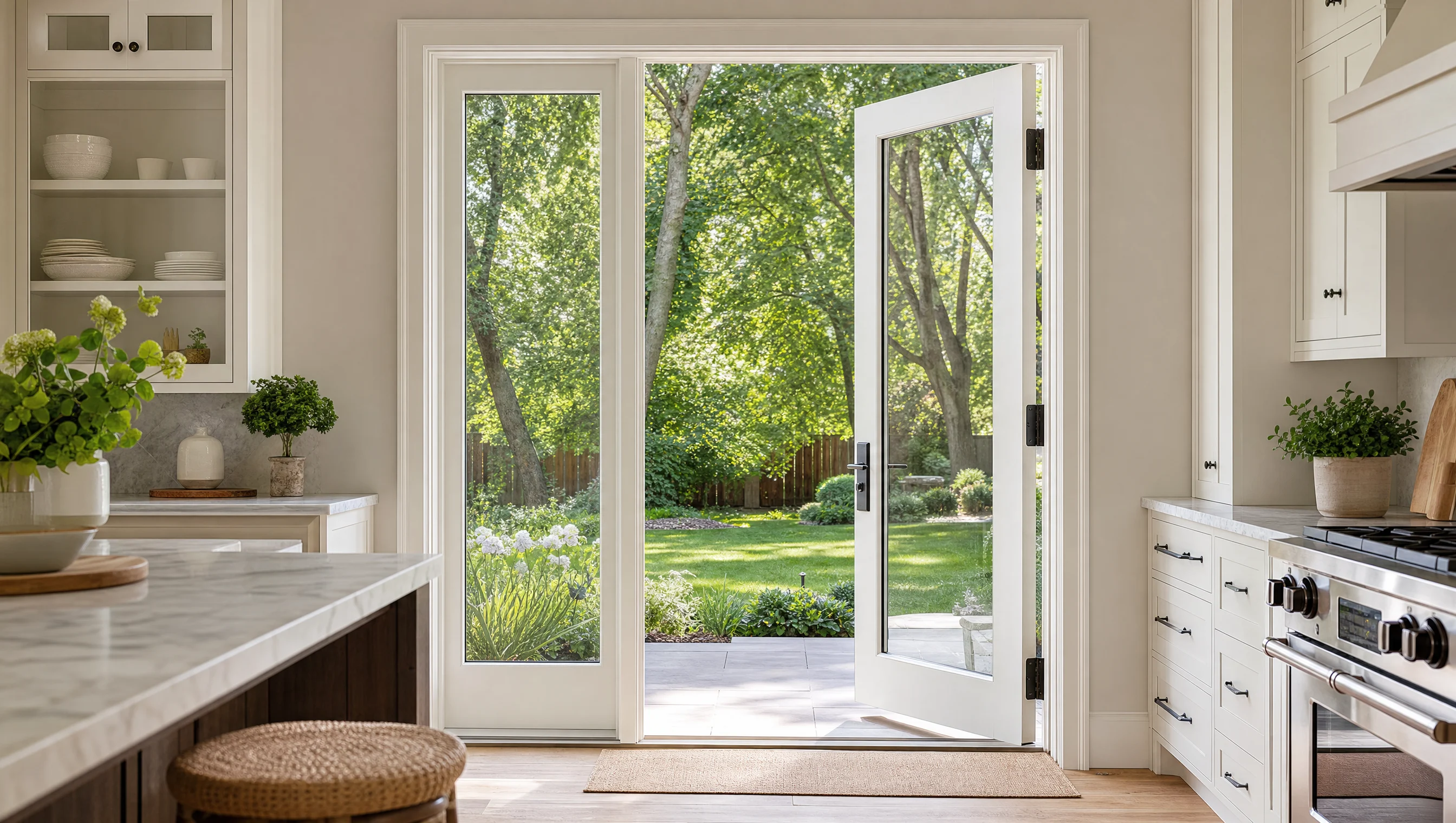
Garden doors give you the look of a French door with the practicality of a single operable panel — a popular hybrid for Quebec homes. They combine the wide glass area of a patio slider with the tight, weatherstripped seal of a hinged door, which is exactly what you want when Montreal hits −25°C with the wind chill. For thousands of homeowners from the Plateau to the South Shore, they have become the sensible middle ground between style and winter performance.
What Are Garden Doors?
A garden door pairs one fixed (stationary) panel with one hinged operating door inside a single, unified frame. From the street it reads exactly like a classic French door — two tall glazed panels, symmetrical sightlines, a traditional mullion down the middle — but only one of those panels actually moves. The other is sealed permanently into the frame, which is the secret to its excellent air-tightness.
Because only one panel swings, the hardware is simpler and the locking system has fewer points to wear out over a 30-year lifespan. The operating door closes against a continuous compression weatherstrip on three or four sides, the same principle that makes casement windows the tightest-sealing window style in Quebec. There is no bottom track for melted snow and grit to collect in, and nothing to glide off its rollers after a decade of use.
Garden doors are sometimes confused with patio doors, but the distinction matters at −10°C. A patio slider seals by sliding one panel past a brush-style weatherstrip, which is inherently leakier than a hinged panel pressed firmly into a gasket. That single difference is why garden doors consistently test better on air infiltration in the Canadian climate.
Why Quebec Homeowners Choose Them
The appeal of a garden door comes down to one idea: most households do not actually need a six-foot-wide opening on a daily basis. You walk out to the deck, you carry in groceries, you let the dog out — all of which one operable panel handles comfortably. By accepting a single moving door, you gain a noticeably warmer, tighter, and lower-maintenance entry for the other 360 days a year when you are not moving a sofa.
- Better insulation than typical sliders — the hinged panel seals against compression weatherstripping on three sides instead of brushing past a track
- Lower cost than a true French door system — one fixed panel means less hardware, simpler structure, and a smaller price tag
- Easy to operate — no bottom track to sweep, no rollers to lubricate, no panel that drags after a few winters
- Works well in narrower openings — typically 60 in. (152 cm) and 72 in. (183 cm), a common rough-opening width in Quebec homes built since the 1970s
- Eligible for rebates — an ENERGY STAR-certified garden door can qualify under federal and provincial programs alongside your window replacements
Thermal Performance in Quebec Winters
In Greater Montreal, where January overnight lows routinely sit near −15°C and the freeze-thaw cycle swings a door frame through dozens of expansion-and-contraction events each season, air-tightness is not a luxury — it is what keeps your heating bill in check. A garden door with a UPVC or composite frame, a Low-E coated double or triple glazing unit, and an argon-filled cavity delivers the kind of sealed performance that a sliding door struggles to match in the same price range.
Look for ENERGY STAR certification rated for Climate Zone D, the coldest Canadian zone that covers the Montreal area, Laval, and the South Shore. A door carrying that label has demonstrated low air leakage and a strong U-factor under tested winter conditions. For the operating panel, multi-point locking is worth the upgrade: pulling the door tight at three points (top, middle, and bottom) compresses the weatherstrip evenly and eliminates the drafty corner that single-latch doors develop over time.
The fixed panel also helps here. Because it never moves, it can be glazed and sealed to near-window standards, effectively giving you a large picture window beside your door with no operating gaps at all. In a typical Quebec living room or kitchen that opens onto a deck, this means more usable wall-to-glass area without the thermal penalty you would pay with two operating French panels.
Frame Materials and Glazing Options
Frame material drives both comfort and longevity. UPVC (vinyl) frames are the value leader for Quebec residential projects: they do not conduct cold the way aluminum does, they never need repainting, and they shrug off the humidity that pushes past 70% in a Montreal July. For wider or taller units, a composite frame — combining a fibreglass or reinforced core with a vinyl finish — adds rigidity so the door stays square through years of freeze-thaw movement.
Glazing is where you decide how the door performs. Double-pane Low-E with argon is the practical baseline and meets ENERGY STAR Zone D for most openings. Triple-pane glass adds another sealed cavity, improves the U-factor, and dampens street noise — a real benefit on a busy Plateau street or near a South Shore highway. Expect to pay roughly 15–20% more for triple glazing, with the payback showing up as steadier indoor temperatures near the door and fewer cold spots on a January evening.
- UPVC frame — best value, zero repainting, excellent thermal break for residential use
- Composite frame — added rigidity for larger units, premium finish options
- Double-pane Low-E + argon — the practical Zone D baseline for most Quebec homes
- Triple-pane glazing — better U-factor, quieter interior, ideal near busy streets
Where to Install Them
Most garden doors open onto a deck, garden, or covered porch where the household mostly enters and exits without needing both panels swung wide. They suit kitchens that lead to a backyard, family rooms that connect to a patio, and basement walkouts on sloped lots common across Laval and the West Island. The single operating panel keeps furniture and traffic flow simple while the fixed panel floods the room with daylight.
Swing direction matters in our climate. Quebec installers typically hang garden doors with an inward swing so accumulated snow and ice on the deck never block the panel from opening — an outward-swinging door can freeze shut against a drift overnight. If your deck is covered or your overhang is generous, an outward swing can work and saves interior floor space, but discuss it with your installer before ordering. Explore options on our garden doors page, or compare against a sliding patio door if your daily routine calls for a wider opening.
Cost and Rebates in 2026
A quality installed garden door in Quebec generally runs $3,000 to $5,500 in 2026, depending on size, frame material, glazing, and hardware finish. That sits below a true two-panel French door system, which adds the cost of a second operating panel, a second lockset, and the structural reinforcement larger openings demand. Triple glazing, decorative grilles, and integrated blinds-between-the-glass push you toward the upper end of the range.
Rebates can meaningfully soften that cost. When you replace an older exterior door with an ENERGY STAR-certified model, the provincial Rénoclimat program and the federal Canada Greener Homes Initiative can both apply — the latter stacking up to $5,000 across qualifying windows, doors, and insulation upgrades on the same project. Bundling your garden door with a window replacement is the smart way to maximize eligibility, and a reputable RBQ-licensed installer will handle the paperwork at no charge. Always confirm current program terms before signing, as amounts and eligibility windows change year to year.
Next Steps for Your Project
The best way to decide between a garden door, a French door, and a slider is to see them installed and operate them yourself. Frame depth, glass area, and swing feel are hard to judge from a brochure, and the right choice depends on how your specific room and deck are laid out.
Visit our showroom in Saint-Laurent to compare real installed examples, or request a free estimation for your home. We manufacture locally, certify our doors to ENERGY STAR Zone D, and back every installation with a long-term warranty and RBQ-licensed crews.
Frequently Asked Questions
Are garden doors more energy efficient than sliders?
Yes — the hinged panel seals against compression weatherstripping rather than gliding past a brush track, so it leaks less air in winter. Combined with Low-E argon glazing and multi-point locking, a garden door typically outperforms a comparably priced slider in the Quebec climate.
What size openings do garden doors fit?
Standard widths are 60 inches (152 cm) and 72 inches (183 cm), which match the rough openings in most Quebec homes built since the 1970s. Custom widths and heights are available, though larger units usually call for a composite frame to stay rigid.
Do garden doors swing inward or outward?
Both options exist, but Quebec homes typically install them with an inward swing so snow and ice on the deck cannot freeze the panel shut. An outward swing can work under a covered porch or generous overhang and saves interior floor space.
Can a garden door qualify for rebates?
Yes. An ENERGY STAR-certified garden door can qualify under Rénoclimat and the Canada Greener Homes Initiative when it replaces an older exterior door. Bundling it with window replacements on the same project helps you maximize the total rebate.
How much does a garden door cost installed in Quebec?
Expect roughly $3,000 to $5,500 installed in 2026, depending on size, frame material, glazing, and hardware. Triple glazing, decorative grilles, and integrated blinds push toward the upper end, while rebates can bring the net cost down.
Do garden doors need much maintenance?
Very little. With no bottom track and no rollers, there is nothing to sweep clean or lubricate. An annual wipe of the weatherstrip and a drop of lubricant on the hinges and lock keep it operating smoothly for decades.