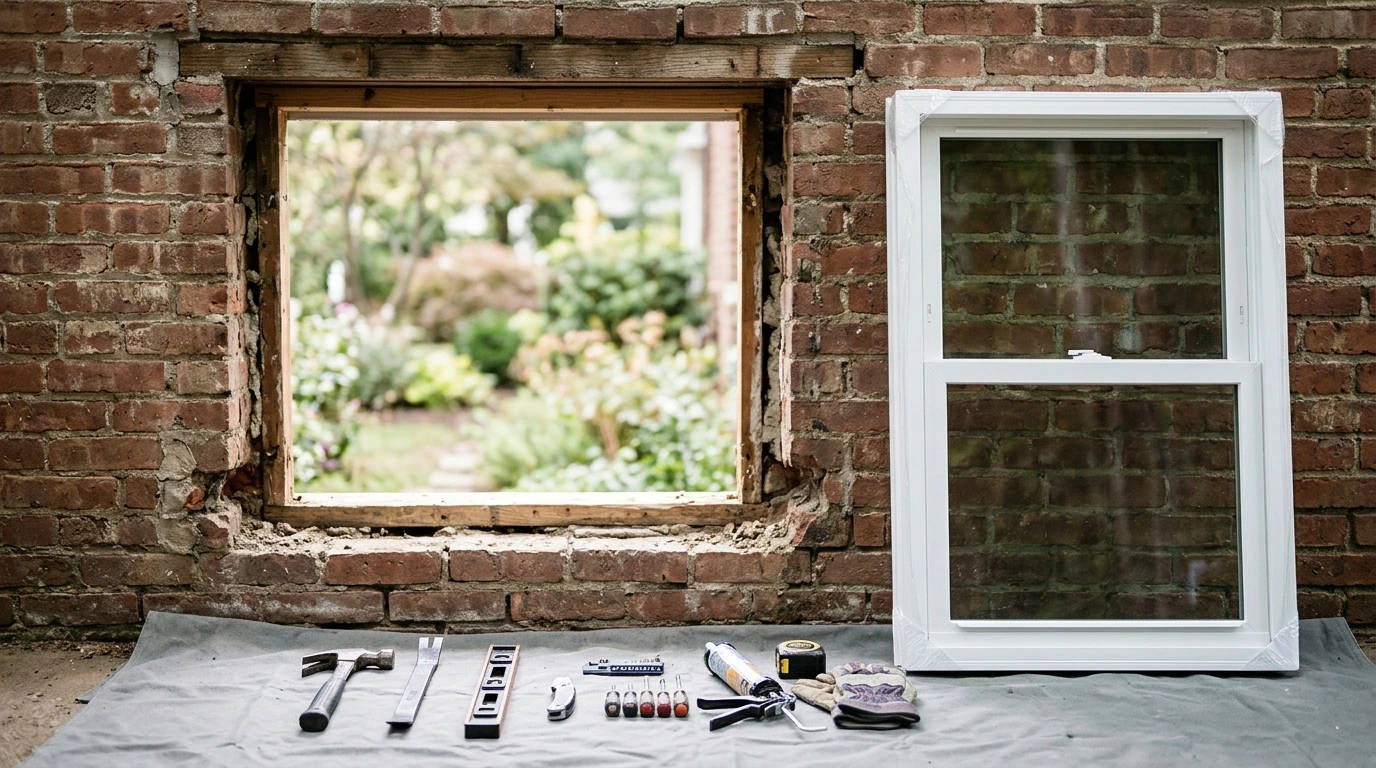
When you compare full-frame vs insert replacement windows, you are really choosing between two ways of installing the same product. An insert, also called a pocket replacement, slips a new window into the existing frame. A full-frame replacement removes the old window completely, down to the rough opening in the wall. Both methods are common in Quebec, and neither is better in every case. The right one depends on the condition of your old frames, your walls and what you expect the project to fix.
How an Insert (Pocket) Replacement Works
In an insert replacement, the installer removes the old sashes, the stops and any hardware, but leaves the outer frame of the old window in place. That frame becomes a pocket into which the new window is set. The new unit is shimmed, fastened to the old frame, insulated around its perimeter and sealed on both sides.
Because the interior trim, the drywall returns and the exterior cladding are not disturbed, the work is generally less invasive. There is less dust, the wall finish stays intact and the window can often be installed from the inside, which is useful on upper floors or on brick walls where removing the frame would mean cutting into the masonry.
The trade-off is that the new window is slightly smaller than the original opening, since it must fit inside the old frame. The glass area is reduced a little and the frame looks a bit wider. On a large picture window this is barely noticeable, but on a small basement or bathroom window the difference can be visible.
How a Full-Frame Replacement Works
A full-frame replacement removes everything: sashes, frame, sill, and usually the interior casing and the exterior trim around the window. The installer exposes the rough opening, which is the framed hole in the wall, and can see the condition of the wood, the insulation and the water barrier around it.
This is the moment to fix what is hidden. Rotten framing can be replaced, a sill membrane or sill pan can be added, the air and water barrier can be connected properly to the new window, and the gap around it can be insulated from edge to edge. The new window is then installed at full size, with new flashing and new trim.
Full-frame work takes more time per opening and involves more finishing, inside and out. On a brick or stone wall, it may require careful work around the masonry, and on siding it often means removing and reinstalling some of the cladding around the window.
- Old window removed completely, down to the rough opening
- Framing, sill and wall cavity inspected and repaired
- Membranes and flashing installed around the opening
- New window set at full size, insulated and sealed
- New interior casing and exterior trim installed
Full-Frame vs Insert Replacement Windows: Key Differences
The two methods differ less in the window itself than in what happens around it. An insert relies on the old frame being solid, square and dry, and keeps whatever is behind it. A full-frame replacement starts fresh and lets the installer deal with the whole opening.
Here is how they compare on the points that matter most to homeowners. Keep in mind that a skilled installer can do excellent work with either method; what matters is choosing the one that suits the condition of each opening.
- Old frame: stays in place with an insert, removed with a full-frame replacement.
- Glass area: slightly reduced with an insert, kept at full size with a full-frame replacement.
- Hidden damage: stays hidden with an insert, exposed so it can be repaired with a full-frame replacement.
- Interior and exterior finish: mostly preserved with an insert, redone with a full-frame replacement.
- Water and air sealing: limited to the joint with the old frame for an insert, rebuilt around the whole opening for a full-frame replacement.
- Disruption: lighter with an insert, more involved with a full-frame replacement.
When an Insert Replacement Makes Sense
An insert is a good option when the existing frame is in sound condition. That means no soft or rotten wood, no signs of water infiltration around the opening, a frame that is reasonably square and a wall that has not been leaking air around the window. Vinyl or aluminum frames from a previous replacement are often good candidates, as long as they are well anchored.
It also suits homes where preserving the interior finish matters, such as plaster walls in an older Montreal plex, deep wood casings you want to keep or a recently renovated room. For condos, where the exterior envelope may be managed by the syndicate, an insert can sometimes simplify the work, but the syndicate's rules come first.
Finally, an insert can be the practical choice for windows that are hard to reach from outside, as long as the installer can still seal the exterior joint properly.
When a Full-Frame Replacement Is the Better Choice
A full-frame replacement is generally recommended when the old frame or the opening is part of the problem. If the wood is soft, the sill is rotting, there are water stains below the window or the frame is badly out of square, putting a new window inside it only hides the damage, which can keep getting worse behind the new unit.
It is also the better choice when you want to change the size, shape or style of the window, for example replacing a slider with a casement window of a different size, or switching from an old unit to a large picture window. And if drafts around the frame, not just through the sash, are a big part of what bothers you, rebuilding the seal around the whole opening is the most thorough fix.
- Rot, softness or mould on the frame or sill
- Water stains on the wall or ceiling below the window
- Drafts coming from around the frame, not only the sash
- A change of window size, shape or opening type
- Old wood windows with hollow sash-weight pockets in the wall that need to be opened and insulated
Questions to Ask Before Choosing a Method
A good recommendation always starts with an inspection of each opening, not a single method applied to the whole house. It is common for one home to have a few openings done as inserts and others done full-frame, depending on their condition and exposure.
When you meet an installer, ask what they found on each window and why they suggest one method over the other. Ask how the gap will be insulated, how the exterior joint will be sealed and how the interior trim will be finished. Ask what happens if hidden damage is found once the old window is out. Clear answers to these questions say a lot about the quality of the work you can expect. Our page on window installation explains the main steps.
Get a Recommendation for Your Home
Choosing between a full-frame and an insert replacement is a decision that is best made in front of the window, with the frame, the wall and the interior finish in view. It is a good time to call a professional if you have noticed soft wood, stains below a window or drafts around the frame, or if you simply cannot tell whether your old frames are sound enough to keep. The cost of each option depends on the openings, the products and the finishing work, so it varies from one project to another.
Unisson Groupe manufactures and installs windows and doors and serves homeowners across Greater Montreal from Saint-Laurent. Browse our window styles, then request a free in-home estimate to have each opening looked at and talk through which method suits it and why.
Frequently Asked Questions
What is the difference between full-frame and insert replacement windows?
An insert replacement keeps the old outer frame and sets the new window inside it. A full-frame replacement removes the entire old window down to the rough opening, so the framing, insulation and sealing around the window can be inspected and redone.
Do insert windows reduce the glass area?
Yes, slightly. Because the new window must fit inside the existing frame, its glass is a little smaller than the original. The difference is minor on large windows but can be noticeable on small ones.
Is an insert replacement less energy efficient?
Not necessarily. The new window unit is the same either way, although an insert has slightly less glass and a wider frame. What matters is the condition of the old frame and how well the joint between the old frame and the new window is insulated and sealed.
Can I mix full-frame and insert replacements in the same house?
Yes, and it is common. Each opening is assessed on its own, so windows with sound frames can be done as inserts while those with rot or leaks are replaced full-frame.
Which method is cheaper?
It depends on the condition of each opening, the products chosen and the finishing work required. The best way to compare is to request a free estimate that looks at each window.