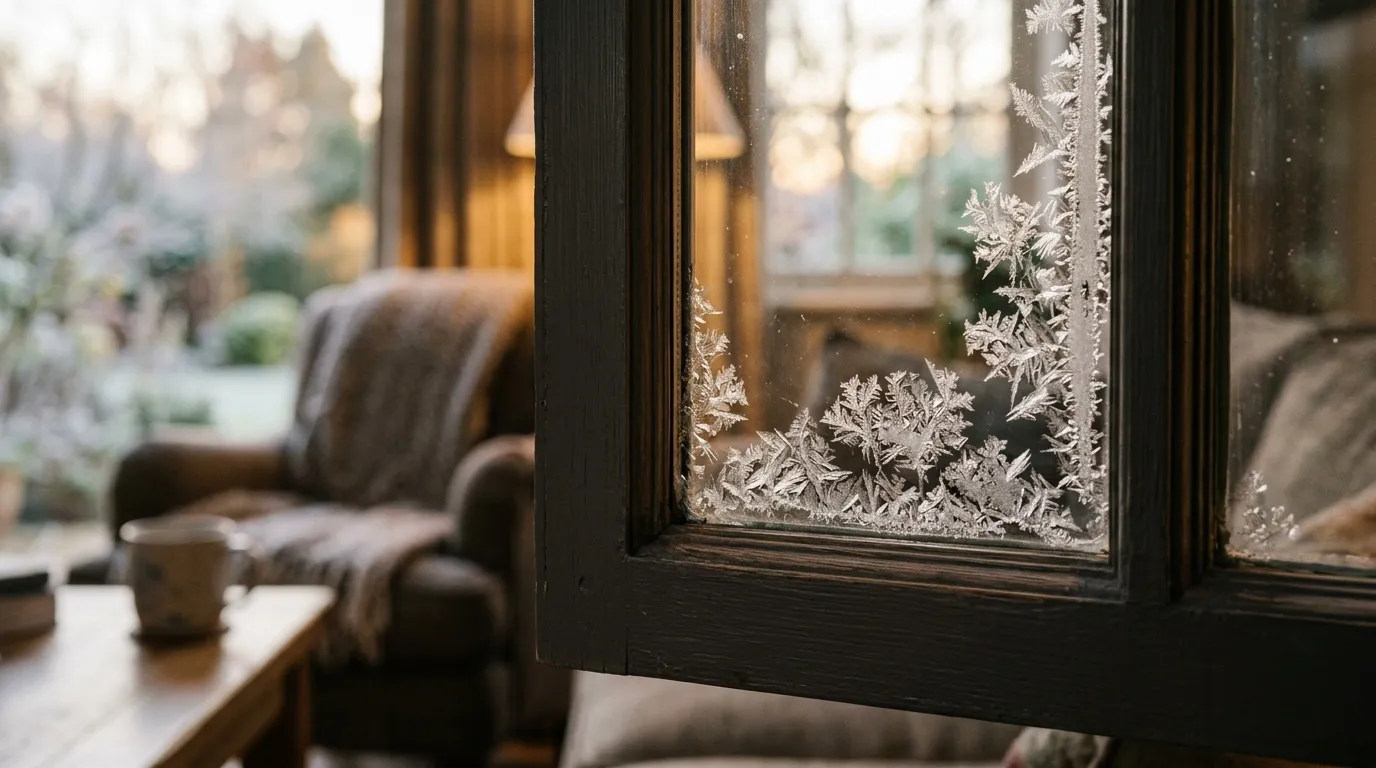
The first morning the thermometer reads -5 °C in Montreal or Laval is the best diagnostic opportunity of the year. Cold air, warm rooms and dry furnace heat turn every weak window into a visible, touchable symptom. Ten minutes with your hand, a stick of incense and, if you have one, a cheap infrared thermometer will tell you more than any sales visit, and this guide explains what each finding means and what to do about it.
Why the first frost is the right morning
Window problems hide in mild weather. At 10 °C outside and 21 °C inside, a poorly sealed frame leaks a little air you cannot feel and loses a little heat you cannot see. At -5 °C the temperature difference across the window more than doubles, drafts become perceptible on skin, and the coldest surfaces drop below the dew point of indoor air and start collecting condensation. The first frost, which arrives in the Montreal area typically between late September and mid-October, is the first morning of the season with all three conditions lined up.
Timing within the day matters too. Do the test between 6 and 8 a.m., before the sun hits the east side and before you open any windows or run a range hood or bathroom fan. Keep the heating on its normal schedule so the furnace or heat pump is cycling, since a running forced-air system slightly pressurizes or depressurizes the house and makes leaks easier to find.
Do the same walk once more in January at -20 °C. Anything marginal in October is severe in January, and comparing the two sets of notes tells you which windows are getting worse fastest.
- Outside temperature: -3 °C or colder, ideally with a light breeze
- Inside: normal thermostat setting, no fans running, blinds and curtains open for at least an hour
- Kit: your hand, a stick of incense or a candle, a notebook, optionally an infrared thermometer
The hand test: where the cold is coming from
Start with the back of your hand, which is more sensitive to temperature than your palm. Hold it 2 to 3 cm from the glass in the centre of the pane, then move slowly to the edge of the glass, along the sash, across the joint between sash and frame, and finally along the joint between the frame and the wall. Note where the sensation changes. A cold centre pane means the glazing itself is weak; a cold band at the edge of the glass points to the spacer; a cold line at the sash joint means worn weatherstripping; a cold line at the frame-to-wall joint means the installation gap is not sealed.
Do the same thing with the room in mind. Stand a metre from the window and hold your hand at waist height: on a bad window you will feel a gentle downward flow of cold air spilling off the glass onto the floor. That convection loop is what makes a room feel drafty even when no air is actually entering, and it explains why the spot next to the window is always the cold seat in the living room.
Write down each window on a simple sheet: room, orientation, and one word per zone: centre, edge, sash, frame. Most homes show a pattern within five windows, and the pattern is the diagnosis.
The incense test: finding actual air leaks
The hand test finds cold; the incense test separates cold surfaces from moving air. Light a stick of incense (a candle works, but incense smoke is easier to read) and hold it 3 to 5 cm from each joint you just checked. Smoke that rises straight up means no leak. Smoke that bends toward the window, flattens, or is pulled into a crack means air is moving through, and the direction tells you whether the house is drawing air in or pushing it out at that spot.
Trace the entire perimeter of the sash, pausing at corners and at the lock. On casements, check the hinge side, where the sash sits deepest and worn weatherstripping is common. On sliders and hung windows, pay attention to the meeting rail where the two sashes overlap; it is the single most common leak point on that style. Then run the incense along the frame where it meets the wall trim and along the sill.
Air leaks matter more than cold glass in energy terms. Natural Resources Canada estimates that air leakage accounts for 25 to 40 percent of heat loss in an older home, and a window that moves the incense smoke is a direct contributor. The good news is that most sash leaks are fixed with weatherstripping and most frame leaks with sealant or foam, both well within a weekend.
- Smoke straight up: no leak at that point
- Smoke bends or flickers: air moving; mark the location
- Smoke pulled into the joint: active infiltration; the top of the fix list
Infrared thermometer: putting numbers on it
A basic infrared thermometer is inexpensive at any hardware store in Quebec and turns the hand test into data. Point it at the centre of the glass, the edge of the glass, the sash, the frame and, for reference, the wall 30 cm away from the window. Keep the same distance for each reading, about 20 to 30 cm, and remember that glass and painted surfaces read accurately while shiny metal does not.
The reference point is the wall. On a reasonably insulated house at -5 °C outside, the interior wall surface reads within 1 to 2 °C of room temperature. A modern double-glazed Low-E window reads roughly 3 to 5 °C below room temperature at the centre of the glass and 5 to 8 °C below at the edge. Old double glazing without Low-E runs 8 to 10 °C below at the centre; a single pane with a storm window can run 12 to 15 °C below. Anything more than about 10 °C colder than the wall is a window that is costing you real money.
Edge readings are the revealing ones. If the centre of the glass is fine but a 5 cm band around the perimeter is 4 to 6 °C colder still, the spacer is conducting heat through the edge of the unit, which is normal on older aluminum spacers and a sign of a warm-edge spacer that has failed on newer ones. Record all five numbers per window; a spreadsheet of these readings is the most persuasive document you can bring to a replacement estimate.
Condensation patterns and what they mean
On the first frost morning, look at every window before anyone opens a blind. Where the moisture sits tells you what is wrong. A light fog across the whole interior surface of the glass, worst on the north side and gone by mid-morning, is usually just high indoor humidity meeting a cold pane; the fix is to lower the humidity to 30 to 40 percent, which in Quebec often means running the bathroom fan longer or adjusting the humidifier on the furnace. Condensation that pools along the bottom edge of the glass and wets the sill points to a cold edge, either an old spacer or a bad seal at the sash.
Moisture between the panes, which does not wipe off from either side, means the sealed unit has failed and the glass needs replacing regardless of anything else you find. Condensation on the frame rather than the glass, especially on an aluminum or older steel frame, means the frame itself is a thermal bridge; that is a design problem that only a new window solves.
Water dripping from the top of the window or streaks running down from the head is the one pattern to treat seriously right away. It usually means warm, humid interior air is reaching a cold cavity above the window, condensing, and running back out, and it is the mechanism that rots the header and the framing above the opening.
Frost in the inside corners: the spacer telltale
A specific symptom deserves its own section because it is so easy to misread. When frost, not just condensation, forms on the interior glass in the bottom corners of the pane, in a curved wedge shape that follows the corner, the edge of the unit is dropping below freezing while the centre stays above it. That geometry is the signature of edge conduction through the spacer. On a window from the 1990s or early 2000s with a plain aluminum spacer it is almost expected at -15 °C; on a window from the last ten years sold with a warm-edge spacer, it means the unit is not performing as sold.
Corner frost is not harmless. Every morning it melts, runs down onto the sash and sill, and every day it evaporates. On a wood or wood-clad window that cycle stains the finish within a season and softens the sash within a few years. On a PVC window the water can find its way into the frame drainage and, if the weep holes are blocked, into the wall.
The short-term response is humidity control and keeping the air moving at the window, since curtains and blinds closed tight over the glass make the corners colder still. The long-term response is replacement of the sealed unit with one built on a warm-edge spacer, or of the whole window if the frame is also cold to the thermometer.
Which symptoms are DIY and which mean replacement
Put your notes in three piles. The first pile is everything the incense test found at the sash: worn weatherstripping, a latch that no longer pulls the sash tight, a slider that has drifted out of its track. These are inexpensive parts and about an hour of work per window, and the improvement is immediate. The second pile is the frame-to-wall joint: gaps the incense found at the trim, which are fixed by removing the interior casing, filling the gap with low-expansion foam, and re-caulking. That is a longer afternoon but still a homeowner's job on a ground-floor window.
The third pile is anything about the glass or the frame itself: fogging between panes, a centre-of-glass reading 10 °C or more below the wall, corner frost on a supposedly modern unit, a frame that is colder than its glass. Weatherstripping does not touch these. A sealed-unit replacement is priced per window in the Montreal area depending on size and coating, and it makes sense on a sound frame less than 15 years old. When the frame is also failing, or when more than a third of the windows landed in this pile, a full replacement is usually the better spend.
The value of the ten-minute test is that it puts you in control of that conversation. Instead of asking a salesperson whether you need new windows, you arrive with a sheet that says which four windows are leaking at the sash, which two have failed seals, and which one on the northwest corner is 12 °C colder than the wall. If you want a professional to confirm the readings and price the options, our free estimate includes an on-site inspection, and bringing your notes to it makes the visit faster and the quote more precise.
- DIY this weekend: weatherstripping, latch adjustment, interior caulking, humidity control
- DIY with more effort: re-foaming and sealing the frame-to-wall gap on accessible windows
- Replacement: failed seals, cold frames, corner frost on recent units, centre-of-glass readings 10 °C or more below the wall
Frequently Asked Questions
How cold does it need to be outside for the test to work?
About -3 °C or colder gives a clear signal. At milder temperatures drafts are hard to feel and condensation may not form. The first real frost of the season, typically late September to mid-October around Montreal, is ideal, and repeating the test at -20 °C in January shows which windows are worst.
Is a little condensation on the glass normal?
A light fog at the bottom of the glass on the coldest mornings is common when indoor humidity is above 40 percent. Persistent water pooling on the sill, condensation on the frame, or frost in the corners are not normal and point to a cold edge, a thermal bridge or a failing unit.
What does frost in the inside corners of the window mean?
The edge of the sealed unit is dropping below freezing while the centre stays warmer, which is the signature of heat conduction through the spacer. It is expected on old aluminum spacers and a sign of an underperforming unit on a recent window sold with a warm-edge spacer.
Can I fix a drafty window without replacing it?
Often, yes. If the incense test shows the leak at the sash, new weatherstripping or a latch adjustment usually solves it with inexpensive parts. If the leak is at the frame-to-wall joint, re-foaming and re-caulking behind the casing fixes it. Leaks through the glass or the frame itself require replacement.
What infrared thermometer reading means a window is bad?
Compare the glass to the wall next to it. A centre-of-glass reading 10 °C or more below the wall at -5 °C outside means a poorly insulating unit. An edge band 4 to 6 °C colder than the centre means the spacer is conducting heat, and a frame colder than the glass means the frame is a thermal bridge.
Should I bring my test results to a window estimate?
Yes. A sheet listing each window's symptoms and readings lets the estimator confirm the problem, skip the windows that are fine and price the right fix for each opening. It usually shortens the visit and makes the quote more precise.