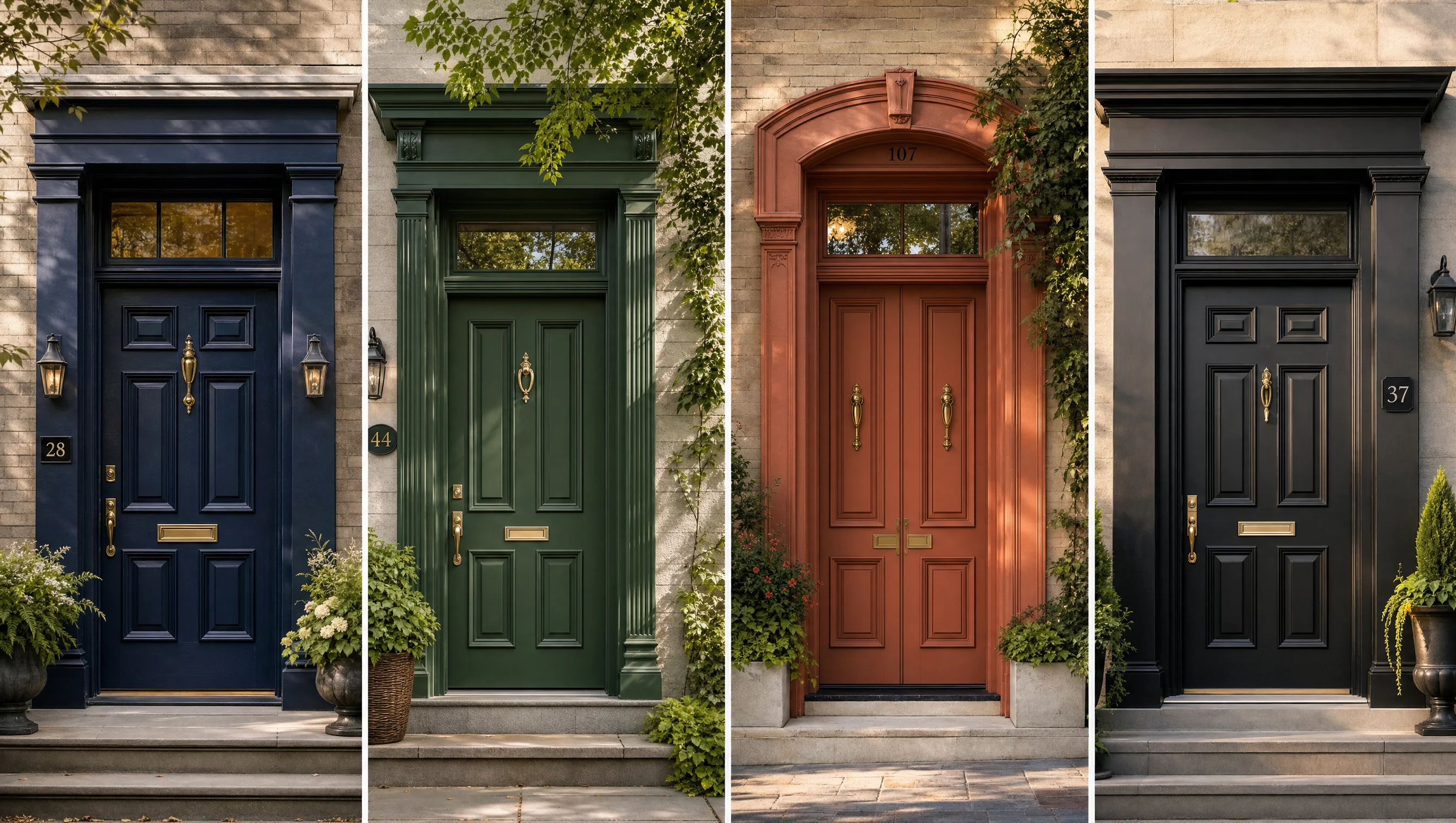
Your front door is the punctuation mark of your facade — the one detail a guest sees up close and a buyer remembers from the curb. In Quebec, that detail has to fight low winter light, road salt, and forty-degree temperature swings while still looking intentional in July. Here is how to pick a color that flatters our architecture, survives our climate, and stays current in 2026.
Why Door Color Is the Cheapest Curb-Appeal Upgrade in Quebec
Real-estate stagers in Montreal consistently rank the front door among the top three exterior changes that move a sale, alongside the lawn and the garage door. A fresh, well-chosen door color costs a fraction of new siding or a roof — roughly $80 to $150 in premium exterior paint, or nothing at all if you order a factory-finished door in the shade you want.
The reason it punches above its weight is focal contrast. The eye naturally travels to the highest-contrast point of a facade, and on most Quebec homes that is the entry. A door that is two or three shades bolder than the wall reads as a deliberate design choice; a door that blends in reads as deferred maintenance.
In our climate there is a second consideration most American color guides ignore: how a hue behaves under cold, blue winter daylight. Saint-Laurent gets fewer than nine hours of daylight in late December, and that light is markedly cooler than the warm summer sun. Colors that look rich in August can turn flat and grey from November to March, so we always recommend judging a shade in both seasons.
Colors for Neutral Facades (Beige, Grey, White)
Beige stucco, grey fibre-cement, and white vinyl are the most common backdrops on homes built across the West Island and Laval since the 1990s. Because the wall itself is quiet, the door can carry real personality without overwhelming the facade.
Pull your accent from a fixed element you cannot easily change — the roof shingles, the stone skirt, or the window trim — so the whole composition feels coordinated rather than random. If your shingles read warm brown, lean into greens and terracottas; if they read cool charcoal, navy and black sing.
- Deep navy — classic and crisp against white trim, and the safest resale choice on a grey or white house
- Forest green — warm and increasingly popular as buyers tire of navy-saturated streets
- Terracotta — bold without being trendy, and a natural complement to warm beige stucco
- Black — modern and authoritative, but specify a fade-resistant finish since black absorbs the most heat
- Muted olive or sage — the breakout neutral of 2026, soft enough to feel timeless
Colors for Red Brick Houses
Red brick is everywhere in Montreal — the duplexes of the Plateau, the rowhouses of NDG and Verdun, the war-era bungalows of Rosemont. Brick is a busy, warm, orange-red surface, so the goal is contrast, not matching.
Two mistakes dominate. The first is a warm red or burgundy door, which fights the brick and muddies both. The second is pure bright white, which photographs beautifully on day one but shows road-salt spray and grime within a single Quebec winter.
Cooler colors create the cleanest separation. A deep teal or peacock blue reads sophisticated against red clay; charcoal grounds the facade without going fully black; and a saturated mustard or ochre picks up the warm undertones in the brick while still standing apart from it.
- Deep teal or peacock — the most flattering single choice for red brick
- Charcoal — modern and forgiving of winter grime
- Saturated mustard or ochre — bold, period-appropriate for older duplexes
- Avoid — warm reds, burgundy, and bright white
Colors for Stone and Greystone Facades
Heritage greystone is the signature of Westmount, Outremont, and the Golden Square Mile, and contemporary builds across the West Island increasingly use cultured-stone veneers in similar grey tones. Stone is textured and tonal, so it pairs best with deep, muted, slightly desaturated colors that respect its weight.
Matte black is the heritage-correct choice on a true greystone and reads timeless rather than trendy. Deep burgundy or oxblood nods to the Victorian palette many of these homes were originally painted in. For a softer, more current look, a muted sage or putty green warms the cool grey without clashing.
Steer clear of bright primaries and any high-gloss finish. Glossy paint reflects the cold sky and exaggerates every surface imperfection, while a matte or satin sheen lets the stone, not the door, remain the star.
Picking a Finish That Survives a Quebec Winter
Color choice is only half the decision; the finish system determines whether that color still looks good in five years. South- and west-facing doors take the brunt of UV exposure and the most punishing freeze-thaw cycling, and dark colors on those orientations can reach surface temperatures above 60°C on a sunny day even in cold weather.
That heat matters because it stresses the substrate. A dark color on a hollow steel door can warp the skin and cook the adhesive; the same color on a fibreglass or insulated composite door handles the load far better. If your heart is set on black or a deep navy on a sun-facing entry, choose fibreglass and a factory-applied finish rated for thermal cycling.
Road salt is the other Quebec villain. Salt spray from plowed streets settles on the lower third of the door all winter, so rinse it off during a midwinter thaw to protect both the finish and the hardware. Brushed nickel, oil-rubbed bronze, and matte black hardware all hide water spotting better than polished chrome.
- Fibreglass doors — best for dark colors and sun-facing orientations; resist warping and hold factory finishes 10–15 years
- Insulated steel — fine in lighter colors and shaded entries; avoid black on a south wall
- Satin or matte sheen — hides imperfections and winter grime better than gloss
- Rinse road salt off the lower door during winter thaws to protect finish and hardware
How to Test a Color Before You Commit
Never choose from a paint chip under a hardware-store fluorescent light — it will lie to you. Order a physical sample swatch (most door manufacturers and paint brands send them free) and tape it directly to your existing door.
Look at it at three times of day: morning, midday, and the low golden light of late afternoon. Each lighting condition shifts the color, and a navy that looks perfect at noon can turn nearly black by dusk. If you have the patience, check it in two seasons, because Quebec winter daylight is noticeably cooler and bluer than summer light.
Finally, judge the swatch from the street, not from your front step. Curb appeal is a long-distance impression. Walk to the sidewalk, then to the far side of the road, and see whether the color still does its job from where buyers and passersby actually stand.
Browse Color and Hardware Options
Once you have a direction, see the full range of factory finishes on our exterior doors page, where you can specify color rather than painting after installation — a factory finish on fibreglass typically outlasts a field-applied coat by years.
To complete the look, pair your color with a coordinated handle, deadbolt, and knocker. Our entry door style guide walks through hardware finishes and how they read against each door color, so the whole entry feels designed rather than assembled.
Frequently Asked Questions
Will dark colors fade in the Quebec sun?
Modern factory-applied, fade-resistant finishes on fibreglass doors hold their color for 10 years or more, even on west-facing entries. Cheaper field-painted finishes fade faster, so a quality coating system matters more than the color itself.
Can I repaint a fibreglass door myself?
Yes. Clean it, scuff-sand lightly, apply an exterior-grade bonding primer, and finish with two coats of 100% acrylic latex exterior paint. Paint on a dry day above 10°C and let it cure fully before winter.
How often do wood doors need refinishing in Quebec?
Real wood doors generally need refinishing every two to three years in our freeze-thaw climate, more often on sun- and weather-exposed entries. This is the main reason many Quebec homeowners switch to fibreglass that mimics a wood grain.
Is black too hot for a south-facing door?
Black is the riskiest color on a sun-facing wall because it absorbs the most heat and can warp a hollow steel door. On fibreglass or insulated composite it performs fine, so match the color to the right substrate.
What door color adds the most resale value?
On most Quebec homes a deep, confident navy or charcoal is the safest resale-positive choice because it reads modern and clean without polarizing buyers. Bolder colors like teal or green can also help if they suit the architecture and neighbourhood.
Should the door match or contrast the window trim?
Contrast almost always looks better. A door two or three shades bolder than the trim creates the focal point that draws the eye, while a perfect match makes the entry disappear into the facade.