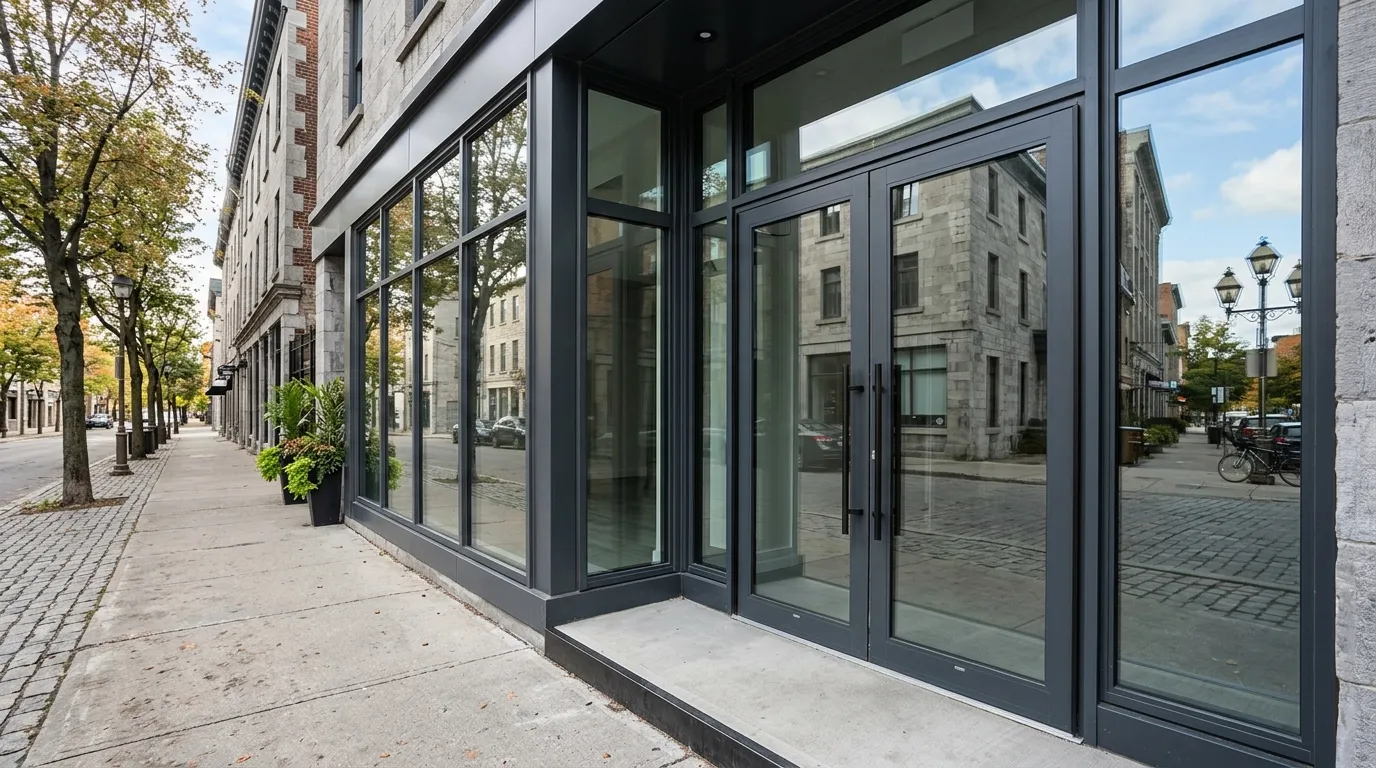
A residential front door opens perhaps ten times a day. A café door on Saint-Denis opens five hundred. That difference changes everything about how a commercial entrance has to be built — the hinges, the closer, the glass, the threshold, the lock — and it is why a storefront fitted with a house door starts failing within a year. Here is what Montreal businesses actually need from their doors and windows, from a dépanneur to a dental clinic, and how to get the work done without closing for a week.
Built for Traffic: Hinges, Closers and Pulls
Commercial doors are rated by cycles, not years. A quality aluminum storefront door with a continuous (piano) hinge or heavy-duty offset pivots is designed for hundreds of thousands of openings; a residential door on three butt hinges will sag, drag on the threshold and loosen at the screws under the same load. If your business sees more than roughly 100 entries a day — most retail, food service and clinics do — specify commercial-grade hardware from the start.
The closer is the component customers notice without knowing its name. A good surface-mounted or concealed closer brings the door shut firmly enough to latch in a February wind but slowly enough that a child or someone with a cane is not struck. Look for an adjustable closer with independent sweep, latch and backcheck speeds, and have it tuned twice a year, because the hydraulic fluid stiffens in cold weather and a closer set in July will slam in January.
Push bars, pull handles and kick plates take the daily abuse. Stainless or anodized aluminum pulls mounted through-bolted, not screwed into the stile, survive; a bottom-rail kick plate protects the door from carts, strollers and delivery dollies. On a busy door, also consider a mid-rail or a taller bottom rail so the glass is not the part that meets a shopping cart.
- Hinging: continuous hinge or offset pivots rated for the door weight; avoid residential butt hinges.
- Closer: adjustable, with backcheck; hold-open function only where fire code allows.
- Pulls and plates: through-bolted pulls, kick plate on the bottom rail, a mid-rail on high-traffic doors.
- Threshold: a low-profile aluminum saddle that survives salt and shovels.
Barrier-Free Access: What the Code Requires
Quebec's Construction Code requires barrier-free access to most new or substantially renovated commercial premises, and municipal by-laws in Montreal enforce it at the permit stage. In practice that means at least one entrance with a clear opening of 800 mm or more (a 36-inch door is the usual answer), a threshold no higher than 13 mm, a level landing on both sides, and a door that can be opened with limited force. Lever handles or push/pull hardware operable with a closed fist replace knobs.
Automatic openers are required in many occupancies and are simply good business in the rest. A low-energy swing operator with a push-plate — the round button at wheelchair height — can be retrofitted to an existing door and dramatically improves the experience for customers with strollers, walkers or full hands. Sensor-activated sliding doors are the better solution above about 300 entries a day and for grocery, pharmacy and clinic use.
Vestibules deserve attention. A two-door vestibule protects the interior from the wind and is a good energy strategy in Montreal, but if the space between the doors is too short, a wheelchair user gets trapped between a closing door and one that has not opened yet. The code sets minimum vestibule depths; if you are tight, one automatic door in the pair solves it.
Tempered vs Laminated: Choosing Safety Glass
Glass in doors, sidelites and any pane close to the floor in a commercial space must be safety glazing. The two options are tempered glass, which is heat-treated to be about four times stronger than annealed and breaks into small blunt cubes, and laminated glass, which sandwiches a plastic interlayer between two panes so that broken glass stays in place. Both meet the safety requirement; they solve different problems.
Tempered is the default for doors and most storefront lites because it is cheaper, lighter and resists the thermal stress of a heated interior against a cold exterior. Laminated is the choice when you want security or sound: a smashed laminated pane stays in the frame, which stops a smash-and-grab from being a thirty-second job, and the interlayer cuts street noise noticeably — valuable for a clinic waiting room on a bus route or an office on René-Lévesque.
For an insulated storefront unit, the common recipe is a laminated exterior pane and a tempered interior pane with a Low-E coating and argon fill: security outside, safety inside, and an energy rating that passes the code. Budget roughly 20 to 40 percent more for laminated over tempered on the same lite size.
- Tempered: doors, sidelites, low panes; economical and strong.
- Laminated: security, noise reduction, UV protection for merchandise near the window.
- Laminated outer + tempered inner: the standard insulated storefront unit for Montreal.
- Security film on existing glass is a stopgap, not a substitute for laminated.
Energy Code for Commercial Glazing
Commercial buildings in Quebec fall under the energy provisions of the Construction Code (based on the National Energy Code for Buildings), which limit the overall thermal transmittance of the envelope and, in the prescriptive path, cap the fenestration-to-wall ratio and set maximum U-values for windows and doors. A storefront that is 80 percent glass is possible, but it requires either better glass than the prescriptive maximum or a trade-off calculation showing the whole envelope performs.
For the owner, this translates into specifying thermally broken aluminum framing — the frame has an insulating polyamide strut between the outside and inside metal — and double- or triple-glazed insulated units with a Low-E coating. Non-thermally-broken storefront, still sold because it is cheaper, sweats and frosts on the inside in Montreal winters, and the condensation ends up on the floor by the door.
Beyond compliance, glass choice affects operating costs. A south-facing storefront on Sainte-Catherine gains a great deal of solar heat in summer; a lower solar heat gain coefficient reduces the cooling load without darkening the display. A north-facing clinic entrance benefits from triple glazing for comfort near the windows. Ask for the performance numbers on the actual unit, and ask your HVAC contractor how they affect equipment sizing.
Security and After-Hours Protection
A storefront is a large piece of glass with a lock in it, and it is worth thinking about the hours it spends empty. Laminated glass, as described above, is the first line. The second is the lock: commercial doors take mortise locks or multipoint systems with a hook bolt rather than a residential deadbolt, and the strike should be reinforced in the frame. Adams Rite-style hook locks in aluminum stiles are the industry standard for a reason.
Access control is now inexpensive enough for small businesses. An electric strike or a maglock with a keypad or card reader means staff have individual codes, a departed employee's access is deleted rather than requiring a re-key, and the door logs entries. For clinics and offices with a locked door and a reception buzzer, an electric strike wired to the desk is a modest addition.
Roll-down shutters or grilles are common on Montreal commercial strips, but many boroughs restrict solid exterior shutters for streetscape reasons. Interior grilles, laminated glass and good lighting are the usual compliant combination. Check your borough's by-law before ordering, and inform your insurer of the glazing and lock specification — some offer premium reductions for laminated glass and monitored access control.
Signage, Vinyl and Frosting on Glass
Storefront glass is your cheapest advertising surface, but a few rules apply. Vinyl lettering and frosted films are easy to apply to the interior face of the glass and are reversible, which matters in a lease. Painted or etched signage is permanent and usually needs the landlord's consent. Whatever you choose, keep sign layout in mind when specifying the glass: a mid-rail or muntin through the middle of a pane will cut through your logo.
Montreal's sign by-laws limit the percentage of window area that can be covered — often 25 to 50 percent depending on the borough — and require French to be markedly predominant on any public signage under the Charter of the French Language, with recent amendments tightening that requirement for storefronts. Plan the design with those constraints from the start rather than redoing it after a visit from an inspector.
Frosted bands are also functional. In a clinic, a frosted band at seated eye height gives waiting patients privacy from the sidewalk without blocking daylight; in an office, a frosted lower third keeps monitors out of view. Ask for the film to be applied after installation and after the glass has been cleaned by the installer, so it goes on a clean, uncontaminated surface.
Restaurants, Clinics, Offices: Different Doors for Different Uses
A restaurant or café entrance takes constant traffic, grease in the air, deliveries through the front door and, in Montreal, a terrasse in summer that doubles the number of openings. Specify a heavy-duty closer, a kick plate, a low threshold that survives constant mopping and salt, and a vestibule or air curtain to keep the dining room warm when the door is open 40 percent of the time in December. If the door opens onto a terrasse, consider a wider leaf or a pair so servers with trays pass without stopping.
A medical or dental clinic needs barrier-free access first, an automatic opener second and privacy third. Laminated glass reduces street noise in the waiting room, and a frosted band handles sightlines. An electric strike at reception lets staff control entry. Because clinics are often in second-floor or strip-mall spaces with shared corridors, coordinate the fire rating of the corridor door with the building owner — a fire-rated door with a closer and no hold-open is often required.
Offices tend to be lower traffic and higher on security and image. A full-height glass entry with a concealed closer and a card reader looks right, and thermally broken framing with triple glazing keeps the reception comfortable in a curtain-wall building. Where the office faces a busy street, laminated glass for sound is the single best upgrade for the people who sit near the front.
Getting It Installed Without Closing the Business
Replacing a storefront door or a run of windows takes a day per opening in most cases, but a business cannot leave a hole in its facade overnight. Plan the sequence with the installer: the new door and frame are pre-assembled and glazed in the shop, the old unit is removed and the new one set and sealed within a few hours, and the door is lockable by the end of the day. Interior trim and finishing can follow on a second visit.
Timing matters. Retail and restaurant installs go best on Monday or Tuesday mornings, or before opening hours; some contractors will start at 6 a.m. for a bakery or café. Clinics usually schedule for a half-day the office is closed. If your lease requires landlord approval for facade work — it almost always does — obtain it in writing along with the borough permit before the order goes in, because a delay at that stage pushes a lead time of four to eight weeks for custom aluminum storefront.
Finally, consider winter. Storefront work is done year-round in Montreal, but sealants and expanding foams have minimum application temperatures, and an open facade in January costs you heating and comfort. If your renovation timeline allows, plan exterior openings for spring through fall and use the winter for interior work. Whatever the season, a manufacturer with its own installation crews will coordinate the sequence more reliably than a broker who subcontracts each trade. See what we can supply on our doors page and contact us to discuss a commercial project.
Frequently Asked Questions
Can I use a residential door on a small shop?
Not for long. A residential door on butt hinges with a household closer and lock will sag, drag and loosen under daily commercial traffic. Commercial-grade hardware and framing are rated for hundreds of thousands of cycles and are the right investment even for a small business.
Do I need an automatic door opener?
It depends on the occupancy and the scope of your renovation, but barrier-free access is required for most commercial premises and an automatic opener is the simplest way to comply on a swing door. It can usually be retrofitted to an existing door.
Tempered or laminated glass for a storefront?
Tempered for doors and most lites where cost and thermal strength matter; laminated where security, noise or UV protection are the concern. Many Montreal storefronts use an insulated unit with a laminated exterior pane and a tempered interior pane.
What does commercial storefront cost in Montreal?
A single commercial aluminum entry door with closer, hook lock and insulated glass is priced by size, glass and hardware; a full storefront with door and several fixed lites is a considerably larger investment. The exact figure depends on your openings and glazing — request a free estimate.
Can I cover my window with signage?
Only partly. Montreal boroughs generally cap window coverage at 25 to 50 percent, and signage must comply with the Charter of the French Language. Interior vinyl and film are reversible and usually easier under a lease than painted or etched glass.
How long does a storefront replacement take?
Usually one working day per opening once the custom unit arrives, with the door lockable the same evening. Lead time for custom aluminum storefront is typically four to eight weeks after permit and landlord approval.