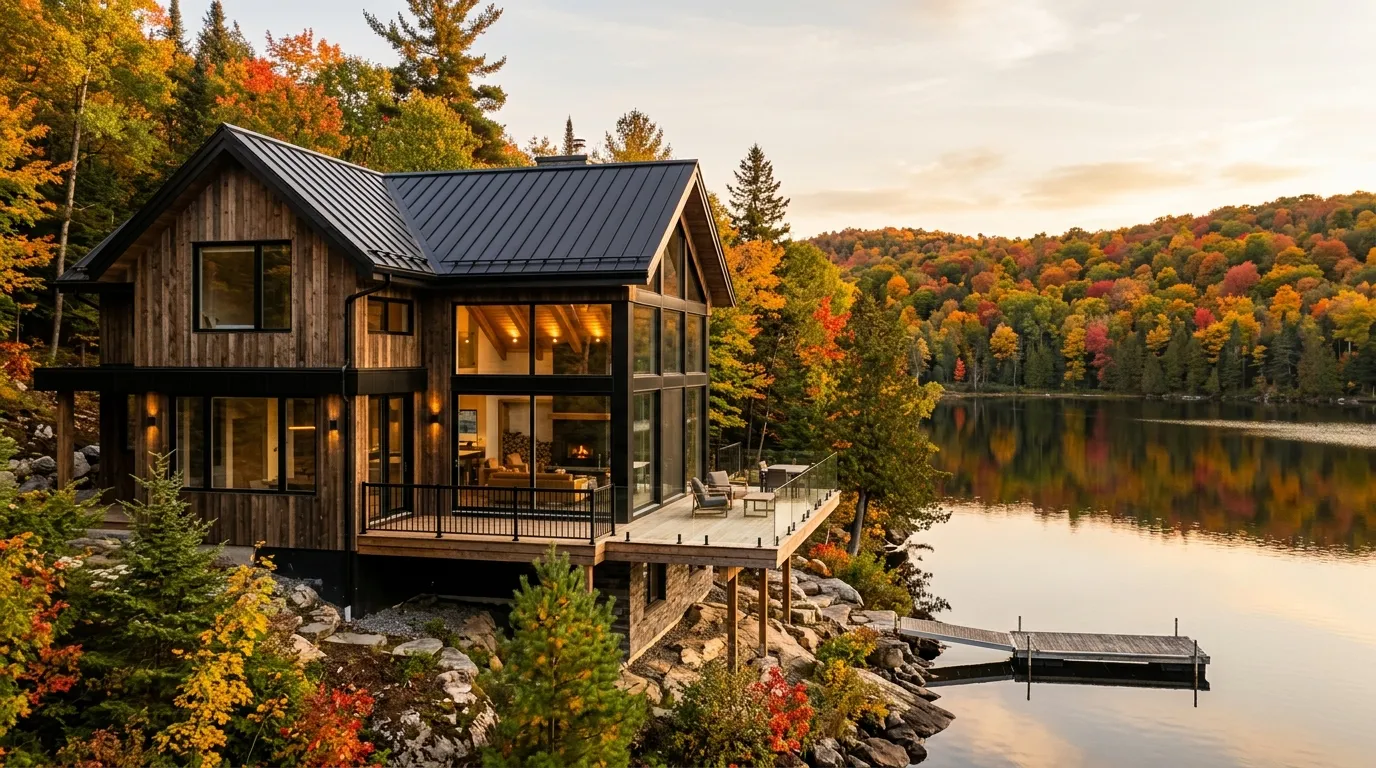
A chalet in the Laurentians lives a harder life than a house in Montreal: colder nights, far more snow, weeks without heat and a view that everyone wants to see through a wall of glass. The windows that work on a street in Rosemont are not automatically the windows that work at 600 metres above sea level near Mont-Tremblant. This guide covers what changes north of Saint-Jérôme and how to specify windows that survive it.
A colder microclimate than the city
The building code's January design temperature — the cold that a heating system must handle — is about -23 °C for Montreal. It drops to roughly -25 °C at Saint-Jérôme, around -27 °C at Sainte-Agathe-des-Monts and Mont-Tremblant, and close to -30 °C by Mont-Laurier. Valleys and lakes hold cold air on still nights, ridge lots take the wind, and the heating season runs three to five weeks longer than on the island. These are approximations from published climatic data, but the direction is unambiguous: a chalet's windows work in a colder, longer winter than the same model in the city.
For a given indoor humidity, colder outdoor air means the inside face of the glass drops closer to the dew point, so condensation and frost appear on a Laurentian window before they would on the same unit in Montreal. The answer is not a different type of window but a better-specified one: low-E coatings, argon fill, a warm-edge spacer and a multi-chamber PVC frame at minimum, with triple glazing the sensible default for any room that will be slept in. A higher Energy Rating on the label translates directly into a warmer inside pane.
The one advantage a chalet has is the sun. Most Laurentian lots are cleared to the south or to the lake, and a well-oriented window with a glazing package chosen for solar gain can offset a meaningful share of its own heat loss on a clear February day. Ask for the SHGC figure, not just the U-factor, when the window faces south.
Heavier snow: roofs, sills and sliding snow
Ground snow loads in the code climb quickly north of the city: roughly 2.6 kPa for Montreal against 3 to 4 kPa across the Laurentides, with the higher villages at the top of that band. Roof structure is the engineer's concern, but the snow affects windows in three ways. It piles up against low walls, burying basement and ground-floor units and pressing on glass and frames while meltwater sits at the sill. It slides off metal roofs in sudden sheets that land on whatever is below. And it accumulates in drifts against the lee side of the building, right where the bedroom windows are.
Plan the openings with those forces in mind. Keep ground-floor sills at least 600 mm above finished grade and protect basement egress windows with covered wells. Where a steep metal roof drains toward a window, either move the window out of the slide path, add snow guards, or specify laminated glass and a frame rated for the extra load. Deep overhangs are the most underrated feature of a chalet: they keep snow, ice and driving rain off the glass and reduce both the structural and the water-penetration demands on the unit.
Because Laurentian sites are often open to the lake or the valley, wind exposure is higher too. Ask your supplier which NAFS Performance Grade and water-test pressure the chosen series carries at the size you need; a large picture window on an exposed lakefront deserves a rating with margin, not the code minimum for a sheltered urban lot.
Seasonal or unheated use: freeze cycles inside the chalet
Many chalets are kept at 5 to 8 °C over the winter, and some are shut down entirely. Either way the interior goes through freeze-thaw cycles that a city house never sees. The moisture left in the building — in the furniture, in the drywall, in the air — condenses on the glass as the temperature falls, freezes there, and then melts in a rush when the owners arrive on Friday night and light the stove. Water runs down the pane onto the sill, refreezes, and does it again the next weekend.
PVC frames handle this well because they are dimensionally stable and do not absorb water; unfinished or poorly finished wood sills, on the other hand, swell and crack within a few seasons. The glazing unit itself is designed for far larger temperature swings than a chalet produces, so the sealed unit is not the weak point. Triple glazing earns its keep here twice: the inner pane stays warmer during the fast warm-up, so far less condensation forms in the first place.
Hardware is the other vulnerability. Cranks, multi-point locks and hinges should be lubricated with a cold-rated silicone or lithium product before closing up, weatherstripping should be clean and dry so it does not freeze to the frame, and weep holes must be clear so meltwater drains rather than freezing in the sill track. If you keep minimal heat, a connected thermostat and a temperature sensor that alerts your phone are cheap insurance against a furnace failure that would otherwise be discovered in March.
- Lubricate cranks, locks and hinges with a cold-rated product before closing up for winter
- Clean and dry weatherstripping; clear every weep hole
- Leave interior doors open and blinds up so sun warms the glass and air circulates
- Install a temperature alert if the chalet is kept above freezing; drain plumbing if it is not
Big view windows without a big heating bill
The lake-facing wall of glass is the reason most people buy a chalet, and it is also where most of the heat leaves. The good news is that the fixed picture window is the most efficient window type per square metre: no sash, no operating hardware, minimal frame and, in the Fixed air-leakage class, essentially no infiltration. Build the view around one or two large fixed units and put the ventilation in flanking casements or awnings, rather than trying to make the whole wall operable.
Glazing choice makes the difference between a wall that costs a fortune to heat and one that pays part of its own way. Triple glazing with two low-E coatings and argon brings the U-factor to roughly two-thirds of a standard double-glazed unit. On a south or south-west lake exposure, a low-E coating selected for a higher solar heat gain coefficient harvests winter sun; on a west face with summer overheating, the reverse. Large triple units are heavy, so confirm the maximum size the series is rated for and make sure the mullions between units are engineered, not just aligned.
Finally, deal with the cold air that pools at the base of any big window. A length of hydronic or electric baseboard, or a run of radiant floor along the glass, breaks the downdraft and keeps the inside pane above the dew point on a -30 °C night. It is a small cost compared with the window and it is what makes sitting next to the view comfortable in January.
Security when the chalet is empty
Cottage country break-ins concentrate in the off-season, and windows are the usual point of entry. The best defence is a combination of hardware and glass. Casements with multi-point locks are far harder to pry than sliders; interior-glazed frames, where the glazing beads sit on the inside, prevent the glass from being lifted out from the exterior; and laminated glass on the ground floor turns a quick smash into a noisy, slow job that most intruders abandon.
Add layers according to how remote the site is. Security film on existing glass is a modest retrofit. Exterior roll shutters or removable panels suit chalets closed for months at a time and double as storm protection. Contact sensors on windows and doors, tied to an alarm with a cellular link rather than a Wi-Fi connection that fails with the power, let you know within minutes. Keep sightlines from the road clear of valuables and use timers or connected lighting so the place does not look abandoned.
Check your insurance policy: many insurers in Quebec require a minimum heat setting, water shut-off or monitoring for a seasonal property left vacant for more than a few days, and a claim after a break-in or freeze can hinge on it.
- Multi-point locks on casements and awnings; avoid sliders on the ground floor
- Interior-glazed frames and laminated glass where access is easy
- Cellular-linked alarm with window and door contacts
- Roll shutters or panels for long closures; timers so the chalet looks lived in
Bugs, wildlife and screens
Nobody who has spent a May weekend in the Laurentians needs convincing about blackflies. Standard 18-by-16 fibreglass mesh stops mosquitoes but lets the smallest biters through; a fine 20-by-20 'no-see-um' mesh keeps them out at the cost of slightly less airflow and view. Order the fine mesh for bedrooms and the screened porch, and standard mesh where the breeze matters more. On casements and awnings the screen sits on the inside, protected from weather and from claws.
Wildlife takes a toll on screens: squirrels, raccoons and the family dog all leave marks. A pet-resistant vinyl-coated polyester mesh is several times tougher than fibreglass and worth the small premium on ground-floor and porch openings. Wasps like to nest in the gap between a screen and a sash left closed all season; a quick inspection on arrival avoids a surprise. Screens do nothing against bears, whose interest is your garbage and bird feeders, not your glazing.
A tip most chalet owners learn late: take the screens out for the winter. Mesh ices up, holds snow against the sash and blocks a noticeable share of the low winter sun that would otherwise warm the glass. Store them flat and dry, and put them back in April before the first hatch.
Wood-look finishes for a rustic style
A chalet wants warm materials, and real wood windows deliver that look — but solid wood exteriors under Laurentian ultraviolet, snow and freeze-thaw need refinishing every few years, which is exactly the maintenance a seasonal owner is least able to provide. The practical route is a PVC or hybrid window with a wood-look finish: woodgrain laminates on the exterior in tones such as dark walnut, driftwood or smoked oak, and interior laminates or real wood veneers that take stain to match pine trim and log walls.
Dark and wood-toned exteriors absorb more summer heat than white, so choose a series whose profiles are reinforced or co-extruded for dark colours, and confirm that the finish warranty covers the exposure. Pair the colour with the roof and siding: dark bronze or black frames read modern against cedar and steel roofing, while brown woodgrains disappear into log and board-and-batten construction. Simulated divided lites turn a large fixed unit into the traditional 'Swiss chalet' grid without sacrificing the insulated glass.
Inside, pine or fir extension jambs and casings finish the frame in the same material as the walls, so the PVC is invisible from the sofa. It is a small upgrade that makes a maintenance-free window feel like part of a hand-built cabin.
Delivery and installation logistics north of Saint-Jérôme
Getting windows to a chalet is a project of its own. Gravel roads, steep driveways, lake-access lots and the spring thaw all matter. Quebec's Ministry of Transport restricts heavy-truck loads on most roads during the thaw period, roughly from mid-March to mid-May depending on the zone, and many private roads are impassable for a delivery truck during the same weeks. Large picture units may need a crane or a crew of six, and both need firm ground. Installers in the region work most efficiently from late May to October, and that is when lead times are longest — order six to ten weeks ahead.
Site measurement deserves extra care. Chalets were often built by owners or small crews with non-standard framing, and log homes settle over their first years, so openings may be out of square and need a slip joint above the window rather than a rigid fit. A supplier who measures on site, rather than from your numbers, will catch this. Budget a delivery surcharge for addresses beyond the Greater Montreal area, which varies with distance and access, and ask whether the installation quote includes travel time.
Permits are handled by the local municipality, and lakefront properties in the Laurentides, Pays-d'en-Haut and Antoine-Labelle MRCs fall under shoreline-protection rules. Replacing a window in the same opening is straightforward; enlarging the lake-facing wall or adding openings can require a permit and, in the riparian band, may be limited. A quick call to the municipal urbanism office before ordering avoids a window that cannot be installed.
Frequently Asked Questions
Do I need triple glazing for a chalet in the Laurentians?
For any room that is slept in or kept heated all winter, yes: the colder design temperatures make condensation and frost far more likely on double glazing, and the inner pane of a triple unit stays warmer. For a three-season screened porch, good low-E double glazing can be enough.
Is it better to leave the chalet unheated or keep it at 5 °C?
Keeping it just above freezing protects plumbing, finishes and the windows' weatherstripping and hardware from repeated freeze-thaw, and it makes warm-up condensation much lighter. If you shut down completely, drain the plumbing, leave blinds open and interior doors ajar, and expect frost on the glass until the stove has run for an evening.
Which glazing should face the lake?
A large fixed picture window with triple glazing and a low-E coating chosen for your orientation: higher solar gain on a south exposure to harvest winter sun, lower on a west exposure prone to summer overheating. Put the operable units on either side rather than in the view.
What screen mesh stops blackflies?
A fine 20-by-20 'no-see-um' mesh. Standard 18-by-16 fibreglass stops mosquitoes but not the smallest blackflies and midges. Use the fine mesh on bedrooms and the porch, and remove screens for the winter to avoid icing.
Can you deliver and install in the Laurentians?
Yes. We deliver and install throughout the Laurentides and beyond the Greater Montreal area, with a distance surcharge that depends on access. Deliveries are scheduled outside the spring thaw restrictions and installations are planned for late spring through fall whenever possible.
Do I need a permit to enlarge the windows facing the lake?
Replacing windows in existing openings normally does not, but enlarging or adding openings on a lakefront wall usually requires a municipal permit, and shoreline-protection rules can limit changes within the riparian band. Check with the municipality before finalizing sizes.