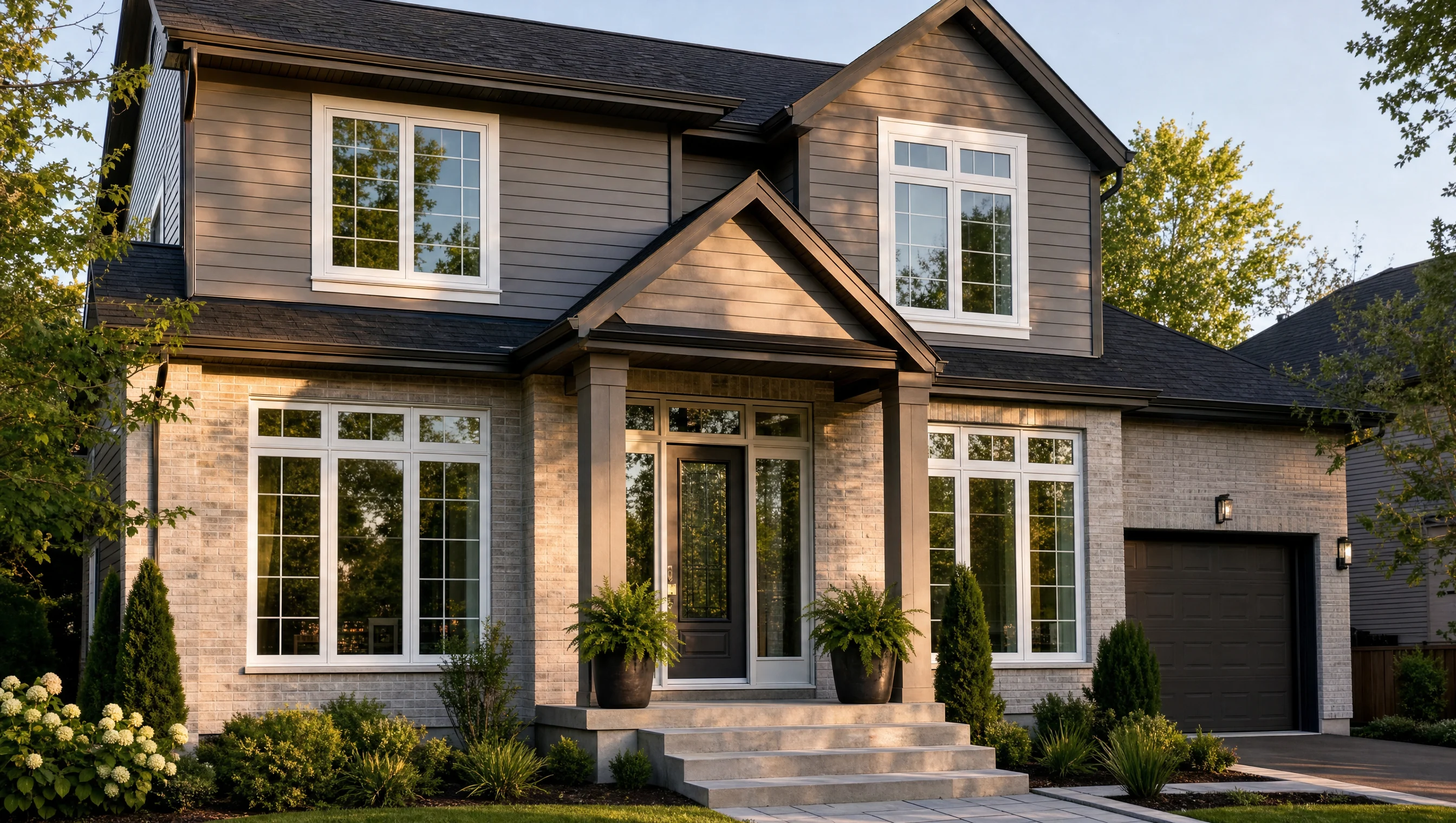
Vinyl windows have become the default choice for Quebec homeowners, and for good reason. They shrug off the brutal freeze-thaw cycles of a Montreal winter, ask for almost no upkeep, and deliver thermal performance that older wood and aluminum frames simply cannot match. This 2026 buyer guide walks you through everything — quality markers, energy ratings, styles, rebates, and the red flags that separate a 40-year window from a 10-year regret.
Why Vinyl Windows Dominate the Quebec Market
In a province where January averages hover around −10°C in Montreal — with overnight lows that routinely dip below −25°C in Laval and the South Shore — window frames endure a punishing freeze-thaw cycle that can repeat dozens of times each winter. Summer brings the opposite stress: humidity above 70% and afternoon temperatures over 30°C. Vinyl (UPVC) handles both extremes far better than wood or aluminum because it does not warp, rot, rust, or conduct cold the way other materials do.
Aluminum frames, popular in Quebec construction through the 1980s, act like a thermal bridge: the metal pulls heat straight out of your home and frosts over on the interior during a cold snap. Wood looks beautiful but demands constant sanding, sealing, and repainting, and it swells and contracts as humidity swings. Vinyl sidesteps both problems with sealed, multi-chamber profiles that trap pockets of still air — nature’s insulator.
Over the past decade, Quebec homeowners have shifted decisively toward high-performance UPVC. The province’s building code now favors these systems, and nearly every major rebate program ties eligibility to ENERGY STAR-certified vinyl units. For most homes in Greater Montreal, vinyl is no longer just the affordable option — it is the smart one.
- Excellent thermal insulation thanks to multi-chamber profiles that trap still air
- No painting, sanding, or sealing required — clean with mild soap and water
- Resists swelling, rotting, and corrosion through humid summers and salty winter air
- Compatible with double and triple-pane glazing engineered for cold climates
- Typical lifespan of 30 to 40 years when properly manufactured and installed
- Colour is integrated through the profile, so scratches do not expose bare material
The Anatomy of a Quality Vinyl Window
Not all vinyl windows are built the same, and the differences are mostly hidden inside the frame. The single most important quality marker is the multi-chamber profile: premium units use four to six internal air chambers, while budget imports often rely on a single hollow void. Each chamber slows the transfer of cold from outside to inside, and on larger windows a galvanized or stainless steel reinforcement core keeps the frame rigid against wind load and prevents sagging over time.
The glass package matters just as much as the frame. Look for a sealed insulated glazing unit (IGU) with a warm-edge spacer rather than a conventional aluminum spacer, which conducts cold around the perimeter and is a common cause of condensation on the bottom of the glass. Argon gas fill between the panes adds roughly 10% to the insulating value, and a soft-coat Low-E layer reflects radiant heat back into the room in winter while blocking summer solar gain.
Finally, inspect the hardware and weatherstripping. Quality casement and awning windows use a multi-point locking system that pulls the sash tight against a continuous compression gasket, creating an airtight seal that single-point latches cannot match. Stainless steel or zinc-alloy operators and hinges will still work smoothly after fifteen Quebec winters, whereas cheap plastic mechanisms become brittle and fail in the cold.
- Four to six chamber profiles for the frame and sash
- Galvanized or stainless steel reinforcement in larger units
- Warm-edge (non-metallic) spacer between glass panes
- Argon-filled cavity with soft-coat Low-E glass
- Multi-point locking and continuous compression weatherstripping
Energy Star Certification: What Quebec Buyers Should Look For
Always confirm that the window is ENERGY STAR certified for “Zone D” or higher — that is the Canadian climate zone covering Greater Montreal, Laval, and the South Shore. Zone D is the coldest climate zone in the standard, so a window rated for it has proven its performance in the harshest tested conditions. A unit certified only for Zone A or B may be perfectly fine in southern Ontario but underperform during a Quebec January.
Two numbers tell you most of the story. Aim for an Energy Rating (ER) of 34 or higher and a U-factor (USI) of 1.40 W/m²·K or lower — the lower the U-factor, the less heat escapes. A triple-pane casement can reach a U-factor near 0.96, while an older double-pane slider might sit around 1.80, and that gap is felt directly on your heating bill and on the comfort of sitting near the window.
These ratings translate to real savings in Quebec’s long heating season. A properly rated set of 12 windows can cut heating costs by $300 to $600 per year in a typical Montreal duplex, and the comfort improvement — no cold draft pooling at your feet, no frost on the glass — arrives the very first winter. Over a 30-year lifespan, those savings often exceed the price premium of the better-rated units several times over.
Most Popular Vinyl Window Styles in Quebec
Style choice depends on ventilation needs, the view you want to frame, the room’s function, and the architecture of your home. Casement and awning windows seal the tightest and are the energy-efficiency champions, which is why they dominate new construction and high-end retrofits across the Plateau and Outremont. Sliders and double-hung windows remain popular where a crank is impractical or for a more traditional look.
The most common vinyl window styles installed across Quebec residences in 2026 are listed below, each linked to its product page so you can compare specifications and finishes. A good installer will often mix styles within a single home — casements in the living room for maximum tightness, an awning above the kitchen sink, and a picture window to frame a backyard view.
- Casement windows — tightest seal, best for energy efficiency
- Awning windows — vents even during light rain
- Double slider windows — flexible airflow control
- Double hung windows — classic look, easy to clean
- Picture windows — maximum daylight, no operating parts
Quebec Rebate Programs Worth Knowing in 2026
Several programs make new vinyl windows significantly more affordable in 2026, and stacking them can recover a meaningful share of your project cost. Rénoclimat, administered through Quebec’s energy transition framework, pays up to $150 per rough opening when you replace single-pane or older double-pane windows with ENERGY STAR-certified models. The program requires a pre- and post-work energy evaluation by a certified advisor, which also gives you a useful roadmap of your home’s biggest heat-loss points.
Federally, the Canada Greener Homes program has supported up to $5,000 in eligible upgrades — windows, doors, insulation, and heat pumps can be combined under one application. Hydro-Québec also runs periodic envelope and electrification incentives worth checking before you sign a contract, since timing your project to an active program can change the math considerably.
The paperwork can feel daunting, but it should not fall on you. Most reputable Quebec installers, including manufacturers who hold a valid RBQ licence, will confirm product eligibility, supply the ENERGY STAR documentation, and help file the rebate forms at no extra charge. Always verify the RBQ licence number before signing — it is your protection and is frequently a condition of rebate eligibility.
- Rénoclimat — up to $150 per rough opening for ENERGY STAR windows
- Canada Greener Homes — up to $5,000 across windows, doors, and insulation
- Hydro-Québec — periodic envelope and electrification incentives
- Always confirm a valid RBQ licence before signing any contract
What Vinyl Windows Actually Cost in 2026
Pricing depends on size, style, glazing, colour, and the complexity of the opening, but realistic 2026 figures help set expectations. A standard double-pane vinyl casement, supplied and installed, typically runs $700 to $1,100, while a triple-pane unit or a larger opening pushes toward $1,200 to $1,400. Picture windows and fixed units cost less per square foot because they have no operating hardware; bay and bow projections cost considerably more.
Colour and finish add a premium. Exterior colours other than white — black, bronze, or a woodgrain laminate, all increasingly popular in Westmount and the Plateau — usually add 10% to 20% because of the specialized laminates and the heat management those darker finishes require. Triple glazing adds roughly 15% over double but is worth it for north-facing rooms and the colder South Shore.
Whole-home projects benefit from economies of scale. Replacing all the windows in a typical Montreal duplex commonly lands between $12,000 and $22,000 before rebates, after which Rénoclimat and federal incentives can return $2,000 or more. Beware quotes that look dramatically lower than the rest — the savings almost always come from thinner profiles, missing reinforcement, or a short glass-seal warranty.
What to Avoid When Shopping for Vinyl Windows
Not all vinyl windows are equal, and cheaper imports often skip the features that matter most in Quebec’s climate. Watch for thin frame walls under 2.5 mm, single-chamber profiles, missing steel reinforcement in larger units, and conventional aluminum glass spacers that invite condensation. These shortcuts rarely show in a showroom but reveal themselves the first time the temperature drops to −20°C.
Be equally cautious about how the quote is structured. An honest proposal itemizes the product, the labour, the disposal of old units, and the warranty terms separately. A vague “all-in” price with no line items makes it impossible to compare bids and easy to hide a downgrade. And always read the warranty: the frame and the glass seal should be covered separately, with the seal warranted for at least 20 years against fogging.
- No multi-chamber profile — thermal performance drops drastically
- Hardware made of plastic instead of stainless or zinc alloy
- Aluminum (cold-edge) spacers instead of warm-edge spacers
- No warranty on the glass seal, or a warranty under 20 years
- Installation quoted “all-in” without itemized labour and materials
Next Steps for Your Window Replacement Project
Start with a free, on-site assessment rather than a phone estimate. A qualified Quebec installer will measure every opening, check each one for square and for hidden rot in the surrounding wall, recommend the right style and glazing for each room based on its orientation, and provide a fixed-price written quote that you can actually compare against others.
Plan the timing too. While professional crews install year-round using protective measures, spring and fall are gentler on caulking and finishing materials, and lead times are usually shorter outside the late-summer rush. Booking a consultation in winter often means a faster install slot when the warmer weather arrives.
If you would like to compare options for your home, request a free estimation with the Unisson team. We manufacture our windows locally in Saint-Laurent, hold a valid RBQ licence, and back every installation with a long-term warranty — and we will help you file your rebate paperwork at no charge.
Frequently Asked Questions
Are vinyl windows good for Quebec winters?
Yes. Multi-chamber UPVC frames combined with double or triple glazing handle Quebec winters as well as or better than wood and aluminum systems. The sealed air chambers act as insulation, and unlike aluminum, vinyl does not conduct cold or frost over on the interior during a cold snap.
How long do vinyl windows last in Montreal?
Properly manufactured and installed UPVC windows from a reputable maker typically last 30 to 40 years in the Montreal climate. The frame itself outlasts the glass seal, which is why you want a separate seal warranty of at least 20 years against fogging.
What is the average price of vinyl windows in Quebec?
Expect $700 to $1,400 per installed window in 2026, depending on size, style, and glazing, before rebates. Whole-home duplex projects commonly run $12,000 to $22,000, after which Rénoclimat and federal incentives can return $2,000 or more.
Can I install vinyl windows in winter?
Yes. Professional crews install year-round using insulated foam, temporary barriers, and cold-weather caulking, working one opening at a time to keep the house warm. That said, spring and fall are easier on sealants and finishing, so mid-season installs are slightly preferable when timing allows.
What rebates can I get for new windows in 2026?
Rénoclimat pays up to $150 per rough opening for ENERGY STAR-certified windows, and the federal Canada Greener Homes program has supported up to $5,000 across windows, doors, and insulation combined. A reputable installer will confirm eligibility and help you file the paperwork at no charge.
What ENERGY STAR rating should I look for in Montreal?
Choose windows certified for Climate Zone D or higher, since that is the coldest Canadian zone and covers Greater Montreal, Laval, and the South Shore. Look for an Energy Rating of 34 or higher and a U-factor of 1.40 W/m²·K or lower for strong cold-climate performance.