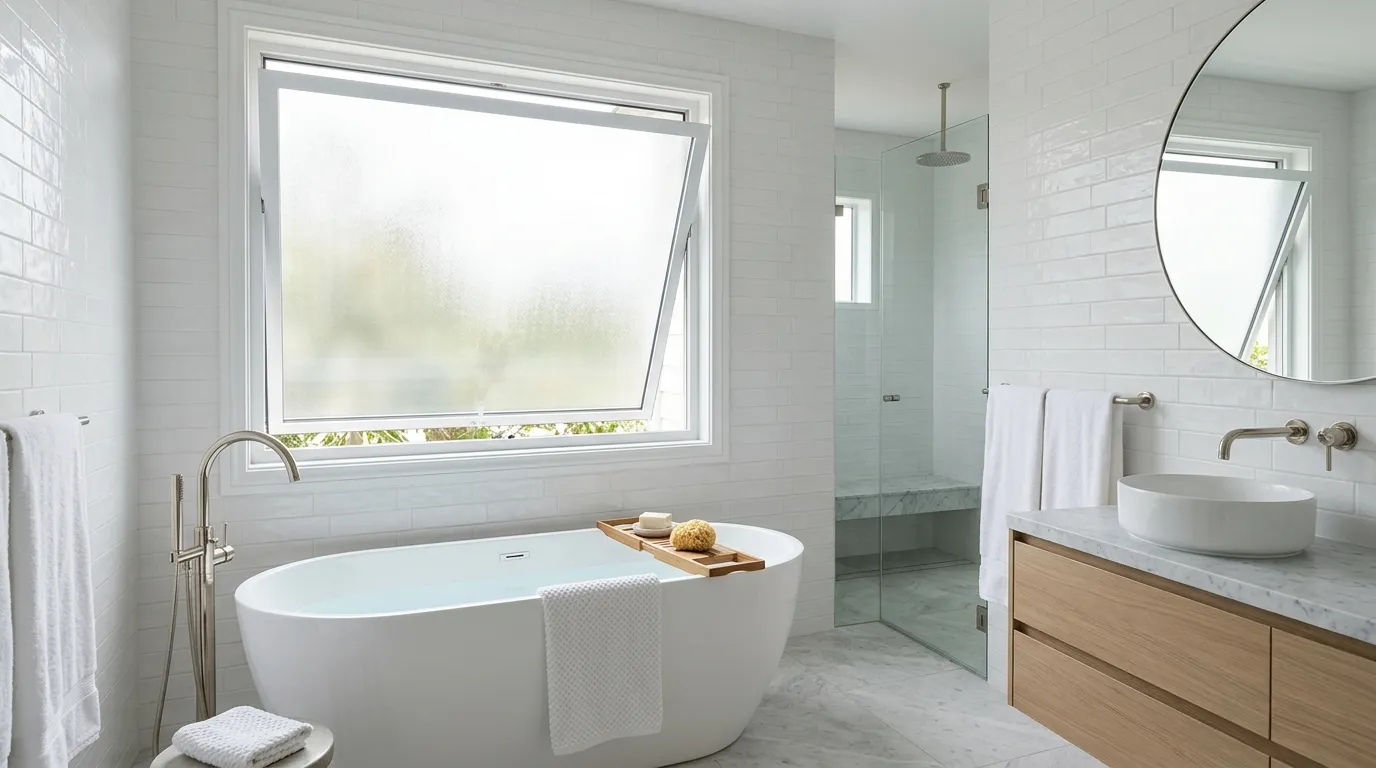
A bathroom is the wettest room in the house and often the one where you most want a window. Getting it right means answering four questions in the correct order: how much privacy, how to vent without letting rain in, what frame will survive twenty years of steam, and where the code requires safety glass. Get those right and the window becomes the best thing about the room; get them wrong and it is the first place mould shows up.
Privacy Glass: Obscure, Frosted and Textured Explained
Bathroom glass is rated by how much it obscures, and the scale runs from one to five. Level one is a light texture that blurs a silhouette at a distance but not up close; level five is a full frost or heavy pattern that shows only light and shadow from any distance. For a ground-floor bathroom facing a neighbour's window three metres away, level four or five is the honest choice; for a second-floor window facing a backyard, level two or three keeps light and a sense of the outdoors.
The three main types behave differently. Acid-etched or satin glass — what most people mean by frosted — gives an even, matte diffusion and a clean modern look, and is available at levels three to five. Textured or patterned glass (rain, reed, glue chip, fluted) is rolled with a relief pattern and is popular again for its retro look; obscurity depends on the pattern, and the textured face should go to the interior to keep it clean. Applied privacy films are the cheapest route and can be added to existing glass, but they scratch, peel at the edges in steam and rarely last more than five years in a bathroom.
Cost is modest. Obscure glass adds a small premium to the price of a bathroom-sized window depending on type and size, and it can be combined with low-e coatings and argon fill. What you cannot do cheaply is change your mind later: obscure glass is a factory option on the sealed unit, and swapping it means replacing the unit.
Why Awning Windows Belong in Bathrooms
A bathroom window's main job after privacy is to let moisture out, and it needs to do so when it is raining, which in Quebec is roughly one day in three. An awning window hinges at the top and opens outward from the bottom, so the sash itself acts as a small roof over the opening. Left open 10 to 15 centimetres in a downpour, it vents steam without letting rain in; the same opening on a casement or slider would soak the sill.
Awnings also suit the placement that bathrooms demand. They work well in wide, short formats that sit high on the wall — above a tub, above a toilet, above the vanity mirror line — where privacy is easier and the glass is out of reach of splashing. A 900 by 500 mm awning at 1.6 metres above the floor is a common and very effective bathroom window. Because the crank operator sits at the bottom, a high awning is still easy to reach.
The limits are worth knowing. Awning windows do not meet bedroom egress requirements, which is irrelevant in a bathroom but matters if you plan to reuse the size elsewhere. They also cannot be fitted with a conventional exterior screen, so the screen sits on the interior, which in a bathroom is actually an advantage: it stays dry and can be removed for cleaning without going outside.
Frames That Survive Steam: Why UPVC
Bathroom windows fail from the inside. Steam condenses on the coldest surfaces — the glass edge and the frame — several times a day, and the frame material decides what happens next. Wood absorbs it and swells, then dries and checks; paint lifts, joints open, and the bottom rail is soft within ten to fifteen years. Aluminum does not rot, but it conducts cold so effectively that the frame itself becomes the condensation surface, and unfinished aluminum pits under repeated wetting.
UPVC is inert to water. The frame will not absorb moisture, swell, rot or corrode, and its multi-chamber profile keeps the interior surface warmer than either aluminum or thin-walled vinyl, which reduces condensation on the frame in the first place. Fusion-welded corners have no joint for water to enter. It also needs no paint, which matters in a room where repainting a window means masking a tub and sealing a room for a day.
Two specification details make the difference in a bathroom. First, ask for a warm-edge spacer in the sealed unit — a stainless steel or composite spacer instead of aluminum — which keeps the glass edge several degrees warmer and can cut edge condensation dramatically. Second, choose a frame with a sloped exterior sill and clear drainage, since the bathroom side will be wetter than any other window in the house.
Windows in Showers and Tubs: The Tempered Glass Rule
A window inside a shower enclosure or directly above a bathtub is common in Quebec's older housing stock and perfectly workable in new work, provided the glass is safety glass. The Construction Code's requirements on glazing in hazardous locations, drawn from Part 9 of the National Building Code and CAN/CGSB-12.1, require tempered or laminated safety glass for glazing in bathtub and shower enclosures and for windows whose glass sits close to the standing surface of a tub or shower — in practice, any window whose bottom edge is within reach of someone slipping.
The reason is not water; it is people. A person who slips in a tub can put an elbow or a head through annealed glass, and the resulting shards are what cause injuries. Tempered glass breaks into small blunt granules; laminated glass cracks but stays in its interlayer. Either satisfies the code. Tempered is the usual choice for windows and adds a modest premium per sealed unit at bathroom sizes.
Beyond the glass, a window in a shower needs a frame that can be fully sealed to the tile or surround. UPVC is the right material here for the reasons above; the interior stop and sill should be finished with a bead of 100% silicone, not acrylic caulk, and the sill should slope into the shower so water runs back onto the tile rather than sitting on the frame. A tile sill or a solid-surface sill piece rather than a wood or MDF extension is the detail that separates a shower window that lasts from one that does not.
Fan and Window: Use Both, in the Right Order
Quebec's code requires mechanical exhaust in bathrooms of new construction — a fan rated at a minimum of 25 litres per second (about 50 cubic feet per minute), ducted to the exterior — and every renovation is a good moment to bring an older bathroom up to that standard. A window is not a substitute for the fan; in January, opening it for twenty minutes is impractical and a fan moves more air anyway. But the two work together better than either alone.
The strategy is straightforward. Run the fan during the shower and for twenty minutes after, on a timer switch so nobody has to remember; an inexpensive timer is the best bathroom moisture investment available. Crack the awning window 5 to 10 centimetres while the fan runs, so the fan draws fresh, dry air across the room instead of pulling it under the door from the hallway. Close the window when the fan stops. In shoulder seasons and summer, the window alone handles most of the load.
Check the fan's actual performance, not its rating. Hold a sheet of toilet paper to the grille with the fan running; if it does not stay put, the fan is undersized, the duct is too long or crushed, or the exterior flap is stuck. Many older Quebec bathrooms have a fan that runs and moves almost nothing. Replacing a 50 cfm builder fan with a quiet 80 to 110 cfm unit is a modest job for an electrician and changes the room.
Condensation Control: What Is Normal and What Is Not
Some fog on a bathroom window during and immediately after a shower is normal and should clear within twenty to thirty minutes with the fan running. What is not normal is water that beads and runs down the glass to pool on the sill every day, frost on the interior glass in winter, or black spotting at the corners of the glazing bead. Those are signs that either the room's ventilation is failing or the window's glass edge is too cold for the room's humidity.
Triple glazing makes a real difference in a bathroom because it raises the interior glass surface temperature. At -20 °C outdoors and a bathroom at 50% relative humidity after a shower, a double-glazed unit with an aluminum spacer will have condensation across most of the bottom third of the glass; a triple-glazed unit with a warm-edge spacer will show a narrow band at the very edge, if anything. On a small bathroom window the upgrade is a modest premium and is worth it.
The last variable is what surrounds the window. A deep interior sill of MDF or painted wood, a heavy curtain or blind that traps cold air against the glass, or a heat register on the far side of the room all worsen condensation. Keep the sill non-absorbent — tile, solid surface or the UPVC extension — use a moisture-rated blind that stops short of the sill, and if there is a choice, put the heat source under the window.
Placement and Sizing Checklist
When planning a new or replacement bathroom window, the decisions below cover almost every situation. Work through them with your installer before the order goes in; most are factory options that cannot be changed on site.
- Height: sill at 1.4 to 1.7 m for a window over a tub or toilet; standard height only if privacy is not an issue.
- Type: awning for any window that must vent in rain; fixed only if the fan is oversized and the window is purely for light.
- Glass: obscure level 3 to 5 as needed, low-e, argon, warm-edge spacer; triple glazing on north and east faces.
- Safety glass: tempered if the window is in a shower or tub enclosure or within reach of one.
- Frame: UPVC, white or a factory colour; no interior wood that will sit in a wet zone.
- Sill: tile, stone or solid-surface interior sill; silicone at all interior joints.
- Ventilation: a fan of 50 cfm minimum on a timer; 80 cfm or more for a bathroom with a separate shower and tub.
Frequently Asked Questions
Which obscure glass level do I need for a ground-floor bathroom?
Level four or five if the window faces a street, a sidewalk or a neighbour's window within about five metres. Level-four satin glass admits plenty of light while showing only shadows; level five is the right call if the window is at eye level.
Can I open an awning window in the rain?
Yes — that is its main advantage. Open 10 to 15 centimetres, the sash acts as a canopy over the opening and rain stays out, except in wind-driven rain hitting the wall head-on.
Does a bathroom window need tempered glass?
Only if it is inside a shower or tub enclosure, or close enough that a person slipping could strike it. A window over the vanity or toilet, away from the tub, can be ordinary glass. When in doubt, tempered adds only a small premium.
Is a window enough to ventilate a bathroom without a fan?
Not in new construction, where the code requires a fan ducted to the exterior. And in practice, no: in January nobody opens a window for twenty minutes after a shower. The window complements the fan; it does not replace it.
Why does my bathroom window sweat more than the others?
Because it combines the highest humidity in the house with glass that is often small and cold. A fan that actually moves air, a timer switch, a warm-edge spacer and ideally triple glazing solve it in the great majority of cases.
Can you put a window in a shower wall?
Yes, with tempered glass, a UPVC frame sealed with silicone, and a tile or solid-surface sill sloped toward the shower. An awning window set high, above the splash line, is the most durable configuration.