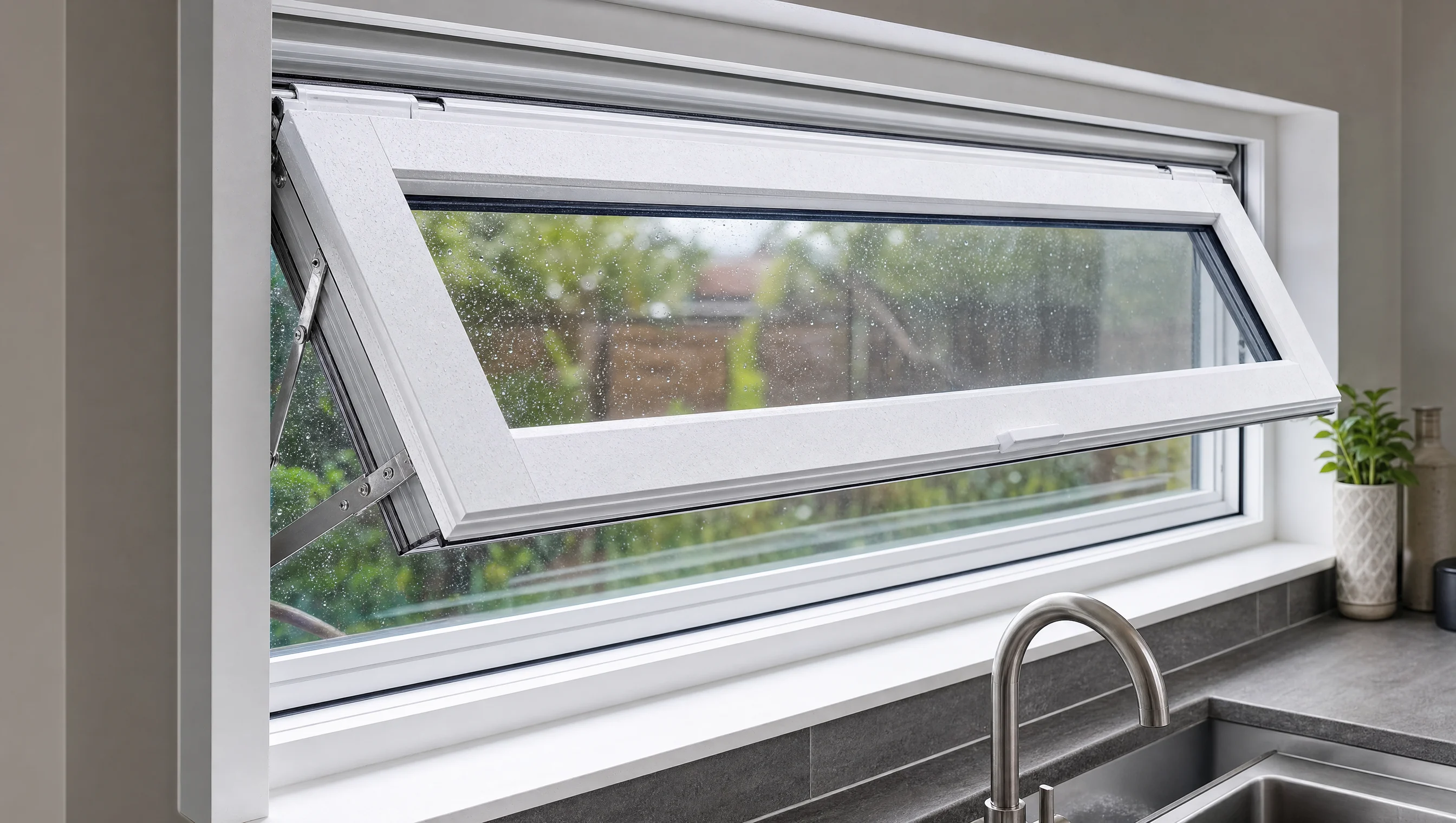
Awning windows are hinged at the top and crank outward from the bottom, so the open sash forms a small sheltering roof over the opening. That single design choice is why they keep working through a Montreal downpour, a humid August evening, and a −10°C January night when most other windows have to stay shut. For Quebec homeowners weighing ventilation against weather-tightness, the awning is one of the few designs that genuinely delivers both.
How Awning Windows Work
An awning window is built around a single sash hinged along its top edge. A rotary crank or a cam handle pushes the bottom of the sash outward, typically to a 30–45° angle, so the glass tilts away from the wall like a small canopy. Because the opening is covered by the sash itself, water runs down the outside of the glass and drips clear of the opening rather than into the room. This is the mechanical reason awning windows are so often paired with rainy, variable climates like Quebec’s.
The sealing mechanism is what sets the awning apart from a slider or single-hung. When you crank the window closed, a continuous compression gasket runs around the entire perimeter and the sash is drawn tight against the frame at multiple locking points. There is no overlapping track for air to slip through and no friction seal that wears loose over time. The result is one of the lowest air-leakage ratings of any operable window style, which matters enormously when the outdoor air is −25°C with the wind chill.
Most quality awning units in Quebec are built with multi-point hardware, meaning a single turn of the handle engages two or three locking cams simultaneously. That even clamping pressure is what produces the consistent gasket compression along the whole frame. Combined with a double or triple-pane sealed glass unit, the assembly behaves more like an insulated panel than a hole in the wall when it is closed for winter.
- Top hinge: the sash pivots from the upper edge so the glass shelters the opening below.
- Outward crank: a geared operator opens the sash without you reaching across furniture or a counter.
- Compression seal: closing the sash pulls it tight against a continuous perimeter gasket.
- Multi-point lock: two to three cams clamp evenly for a uniform air-tight seal.
Ventilation You Can Use in the Rain
The headline benefit for Quebec is simple: you can leave an awning window open during a rainstorm. Spring and fall in the Montreal area bring frequent, fast-moving showers, and a casement or slider left open will let that water straight onto your sill and floor. The awning’s outward-tilting sash sheds rain away from the opening, so a kitchen or bathroom can keep breathing even when the sky opens up.
That matters more than it sounds because Quebec homes spend a lot of the year sealed up tight. From November through April we keep windows closed against the cold, and modern airtight construction means moisture from cooking, showers, and simply breathing has nowhere to go. Indoor relative humidity that climbs above 50–55% in winter is a recipe for condensation on glass, mould on sills, and that musty basement smell. An awning window that can be cracked open for a few minutes — even in light rain or wet snow — gives you a controlled way to flush that humid air out.
Awnings are also excellent for passive summer cooling. Placed low on a wall, an open awning draws cool air in at ground level; paired with a higher window or a fixed transom that lets warm air escape, you create a gentle stack-effect breeze without running the air conditioner. In a Plateau triplex or a Laval bungalow, that can shave real dollars off a July Hydro-Québec bill.
- Keep ventilating a bathroom or kitchen through spring and fall showers.
- Flush winter indoor humidity below 50% to prevent condensation and mould.
- Pair a low awning with a high vent for passive stack-effect cooling in summer.
- Crack the sash just a few centimetres for trickle ventilation without a draft.
Energy Performance in a Cold Climate
Quebec sits in ENERGY STAR Climate Zone D, the most demanding heating zone in the program, so window efficiency here is not a marketing nicety — it is the difference between a comfortable room and a cold draft you feel from across the kitchen. Awning windows have a structural advantage because their compression seal does not depend on a sliding track that loosens with use. A well-built triple-pane awning can reach a U-factor in the range of 0.16–0.20 (roughly 0.9–1.1 W/m²·K), which is excellent for an operable unit.
Air-tightness is measured separately, and it is where awnings shine. The continuous gasket and multi-point clamp routinely deliver air-leakage performance better than 0.5 L/s per square metre — well inside the strictest tier. Over a Montreal heating season that runs roughly mid-October to mid-April, lower leakage means your furnace runs less and the room next to the window stays usable instead of becoming the spot nobody wants to sit.
Specifying low-emissivity (low-e) coatings and argon or krypton gas fill pushes performance further. For Quebec, a low-e coating tuned to retain heat indoors is usually the right call, paired with a warm-edge spacer to keep the glass perimeter from getting cold enough to condense. If you are also looking at other openings, our guides to casement windows and awning windows walk through the same glass options in more detail.
- ENERGY STAR Zone D: look for the certified mark on the strictest Canadian zone.
- U-factor 0.16–0.20: achievable with triple glazing and good seals.
- Low air leakage: the awning’s compression seal beats most sliding designs.
- Low-e + argon/krypton: the coating and gas fill that make winter glass warm.
Best Places to Install Awning Windows
Awning windows are wider than they are tall, which makes them perfect for spots where a full-height window will not fit or is not wanted. The classic Quebec application is high on a wall — above a kitchen sink, over a bathroom vanity, or near the ceiling in a bedroom — where you want light and air but also privacy. Because the crank lives at the bottom of the sash, you can reach it easily even when the window itself is mounted out of arm’s reach over a counter.
Basements are the other natural home for awnings. Many Montreal and South Shore basements have short, wide window openings near grade level, and an awning sash that opens outward sheds rain and melting snow away from the foundation. Just be mindful of egress rules: a bedroom in a finished basement needs a window that meets minimum egress dimensions, and an awning’s top hinge can limit the clear opening, so confirm the code requirement before you spec one for a sleeping room.
They also pair beautifully with fixed picture windows. A large fixed pane flanked or topped by narrow awning units gives you an unbroken view with discreet, weather-proof ventilation — a combination you see in many renovated Westmount and Outremont homes. For full-height openings where you want the whole sash to swing wide, a casement is usually the better partner, and many Quebec projects mix both styles across one elevation.
- Above kitchen sinks and bathroom vanities for light, air, and privacy.
- Near the ceiling in bedrooms for ventilation without sacrificing wall space.
- In basements where the opening is short and wide — but check egress sizing.
- Combined with fixed picture windows for a clean view plus discreet airflow.
Rebates and Programs Worth Knowing
Replacing windows in Quebec is one of the more rebate-friendly home upgrades, and an ENERGY STAR awning usually qualifies. The provincial Rénoclimat program, run by Transition énergétique Québec, offers grants for upgrading to certified high-efficiency windows — commonly in the range of up to roughly $150 per rough opening replaced, with the exact amount tied to a pre- and post-work energy evaluation. The mandatory evaluation also gives you a documented baseline of your home’s air-tightness, which is useful information in its own right.
On the federal side, programs aligned with the Canada Greener Homes initiative have offered support of up to about $5,000 for a package of efficiency retrofits, with windows and doors among the eligible measures. These programs change over time and sometimes pause, so always confirm current availability and stacking rules before you sign a contract — provincial and federal grants can sometimes be combined, which materially changes the math on a whole-house window project.
One non-negotiable in Quebec: hire a contractor who holds a valid RBQ licence. The Régie du bâtiment du Québec licence is your protection on workmanship and a frequent eligibility requirement for rebates. Ask for the licence number up front, and keep your invoices — you will need them both for the rebate paperwork and to register your manufacturer warranty.
- Rénoclimat: grants up to roughly $150 per rough opening for ENERGY STAR windows.
- Canada Greener Homes–aligned support: up to about $5,000 across eligible retrofits.
- RBQ licence: required for quality assurance and often for rebate eligibility.
- Keep every invoice — you need it for both rebates and warranty registration.
Cost and Material Choices
For a standard residential awning window in the Montreal market, supplied and installed, you can reasonably budget somewhere in the range of $700 to $1,600 per unit depending on size, frame material, and glass package. Triple glazing, decorative grilles, and custom colours push toward the upper end; a modest white PVC awning over a bathroom sits near the lower end. As always, get the price per opening rather than a single lump sum so you can compare quotes fairly.
Frame material is the biggest driver of both price and long-term performance. PVC (vinyl) is the most popular choice in Quebec because it is affordable, never needs painting, and insulates well against the cold. Hybrid frames — PVC inside with an aluminum exterior cap — cost more but give you a tougher, paintable outer face that handles UV and freeze-thaw cycling without fading. Aluminum-clad wood is the premium option for heritage homes where the interior look matters.
Whatever the material, the freeze-thaw reality of Quebec winters — where the temperature can swing across 0°C dozens of times each season — rewards quality hardware. Cheap operators and locks are the first thing to fail when ice, grit, and repeated expansion work on them. Spend on a stainless or corrosion-resistant operator; it is a small fraction of the window cost and the part you will touch every day.
- Budget range: roughly $700–$1,600 per awning supplied and installed.
- PVC: affordable, maintenance-free, and a strong winter insulator.
- Hybrid (PVC + aluminum): a durable, fade-resistant, paintable exterior.
- Hardware: invest in a corrosion-resistant operator for freeze-thaw durability.
Care and Maintenance Through the Seasons
Awning windows are low-maintenance by design, but a little seasonal attention keeps them sealing tightly for decades. Twice a year — ideally in spring and fall — wipe down the perimeter gasket with a damp cloth and check that it is still soft and continuous. A dried-out or torn gasket is the most common cause of a sudden winter draft, and replacement gaskets are inexpensive and easy to fit.
The crank operator deserves a drop of light machine oil or a silicone-based lubricant once a year; avoid heavy greases that attract dust and grit. If the handle feels stiff or gritty, do not force it — that is how gears strip. In coastal-influenced or salted-road areas, rinse exterior hardware occasionally to clear road salt that accelerates corrosion through the freeze-thaw season.
Finally, manage interior humidity actively. Even the best window will show condensation if your indoor air is too moist, so run bathroom and kitchen exhaust fans, and crack an awning for a few minutes after showering or cooking. If you regularly see frost on the inside of the glass on the coldest mornings, that is a humidity signal, not necessarily a window defect — aim to keep winter indoor humidity below about 40% when it is very cold outside.
- Wipe and inspect the perimeter gasket each spring and fall.
- Lubricate the crank operator yearly with light oil or silicone, never heavy grease.
- Rinse exterior hardware in salted-road areas to slow corrosion.
- Keep winter indoor humidity around or below 40% on the coldest days.
Frequently Asked Questions
Can I really leave an awning window open when it rains?
Yes — that is the awning’s signature advantage. Because the sash tilts outward from a top hinge, it forms a small canopy that sheds rain away from the opening, so light to moderate showers stay outside while air keeps flowing in.
Are awning windows good for Quebec winters?
They are among the best operable styles for cold climates. The compression seal and multi-point lock pull the sash tight against a continuous gasket, giving very low air leakage, and a triple-pane unit can reach a U-factor around 0.16–0.20 for strong winter performance.
What is the difference between an awning and a casement window?
Both crank outward, but an awning hinges at the top and is usually wider than it is tall, while a casement hinges at the side and opens like a door. Awnings suit high or basement placements and rainy ventilation; casements suit full-height openings and maximum airflow.
Do awning windows qualify for Quebec rebates?
Generally yes, if they are ENERGY STAR certified for Zone D. Rénoclimat can offer up to roughly $150 per rough opening, and Canada Greener Homes–aligned support has reached up to about $5,000 across eligible retrofits, though you should confirm current program rules before signing.
How much does an awning window cost installed in Montreal?
Budget roughly $700 to $1,600 per unit supplied and installed, depending on size, frame material, and glass package. A basic white PVC awning sits near the low end, while triple glazing, custom colours, and hybrid frames push toward the top of the range.
Can an awning window be used as a basement bedroom egress window?
Sometimes, but check the code first. Awning sizes work well for short, wide basement openings, but the top hinge can reduce the clear opening, so confirm the unit meets minimum egress dimensions before specifying it for a room used for sleeping.