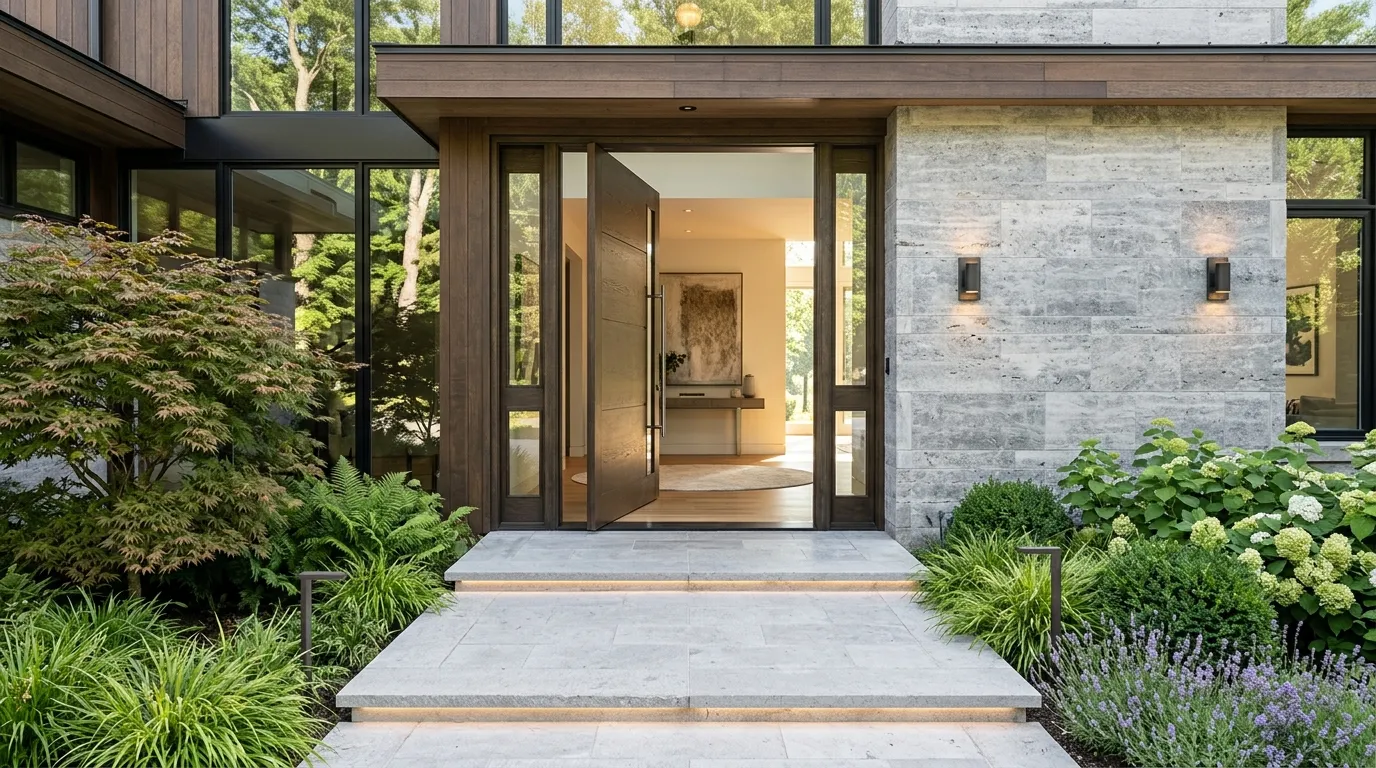
Most Quebecers over 65 say the same thing: they want to stay in their own home, not move to a residence. Whether that works out often comes down to details nobody thinks about at 45 — a door that is 30 inches wide instead of 36, a patio threshold that catches a walker, a window crank that a hand with arthritis can no longer turn. This guide covers what to change on doors and windows, what it costs in Quebec, and which programs can help pay for it.
Why Doors and Windows Are the Place to Start
When people think about adapting a home, they picture grab bars and a walk-in shower. Those matter, but the first obstacle a person with reduced mobility meets is usually a door: the front entry, the door to the garage, the patio door to the deck. If those openings are too narrow, have a raised sill or need a firm grip to operate, the rest of the house may as well be off-limits.
Windows are the second, quieter problem. An older adult who cannot open a bedroom window loses control over fresh air, and one who cannot see out from a chair loses contact with the street and the yard. Occupational therapists consistently rank a view and easy ventilation among the things that keep people mentally well at home.
The best time to address all this is when you are already replacing doors or windows for other reasons — energy savings, rot, a failed sealed unit. Building accessibility into a replacement that is happening anyway adds a modest premium; retrofitting a two-year-old door to widen the opening means paying for the job twice.
Door Width: Why 36 Inches Is the Number
A standard interior door in an older Montreal home is often 28 or 30 inches wide, and even many exterior doors are 32 inches. A manual wheelchair needs a clear opening of roughly 32 inches (815 mm) minimum, and a clear opening is not the door slab width — you lose about two inches to the door thickness and the hinge side when the door is open at 90 degrees. That is why a 36-inch slab is the practical target: it yields a clear opening close to 34 inches, enough for a wheelchair, a walker with someone beside it, or a stretcher.
Widening an exterior opening is structural work. On a brick-veneer bungalow in Saint-Laurent or Laval, the lintel above the door usually has to be replaced with a longer steel angle, and the rough opening framed to suit. Budget for the carpentry and masonry on top of the door itself; the amount depends on the wall construction and whether an electrical run is in the way.
If widening is impossible — a load-bearing post beside the door, a stair landing that cannot shrink — offset hinges (sometimes called swing-clear hinges) buy back about 1.5 inches by moving the open slab out of the opening. It is not a full solution, but on a 32-inch door it can be the difference between a wheelchair fitting or not.
- Clear opening target: 32 in (815 mm) minimum; 34 in or more is comfortable for power chairs.
- Manoeuvring space: at least 1,500 mm of clear floor in front of the door on the pull side so a chair can approach and turn.
- Swing direction: an out-swinging exterior door leaves more room inside a small vestibule, common in Montreal duplexes.
- Glazing in the door: a lite at seated eye height (about 1,000 to 1,100 mm) lets someone see who is at the door without standing.
Low and Zero Thresholds Without Letting Winter In
A standard exterior door sill sits 25 to 40 mm proud of the floor. To a walker, a cane tip or a wheelchair caster, that is a trip hazard or a wall. Barrier-free guidelines call for a threshold no higher than 13 mm, bevelled on both sides so a wheel rolls over it rather than hitting it.
The difficulty in Quebec is obvious: a low sill has less material between a snowdrift and your floor. Good low-profile sills solve this with a thermal break, a drainage channel that sends meltwater out rather than in, and a compression seal at the bottom of the door that seats against the sill rather than sweeping over it. Quality manufacturers offer ADA-style sills as an option on steel and fibreglass entry doors; ask for it explicitly at quotation, because it is not a field modification.
For a patio door, the equivalent is a low-profile or recessed track. On a well-designed recessed track, the rolling panel's track is set into the sill so the top of the rail is flush with the interior floor, with the exterior side stepping down for drainage. Paired with a properly built deck or a small ramp outside, that makes the garden or balcony genuinely reachable. See the options on our patio doors page.
Lever Handles, Smart Locks and Who Holds the Key
A round knob requires a pinching grip and a twist of the wrist — precisely the two motions that arthritis, a stroke or Parkinson's take away first. Lever handles operate with a closed fist, a forearm or an elbow. Replacing a knob with a lever on an existing door is a straightforward hardware swap, and on a new door it is simply a matter of specifying the right trim.
The lock deserves the same thinking. A keyed deadbolt with a small thumb-turn is hard to use with reduced dexterity; a multipoint lock that engages when the lever is lifted is easier and also seals the door better in winter. Going a step further, an electronic lock with a keypad or a phone app means no key to fumble with at all.
For families, the real value of a smart lock is caregiver access. A home-care worker from the CLSC, a neighbour who checks in, or an adult child in another city can be given a time-limited code, and the lock keeps a log of who came and when. If a parent falls and cannot reach the door, paramedics can be let in remotely — a scenario that comes up far more often than people expect. Keep the smart lock on a door with a mechanical override and make sure someone nearby has a physical key.
Windows You Can Open and See Out Of From a Chair
The most common complaint we hear from older clients is not about doors; it is about a casement window they can no longer crank. Standard cranks sit at the bottom of the frame, need a full rotation of the wrist and get stiff after a decade. Folding or extended-handle cranks reduce the force, and some casement hardware now uses a gear ratio that opens the sash with fingertip pressure. When choosing new casements, ask to try the operator in the showroom.
Sill height matters just as much. A seated person's eye line is roughly 1,100 to 1,200 mm above the floor; a window whose sill is at 900 mm or lower gives a real view of the street rather than a slice of sky. In a bedroom that also means the crank is within reach without leaning. Quebec's building code requires guards or opening limiters when a sill is below 900 mm on an upper floor, so on a second storey plan for a limiter rather than skipping the low sill.
Awning windows are worth a look for bathrooms and kitchens: they open at the bottom, can be left ajar in the rain and are operated by a single crank at the bottom rail. Tilt-and-turn windows let the sash tilt in from the top for ventilation with one handle movement, though the inward swing needs clear space in front of the window.
- Casement: specify easy-operate hardware and a folding crank; mount at the sill, not high on the jamb.
- Awning: ideal above counters and in bathrooms; check reach over the sink before ordering.
- Sliders: easy if the sash is light; heavy triple-glazed sashes can be harder to push than a crank.
- Screens: ask for screens that lift out from inside without tools for cleaning.
Lighting and Contrast: Seeing the Edge
Vision changes with age, and a lot of falls at doorways happen because the person simply did not see the step. An entry threshold in the same tone as the floor disappears; the same threshold in a contrasting colour is obvious. Choose a sill finish that reads clearly against both the interior floor and the exterior landing, and keep the door itself a different tone from the surrounding wall so the opening is easy to locate.
Light is the other half. More glass in the entry — a sidelite, a larger lite in the door, a transom — raises daylight in the vestibule, which is the darkest part of many Montreal homes. Outside, a motion-activated light above the door and a photocell light on the path mean nobody comes home to a dark step in December at 4:30 p.m.
On patio doors, large clear panes can themselves be a hazard for someone with low vision. A simple frosted band or decorative strip at eye height on the fixed panel makes the glass visible, and tempered glass — standard on quality patio doors — means a collision breaks safely if it happens.
Costs, Quebec Programs and Tax Credits
A realistic budget for a fully accessible front entry — 36-inch fibreglass door, low-profile sill, lever multipoint hardware, a smart lock and the framing work to widen the opening — depends on the door, the hardware and the extent of the structural work in the Montreal area. A patio door with a recessed track and easy-glide rollers is priced by size and glazing. Windows with easy-operate hardware add little over a standard replacement. The exact figure depends on your openings and glazing — request a free estimate.
Quebec's Programme d'adaptation de domicile (PAD), administered by the Société d'habitation du Québec through municipalities, can fund adaptations for a person with a lasting disability that limits daily activities, up to a maximum set by the program for a single-family home, with a possible supplement in some cases. An occupational therapist's evaluation is required, the work must be approved before it starts, and processing can take many months, so apply early. Amounts and eligibility criteria change; confirm the current rules with your municipality or the SHQ before counting on a figure.
On the tax side, Quebec offers a refundable tax credit for home-support services for seniors, and both governments have offered credits for accessibility renovations — the federal Home Accessibility Tax Credit and the Multigenerational Home Renovation Tax Credit, for example — with eligibility tied to age or disability status and to the type of work. These programs are revised regularly; ask your accountant which apply in the year the work is done, and keep every invoice, because the contractor's detailed invoice is what supports the claim.
Planning the Project So It Happens Once
Start with an occupational therapist if a specific condition is involved. They will tell you which openings matter, what clear widths the person actually needs, and produce the report that programs like PAD require. Bring that report to the door and window consultation so the products are specified to the right numbers rather than to a generic idea of accessibility.
Then sequence the work. Widening an entry, pouring a landing or building a ramp and replacing the door should happen in the same window of time; doing them in different years means paying for demolition twice. If a full renovation is not in the cards, prioritize by frequency of use: the door used every day first, the bedroom window second, the patio door third.
Finally, think ahead by a decade. A door that a 68-year-old finds convenient should still work for the same person at 78 with a walker. Specifying the wider opening, the flat sill and the lever hardware now, while it is cheap, is what makes staying home a plan rather than a hope.
Frequently Asked Questions
How wide does a door need to be for a wheelchair?
A clear opening of at least 32 inches (815 mm) is the usual minimum, and 34 inches is more comfortable. Because the slab and hinges take up space, a 36-inch door is the practical way to get there.
Can a zero-threshold door really keep out Quebec winter?
Yes, if it is designed for it. Low-profile sills with a thermal break, an exterior drainage channel and a compression seal under the door perform well; what fails is a standard sill simply cut down on site, which should never be done.
Does the PAD program cover replacing doors and windows?
It can, when the work is needed because of a lasting disability and is recommended by an occupational therapist. The application must be approved before work begins, and amounts and criteria change, so verify with your municipality or the SHQ.
Are smart locks safe for an older person living alone?
Used well, they add safety: no key to lose, time-limited codes for caregivers and remote unlocking for emergency services. Keep a mechanical override and give a trusted person a physical key in case of a dead battery.
Which window type is easiest to operate with limited hand strength?
Casements with easy-operate hardware and a folding crank, or awning windows, are usually the easiest. Test the operator in a showroom, and make sure the crank will be within reach from a seated position once installed.
Is it worth adapting a home I might sell in five years?
Usually. Accessible entries and easy-operate windows appeal to a growing share of buyers, and well-done adaptations look like quality upgrades rather than medical equipment. Avoid anything that reads as institutional and the work will not hurt resale.